Locations:





Interim results of RUBY study also indicate improved physical function and quality of life

Image content: This image is available to view online.
View image online (https://assets.clevelandclinic.org/transform/ce5e7006-6910-46d8-b79a-b43f69908cd4/gene-editing)
gene editing
The reni-cel experimental gene therapy for severe sickle cell disease continues to show promising results. Now tested in a full cohort of 40 patients, some with more than two years of follow-up, the one-time infusion of gene-edited stem cells has helped 95% of enrolled patients avoid vaso-occlusive events (VOEs).
Advertisement
Cleveland Clinic is a non-profit academic medical center. Advertising on our site helps support our mission. We do not endorse non-Cleveland Clinic products or services. Policy
“This is remarkable for these patients, most of whom had numerous severe VOEs requiring an average of nearly five hospital admissions each year,” says Rabi Hanna, MD, Chair of Hematology and Medical Oncology at Cleveland Clinic Children’s. “In addition, these patients have reported improvements in their physical and social functioning. Not only is the treatment reducing their pain and functionally curing them of sickle cell disease, but it is also helping them live like people without disease.”
Dr. Hanna presented these latest results of the phase 1/2 RUBY trial at the 2025 American Society of Hematology meeting.
Reni-cel gene therapy is novel because it targets HBG1 and HBG2 genes to increase production of fetal hemoglobin. The effect is similar to what occurs naturally in hereditary persistence of fetal hemoglobin, a genetic condition in which patients continue to produce fetal hemoglobin into adulthood. When patients have that condition along with sickle cell disease, they usually do not have sickle cell symptoms.
“Hereditary persistence of fetal hemoglobin prevents red blood cells from sickling,” Dr. Hanna says. “While we do not know the long-term effects of edited genes, nature has already shown us the long-term effects of HBG1/2 mutation. Those patients are living healthy, normal lives. That’s what we’re trying to mimic with reni-cel.”
The 40 patients in the RUBY trial (mean age 24.2; 10 patients age 12-18) had severe sickle cell disease, with a mean of 4.6 severe VOEs per year. All lacked a matched donor for bone marrow transplantation.
Advertisement
Their hematopoietic stem and progenitor cells were collected and edited with CRISPR-Cas12a technology to alter HBG1 and HBG2 genes. Following myeloablative conditioning with busulfan, the patients received one infusion of the edited cells (reni-cel).
At the time of these interim study results, 24 patients had been monitored for more than 12 months after receiving the infusion, and six patients had been monitored for more than 24 months. All patients showed successful engraftment of neutrophils and platelets.
Following reni-cel infusion:
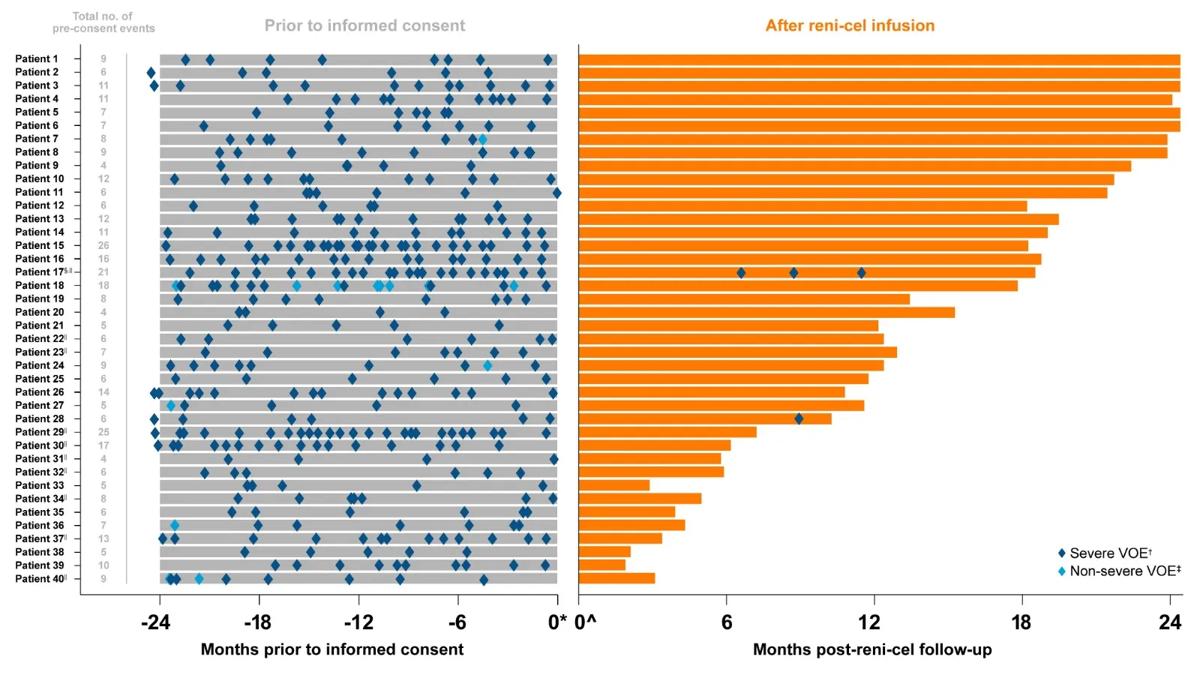
Image content: This image is available to view online.
View image online (https://assets.clevelandclinic.org/transform/90d5f7f8-0705-4517-ae59-00c3e554d1c7/reni-cel-graphic)
Of 40 treated patients, 38 were VOE-free after infusion of reni-cel, as of the data cutoff date. In this figure, each patient is represented with a gray line before infusion and an orange line after infusion. Each blue dot represents a pain crisis. 0^ is day reni-cel was infused. †A severe VOE requiring medical attention (despite hydroxyurea or other supportive care) is defined as an acute pain episode due solely to vaso-occlusion resulting in ≥ 24-hour hospitalization or emergency department (ED) observation, or ≥ 2 visits to a day unit/ED within 72 hours requiring pain medication. Severe VOEs also include acute priapism, acute chest syndrome or hepatic/splenic sequestration. ‡A non-severe VOE is defined as an acute pain episode with no medically determined cause other than vaso-occlusion. §Patient 17 had chronic SCD-related pain and right-hip avascular necrosis, with 21 severe VOEs in the two years before consent. || Patients aged ≤ 18 years.
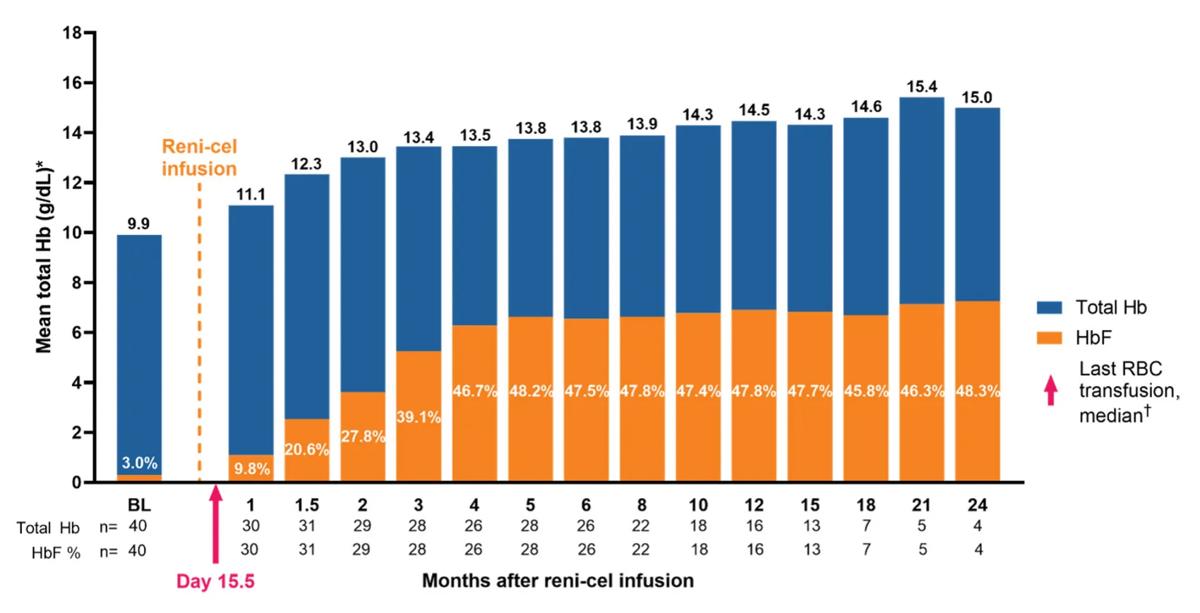
Image content: This image is available to view online.
View image online (https://assets.clevelandclinic.org/transform/819260ae-a733-4da2-afd6-5e7503747d78/reni-cel-graph)
After reni-cel infusion, patients achieved early correction of anemia, with durable normalization of hemoglobin and sustained increases of fetal hemoglobin. *Central laboratory reference range: 12.0-16.0 g/dL for females and 13.6-18.0 g/dL for males. †The last red blood cell transfusion occurred a median (range) of 15.5 (-9.0-38.0) days after reni-cel infusion (N = 40). BL, baseline; RBC, red blood cell; Hb, hemoglobin; HbF, fetal hemoglobin.
In addition, patient-reported outcome scores (PROMIS-57) improved for:
Advertisement
Final results will be reported when all 40 patients reach 24 months of follow-up.
While allogenic bone marrow transplantation is a curative treatment for patients with sickle cell disease, it is not ideal for everyone, notes Dr. Hanna. It comes with a risk of graft rejection or sometimes graft-versus-host disease (GVHD), and it is not available to patients without an appropriately matched and available donor.
“Gene therapy is a transformative addition to the range of treatments for sickle cell disease because every patient can be their own donor, with no need for immunosuppression and no risk of GVHD,” Dr. Hanna says. “Still, it’s a long journey for the patient, taking about one year from evaluation to collection of stem cells, gene editing, chemotherapy admission and infusion of modified stem cells. Also, reni-cel changes only blood-producing stem cells — not sperm or egg cells. That means patients are still at risk of transmitting sickle cell disease to their offspring. They still need genetic counseling when they’re ready to start a family.”
Advertisement
Advertisement
Cleveland Clinic and Cleveland Clinic Abu Dhabi expand access to potentially curative care
Helping families understand what treatment can and cannot change
Integrated care model reduces length of stay, improves outpatient pain management

New course offers insights into clinical, psychosocial and ethical dimensions of care
Watch for sudden unilateral vision loss without pain

Efficacy, safety and tolerability data shared at hematology meeting
Nurses play key role in comprehensive lifetime treatment program

How to combat the rise in mortality when patients become adults
 Search