Locations:





Large-scale database also reveals potential for immunotherapy to protect against cancer
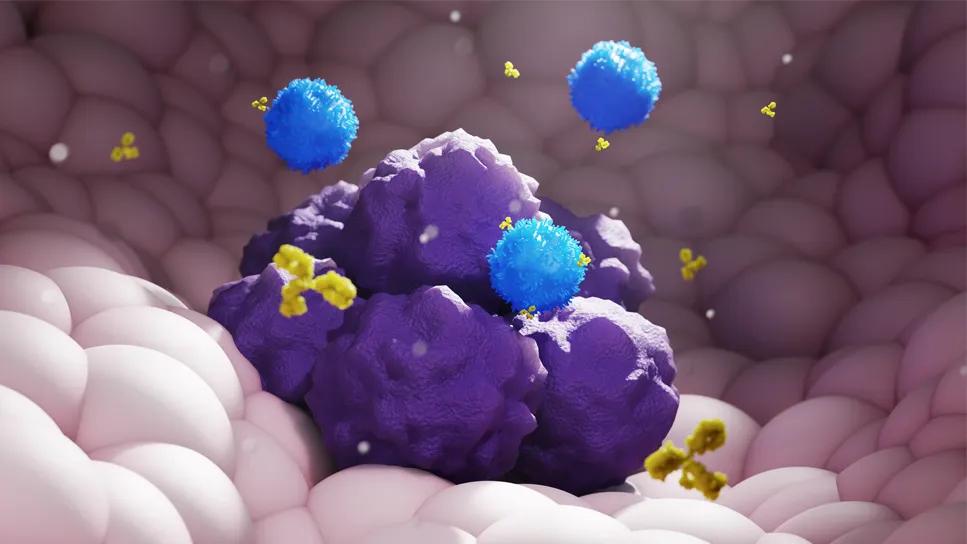
Image content: This image is available to view online.
View image online (https://assets.clevelandclinic.org/transform/d7525d68-34b7-452c-ac25-a09081f8488f/medical-illustration-of-immunotherapy-2169676150)
Immune checkpoint inhibitor illustration
Patients who receive immunotherapy have a statistically-significant reduced incidences of secondary cancer compared to those who received chemotherapy alone, according to a wide-scale study published in Clinical Cancer Research. Based on the insights gained, researchers believe this same therapy may have future potential to stave off cancer in people with a high risk for cancer, including patients with hereditary risk.
Advertisement
Cleveland Clinic is a non-profit academic medical center. Advertising on our site helps support our mission. We do not endorse non-Cleveland Clinic products or services. Policy
“I’m hopeful that one day we will be able to use immunotherapy in patients with a high risk of cancer, including patients with hereditary cancer syndromes, like mismatch repair disorders,” says Moaath Mustafa Ali, MD, MPH, study co-author and Lead Investigator for Immunotherapy Research at Cleveland Clinic Enterprise.
While serving as a primary hematologist/oncologist at a VA hospital, Dr. Mustafa Ali saw many patients at high risk of cancer re-emergence due to increased smoking or alcohol intake. Knowing that immunotherapy could restore antitumor immunosurveillance, he theorized that it might also offer protective mechanisms that could prevent secondary primary cancers in his patients.
When he joined Cleveland Clinic Cancer Institute in 2022, Dr. Mustafa Ali recruited his mentee and new research colleagues to join him in putting this theory to the test. The researchers began a 2.5-year endeavor to compare occurrences of secondary primary cancer among those who received immunotherapy versus those who received other treatment modalities.
The retrospective study included 5,576 patients treated for a variety of cancers between 2010-2022 across Cleveland Clinic centers in Ohio. This represents one of the most sizeable immunotherapy databases created to date.
Of the patients, 23% had received immunotherapy as frontline treatment and 17% received immunotherapy as secondary treatment, either as monotherapy or in combination with chemotherapy or radiation. The most common form of immunotherapy was anti–PD-1/PD-L1 and/or anti–CTLA-4 agents. The remainder of patients received chemotherapy and/or radiation.
Advertisement
Median follow-up was 47.5 months, during which time 264 patients were diagnosed with secondary primary cancers.
The data bore out Dr. Mustafa Ali’s theory. The researchers discovered a statistically significant reduction in secondary primary cancer risk among patients who had received immunotherapy. The probability of being free of secondary primary cancers at two years post-therapy and four years post-therapy was 97% and 94% in the immunotherapy cohort versus 95% and 92% in the non-immunotherapy group. This means that patients who received immunotherapy had a 43% lower chance to develop a second primary cancer.
Since patients with mismatch repair disorders tend to be highly sensitive to immunotherapy, the researchers are keen to determine if this treatment could be used a preventative measure in precursor conditions such as Lynch syndrome, which results from a mismatch repair gene mutation. Additionally, they are looking to design a study to determine if immunotherapy could play a role in preventing cancer in those with elevated risk due to high alcohol intake or smoking.
“Immunotherapy allows T-cells to recognize and destroy cancer cells. Based on that concept, it’s possible that immunotherapy could be harnessed at the preclinical stage,” explains Dr. Mustafa Ali. “The question for us was whether it would be too risky to use for this purpose.”
To answer that question, the researchers analyzed adverse events from 5,556 patients in the database with solid tumors, with a median follow-up of 14 months. The data showed that immunotherapy was not associated with significant increases in overall cardiovascular-related adverse events, myocardial dysfunction or renal impairment. The therapy was associated with notable increases in endocrine adverse events, the majority of which were grades 1-2.
Advertisement
Having built one of the largest immunotherapy databases in the world, the researchers spurred a significant amount of clinical research output as well as potential collaborations with several biotechnology firms.
This concept of using immunotherapies to rev up the immune system to prevent cancer piqued the interest of Demitrios Dedousis, MD, an oncologist and cancer geneticist with Cleveland Clinic Cancer Institute. He cares for patients with a genitourinary malignancy as well as patients with high genetic risk of cancer, including patients with Lynch syndrome as well as those with TP53 gene changes. Diseases causing TP53 gene changes result in a 70% lifetime risk of cancer in men and virtually 100% lifetime risk in women.
Early on in his career, Dr. Dedousis studied a large dataset of women with both rheumatoid arthritis and breast cancer and found those with both conditions had significantly better outcomes. “When we looked at the histology under the microscope, we found more immune cells within their tumors,” explains Dr. Dedousis. “This led to my interest in using immunotherapy to try and reduce the risk of developing cancer in those with a hereditary predisposition for it.”
Early on in his career, Dr. Dedousis studied a large dataset of women with both rheumatoid arthritis and breast cancer and found those with both conditions had significantly better outcomes. “When we looked at the tumor cells under the microscope, researchers found more immune cells within the tumors of patients with better survival,” explains Dr. Dedousis. “This led to my interest in using immunotherapy to try and reduce the risk of developing cancer in those with a hereditary predisposition for it.”
Advertisement
The concept would be to give people a shorter course of immunotherapy than would be typical for someone with active disease, thereby potentially reducing adverse event incidences. Dr. Dedousis and his team is now evaluating the patient population, conducting risk assessments and pursing industry partnerships.
Advertisement
Advertisement

Adding 177Lu-PSMA-617 to ADT plus an ARPI cut the risk of radiographic progression or mortality by 28%

New program will help patients improve fitness and manage weight after cancer treatment

Cleveland Clinic hematologist highlights new guidelines and treatment advances in immune thrombocytopenia
NIMBLE replaces weekly tumor board delays with same-day multidisciplinary recommendations

Cleveland Clinic study provides validation for the test, which combines AI and pathological data to predict outcomes in postoperative patients
Advanced imaging technology catches metastases much earlier, allowing treatment with fewer side effects

Reduced radiation for lymph node areas reduces side effects

Large Cleveland Clinic analysis may help resolve a longstanding question over optimal fractionation
 Search