Locations:





Evidence-based recommendations for managing pain, nausea and other treatment reactions
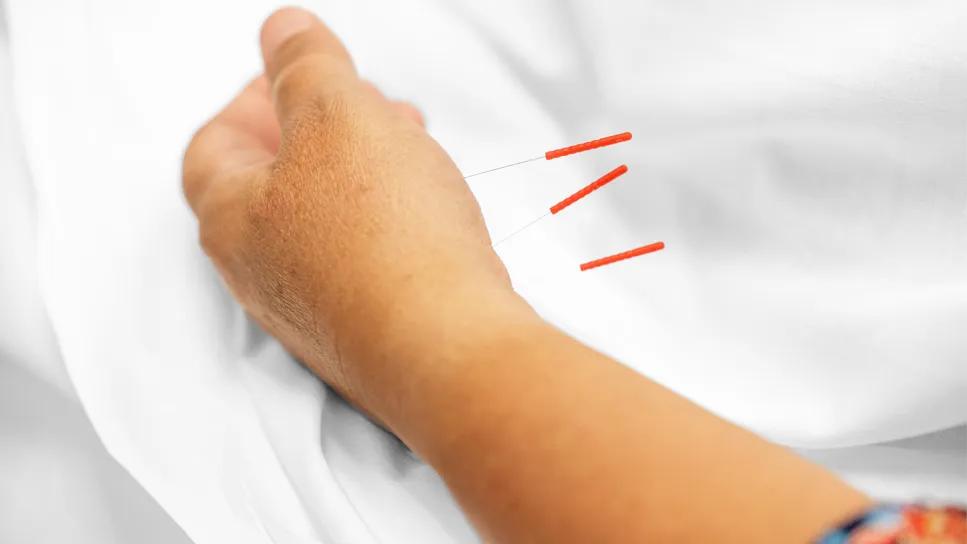
Image content: This image is available to view online.
View image online (https://assets.clevelandclinic.org/transform/20d7bf9b-5f3c-4a59-8705-c848feeadfee/acupuncture-on-inner-wrist)
Acupuncture in wrist
ASCO and the Society for Integrative Oncology found that using acupuncture could reduce chemotherapy-related nausea and vomiting during and after breast cancer treatment. The organizations issued joint guidelines in 2022 stating that acupuncture should also be recommended for general cancer pain or musculoskeletal pain. However, there remains limited awareness about this supportive modality.
Advertisement
Cleveland Clinic is a non-profit academic medical center. Advertising on our site helps support our mission. We do not endorse non-Cleveland Clinic products or services. Policy
Acupuncture isn't intended to replace medications like ondansetron or tramadol but it may reduce a patient's reliance on these drugs. "The purpose is to manage the patient's side effects and help improve their function so they can stick with their care plan a little more effectively,” says Timothy, Sobo, MOAM, LAc, CEC, CPT, a licensed acupuncturist at Cleveland Clinic in Beachwood, OH. “Acupuncture can limit chemotherapy-induced neuropathy, fatigue, hot flashes, anxiety, dry mouth, nausea, vomiting or pain.”
Acupuncture involves inserting tiny, sterile needles to stimulate specific points of the body. Stimulating these points elicits natural responses that release neurotransmitters and other neurochemicals, such as serotonin, dopamine, endorphins, acetylcholine and gamma-aminobutyric acid. For example, releasing endorphins helps with pain while releasing dopamine can calm your nervous system so you’re not in fight or flight mode. “Ultimately, the goal is to get the body to regulate itself to do this more effectively on its own,” explains Sobo.
Acupuncture treatment is personalized to each patient based on their side effects. Since acupuncture works on the whole body systemically, practitioners can treat multiple issues simultaneously. Depending on many factors, patients usually should expect that therapy will yield improvements after several sessions and will remain for a few days at a time.
To ensure patient safety, acupuncture should always be performed by a licensed and credentialed professional.
Advertisement
Generally speaking, patients who are suffering from mild, moderate or severe side effects such as anxiety, pain, neuropathy, nausea or vomiting may benefit from an acupuncture referral. “The sooner treatment is started, the better the chances of keeping side effects well managed,” Sobo notes.
Fortunately, there is minimal risk of trying acupuncture and there are no known drug interactions. Very light bleeding or bruising or some lightheadedness could occur. Typically, even patients on a standard dose of blood thinner can receive acupuncture, depending on their platelet count.
It’s not uncommon for patients to have some misconceptions about acupuncture. They may not realize there is science supporting its use. Educating them about evidence of the therapy can help patients feel more receptive to trying acupuncture. Sobo notes that some patients may also mistakenly believe that acupuncture treats cancer. It does not. It’s a supportive therapy to specifically address side effects.
Another common worry many people have is whether acupuncture will hurt. Since the filiform needles used are extremely small (typically between 0.2-0.25 mm in diameter), the treatment is not painful.
In terms of real-world observations, Sobo has seen patients experience relief from neuropathy, nausea and vomiting. “It’s a real quality of life improvement when you can reduce a patient’s reliance on multiple medications for managing side effects,” he says.
To gain greater insights, Cleveland Clinic Cancer Institute is studying the use of acupuncture on an outpatient basis for patients during infusions. The aim is to better understand its impact on treatment-related symptoms.
Advertisement
Advertisement
Adding 177Lu-PSMA-617 to ADT plus an ARPI cut the risk of radiographic progression or mortality by 28%

New program will help patients improve fitness and manage weight after cancer treatment

Cleveland Clinic hematologist highlights new guidelines and treatment advances in immune thrombocytopenia
NIMBLE replaces weekly tumor board delays with same-day multidisciplinary recommendations
Cleveland Clinic study provides validation for the test, which combines AI and pathological data to predict outcomes in postoperative patients
Advanced imaging technology catches metastases much earlier, allowing treatment with fewer side effects

Reduced radiation for lymph node areas reduces side effects
Large Cleveland Clinic analysis may help resolve a longstanding question over optimal fractionation
 Search