Locations:





Evidence suggests empathy influences immune function and well-being
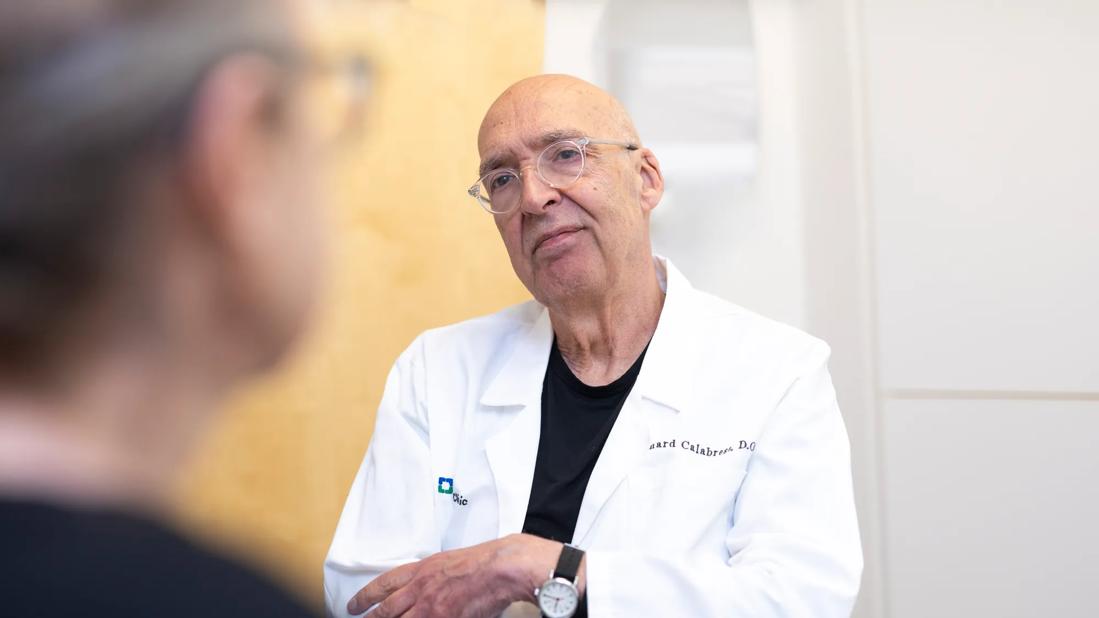
Image content: This image is available to view online.
View image online (https://assets.clevelandclinic.org/transform/00dd38aa-a359-4064-97a6-b1f8efa45b59/Calabrese-with-patient)
Dr. Calabrese listening to a patient in an office setting
In March 1927 Francis Peabody, MD, delivered to Harvard Medical School students a renowned lecture and an associated JAMA editorial about the importance of human connection in medicine. He famously concluded that “one of the essential qualities of the clinician is interest in humanity, for the secret of the care of the patient is in caring for the patient.”
Advertisement
Cleveland Clinic is a non-profit academic medical center. Advertising on our site helps support our mission. We do not endorse non-Cleveland Clinic products or services. Policy
A century of technological advancement has transformed medicine, and in rheumatology few developments have been more consequential than the emergence of targeted therapies for immune-mediated inflammatory diseases. These treatments have revolutionized outcomes and fundamentally reshaped clinical practice.
Despite these advances, they have not eliminated the human suffering that often accompanies chronic immune-mediated disease, including fibromyalgia, fatigue, central sensitization and the polysymptomatic distress many patients experience. At the same time, there has been renewed interest in patient empowerment and the therapeutic value of empathic communication, driven by growing evidence that empathy can improve health-related quality-of-life measures and potentially influence biologic pathways linked to immune function and well-being.
“Empathy is more important now than ever because of how healthcare has evolved,” says Cleveland Clinic immunologist Leonard Calabrese, DO, Director of the R.J. Fasenmyer Center for Clinical Immunology. Dr. Calabrese has maintained a longstanding educational and research interest in empathy since his early involvement in medical humanities at the Cleveland Clinic Lerner College of Medicine.
“The goals of modern therapy for complex illness are clear,” says Dr. Calabrese. “We want improved survival and effective treat-to-target outcomes, so it is understandable that modern medicine has focused heavily on objective measures and biologic efficacy. But patients continue to have an enduring need to feel heard, validated, reassured and understood. Even when disease activity is controlled, people want confidence that they are not being marginalized and that their suffering is recognized.”
Advertisement
For these reasons, a major focus of Dr. Calabrese’s academic career has been the study of empathy. He has continuously explored ways to better communicate unmet needs and to teach the practical skills of empathic communication. While Dr. Peabody emphasized that the physician-patient relationship is central to all of medicine, Dr. Calabrese believes this may be especially true in the care of patients with immune-mediated and other complex chronic disorders that are often poorly understood, multisystemic or historically stigmatized.
“My mission is to demonstrate that empathy is not a soft substitute for biomedical progress,” says Dr. Calabrese. “It is a measurable, teachable clinical skill with biologic implications. Increasingly, we recognize that many chronic illnesses involve disturbances in neuroimmune network regulation, and empathic communication between clinician and patient may influence those pathways in meaningful ways. Suffering itself has physiological correlates. Properly understood, empathy can be therapeutic in ways that align with modern neuroscience.”
Conversations about empathy in medicine must begin with a shared understanding of what empathy is — and what it is not. Misconceptions remain common. Dr. Calabrese describes empathy as both a mindset and a communication skill: the capacity to understand another person’s experience and effectively communicate that understanding back to them.
“Empathy allows one person to stand in another person’s shoes but not live in their shoes,” he says. “In medicine, however, understanding alone is insufficient. The key is the ability to communicate that understanding in a way that allows the patient to genuinely feel connected, heard and respected.”
Advertisement
Empathy and empathic communication, he argues, are hallmarks of master clinicians. Dr. Calabrese credits Mohamadreza Hojat, PhD, of Thomas Jefferson University, architect of the Jefferson Scale of Empathy and a long-time collaborator, with shaping much of his thinking on the topic.
Two persistent misconceptions continue to limit broader acceptance of empathy as a clinical tool. The first is the belief that empathy is synonymous with sympathy and therefore emotionally hazardous, potentially contributing to physician burnout. The second is the perception that empathy is merely a social nicety with little impact on meaningful clinical outcomes.
Neither assumption is supported by evidence, according to Dr. Calabrese.
“Sympathy is primarily an emotional reaction — feeling bad for someone — without necessarily communicating that feeling,” he explains. “Empathy is different. As clinicians, we can enter difficult emotional spaces with patients and emerge without becoming consumed by them. That is the power of cognitive empathy.
“When we communicate empathy effectively, both patient and clinician benefit,” he adds. “Patients feel heard and appreciated, but clinicians often experience greater meaning and fulfillment in their work as well. The data increasingly support this.”
The misconception that empathy lacks scientific grounding is being challenged by emerging work in placebo and nocebo science, neurobiology and the brain-immune axis. One study that particularly influenced Dr. Calabrese was published in 2009 by Bruce Barrett and colleagues at the University of Wisconsin-Madison (Fam Med. 2009;41(7):494-501). Investigators demonstrated that patients with common colds who received highly empathic care recovered more quickly than those treated in a deliberately neutral, transactional manner.
Advertisement
“What captured my attention was that the investigators also observed measurable changes in immune biomarkers associated with the empathic interaction,” he says. “It was an eye-opening moment for me and fundamentally changed the way I thought about the biology of healing relationships.”
Dr. Calabrese emphasizes that the fi eld remains in its early stages and that much remains unknown about the clinical implications of empathy-driven neuroimmune modulation. Nevertheless, the humanistic value of empathy alone provides compelling reason to refine and teach these skills more intentionally. From a practical clinical standpoint, he explains, empathic communication strengthens the therapeutic alliance, improves patient satisfaction, enhances confidence in care plans and increases treatment adherence. These benefits may be especially important in rheumatology, where patient-reported outcomes and symptom burden often extend beyond measurable inflammatory activity.
Dr. Calabrese also believes strong empathic connection may facilitate a state of physiologic attunement between patient and clinician.
“When that happens, everything slows down and we begin operating on the same emotional level,” he says. “This reflects the biology of placebo in its most constructive sense — not deception, but the neuropsychologic and neuroimmunologic capacity to relieve suffering.”
He is careful to note that empathic communication is not a replacement for effective therapy. Rather, it may complement biologic treatment by helping alleviate polysymptomatic distress, including fatigue, sleep disturbance, dysautonomia, cognitive dysfunction and central sensitization. All complicate immune-mediated inflammatory diseases and frequently overlap with fibromyalgia.
Advertisement
Within placebo-nocebo science, this phenomenon has been described as “interpersonal healing,” and research suggests it may positively influence outcomes in disorders ranging from low back pain and irritable bowel syndrome to respiratory infections. Dr. Calabrese notes that this remains a relatively underexplored area within rheumatology.
The rapid emergence of ambient AI and automated medical scribing technologies may paradoxically create new opportunities to strengthen the clinician-patient relationship. Clinicians have reported high satisfaction with these tools because of improved efficiency, reduced documentation burden and potential mitigation of burnout. Less discussed, however, is their ability to fundamentally reshape the choreography of the exam room. For decades, electronic medical records have drawn physicians’ attention toward keyboards and computer screens and away from patients.
“That has been a major impediment,” says Dr. Calabrese. “Approximately 80% of empathic communication is nonverbal — eye contact, facial expression, posture, attentiveness and emotional presence.”
Ambient listening technologies generate documentation passively in the background, which allows clinicians to conduct interviews and examinations without continuous typing. Dr. Calabrese believes this creates a unique opportunity to restore many of the relational skills that modern medical practice has unintentionally eroded.
“We now have the opportunity to revisit the core human skills of medicine,” he says. “Eye contact, attentive listening, respectful touch and emotional presence become available to us again. These are teachable skills, and, importantly, they can also be reinforced and measured.”
As for whether empathic communication can truly be taught, Dr. Calabrese believes the answer is unequivocally yes, as reflected by numerous studies.
“Empathic communication is a little like learning a musical instrument,” he says. “Some individuals are naturally gifted, while others require more deliberate practice. But the evidence strongly suggests these skills can be developed.”
He argues that empathy training should extend far beyond the limited exposure many physicians received during medical school. Toward that end, Dr. Calabrese is developing a highly efficient virtual educational program focused on the practical dimensions of empathic communication, particularly nonverbal behaviors and techniques that strengthen therapeutic connection. Ultimately, he hopes such programs can also serve as research platforms to determine whether targeted empathy training can measurably improve patient outcomes, clinician satisfaction and the overall experience of care.
“If the patient feels better and the practitioner feels better,” says Dr. Calabrese, “that’s a win-win.”
Advertisement
Going beyond simple referrals to streamline patient access

Cleveland Clinic group works toward earlier diagnosis of this rare disease

From dryness to diagnosis

New clinic meets Hispanic patients where they are
Fellows will train under faculty with broad range of expertise
Collaboration was key to identifying source of nerve condition
When to suspect concurrent giant cell arteritis
New research explores the role of immune cell and blood-brain barrier changes
 Search