Locations:





 Search
Icon one of many upgrades in new building
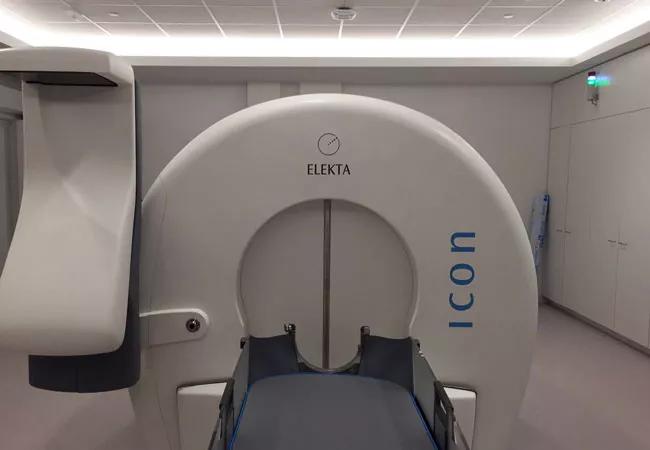
Image content: This image is available to view online.
View image online (https://assets.clevelandclinic.org/transform/7ac522bd-22a4-40da-bd97-1e43352544ac/suh-icon_650x450_jpg)
suh-icon_650x450
The new Taussig Cancer Center building, which opened March 6, 2017, houses Ohio’s first Leksell Gamma Knife Icon™ radiosurgery technology. Icon offers the most precise brain radiosurgery capabilities of any currently available technology.
Advertisement
Cleveland Clinic is a non-profit academic medical center. Advertising on our site helps support our mission. We do not endorse non-Cleveland Clinic products or services. Policy
The addition of this new technology further enhances patient care, research and education at Cleveland Clinic Cancer Center. Since 1997, the center has performed over 6000 cases using Gamma Knife for brain tumor treatment. Cleveland Clinic is also one of the few centers to offer a week-long Gamma Knife training course, which has trained hundreds of physicians and medical physicists. In addition, the center is active in scientific and clinical research, has ongoing clinical trials for patients with brain metastases and holds an annual international symposium on radiosurgery.
Icon’s front-mounted, cone-beam CT scanner allows the physician to verify the patient’s head position prior to treatment. This verification enables physicians to treat tumors in locations close to critical structures such as the optic apparatus and brain stem, and to replace rigid frames that screw into a patient’s skull with a mask as a stereotactic reference.
The mask “offers a better patient experience for some patients and allows us to divide treatments over multiple sessions, which is useful for some complex cases,” says John Suh, MD, Chair of the Department of Radiation Oncology at Cleveland Clinic’s Taussig Cancer Center and Associate Director of the Gamma Knife Center. The presence of high-definition motion management, which uses an infrared camera, monitors any patient motion during treatment.
The new 377,000-square-foot, $276 million Cancer Center building is designed, top to bottom, to “optimize multidisciplinary care and patient experience and minimize wait times,” says Dr. Suh. The light-filled building extends its brightness to the lower level of the radiation treatment center with an enormous standing skylight that protrudes into the parking drop off area. “The presence of natural light into the radiation oncology department is very important. It helps make the space more open and inviting, which helps comfort patients and their families,” says Dr. Suh.
Advertisement
All radiation treatments will occur in the new Cancer Center. Six state-of-the-art linear accelerators with image guidance, two large bore CT simulators, a hyperthermia suite, a high-dose rate brachytherapy suite and MRI for simulation will join Icon in the array of radiation treatments available for Cleveland Clinic patients. In addition, the lower level will feature a large physician conference room with two 100-inch monitors.
“It’s a very exciting time in oncology, in particular radiation oncology,” says Dr. Suh. “We plan to create the future of cancer care in the new Taussig Cancer Center by providing timely, compassionate, innovative and comprehensive cancer care.”
Advertisement
Advertisement

Improving access to specialists
Dotatate PET/CT scan and molecular testing informed treatment trajectory

A proactive, framework-based approach

Patients on ibrutinib were more than twice as likely to experience atrial fibrillation or heart failure than those on second-generation alternatives.
Expert recommendations introduce use of targeted agents
Combination therapy may soon represent new standard of care

Research findings offer clues for improving disease outcomes in men

Creating a safe space for patients