Locations:





Biologic therapy and advances in monitoring may ease treatment and follow-up for families
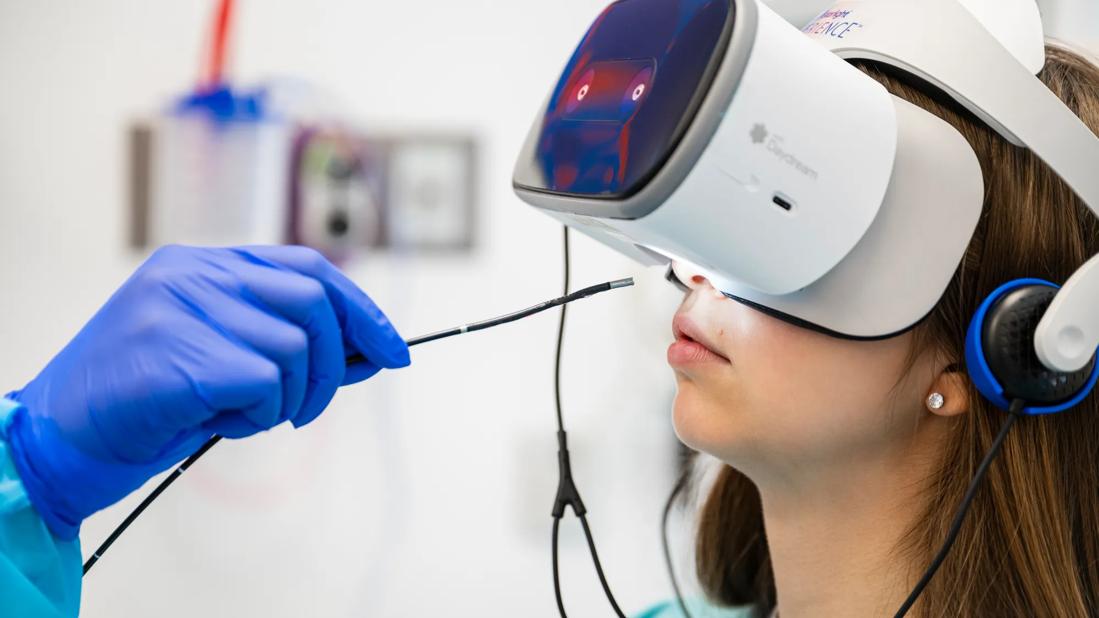
Image content: This image is available to view online.
View image online (https://assets.clevelandclinic.org/transform/da643d00-9f63-425c-8d12-ef22dc3bb341/CHP_4025867_06-15-23_032_SCG-jpg)
Girl wearing virtual reality headset, preparing for transnasal endoscopy
For children with eosinophilic esophagitis (EoE), treatment has traditionally relied on food elimination diets, proton pump inhibitors and swallowed corticosteroids. These remain effective options for some patients and families, but not all.
Advertisement
Cleveland Clinic is a non-profit academic medical center. Advertising on our site helps support our mission. We do not endorse non-Cleveland Clinic products or services. Policy
Now, newer therapeutic and monitoring approaches are expanding what care can look like.
At Cleveland Clinic Children’s EoE clinic, pediatric gastroenterologist Sophia Patel, MD, and pediatric allergist and immunologist Brian Schroer, MD, are helping families navigate a growing range of options, including biologic therapy, unsedated transnasal endoscopy and emerging office-based monitoring tools. These advances are making EoE care more individualized and, in many cases, more manageable.
One of the biggest recent developments in EoE care is monoclonal antibody dupilumab (Dupixent®), which was approved for EoE by the U.S. Food and Drug Administration in 2022.
“Dupilumab gives us another option for patients who have not tolerated or responded well to swallowed steroids, food avoidance or twice-daily antacids,” Dr. Patel says. “And, for many families, the dosing schedule is easier to maintain.”
Dupilumab is a subcutaneous injection that can be given at home. Depending on the child’s weight and other dosing factors, it may be given weekly or every other week.
“That convenience can matter in a chronic disease that often requires long-term treatment,” Dr. Patel says. “For some families, an injection at home is much more practical than trying to give an oral medication once or twice a day indefinitely.”
Clinical trial data have been encouraging. In a phase 3 trial involving children ages 1 to 11, histologic remission reached 68%.
Dr. Patel says dupilumab has also been useful for patients with esophageal fibrosis.
Advertisement
“It’s one of the medications that we’ve seen actually improve some of the fibrotic changes common in EoE,” she says.
For many children, dupilumab’s benefits extend beyond the esophagus.
“EoE most often occurs in patients who have other allergic conditions,” says Dr. Schroer. “Many of these children also have asthma, eczema, nasal allergies or food allergies.”
That overlap is one reason dupilumab can be especially useful. In addition to EoE, it is approved for conditions such as asthma, atopic dermatitis and nasal polyps.
“The best part about using dupilumab is the ability to give patients one drug to relieve their EoE and other symptoms,” Dr. Schroer says.
Dr. Patel notes another practical advantage: Patients treated with dupilumab may be able to go longer between surveillance endoscopies than those using some other treatment strategies.
“With food elimination, you often need to rescope within a few months to see whether the diet is working,” she says. “Similarly, with other medications, we typically repeat endoscopy after about 8 to 12 weeks. Dupilumab takes a little longer to reach its full effect, but that can also mean less frequent endoscopic surveillance.”
Although EoE diagnosis still requires a conventional sedated upper endoscopy with biopsy, newer tools are creating more options for monitoring children who have already been diagnosed.
One is transnasal endoscopy, which Cleveland Clinic Children’s has been performing since 2023. The procedure allows clinicians to visualize the esophagus and obtain biopsies without sedation.
Advertisement
The patient’s nose and throat are numbed with lidocaine spray, and the procedure is done in clinic while the patient is awake. It typically takes less than 10 minutes.
To make the experience easier for children, the team uses distraction techniques such as virtual reality headsets so patients can watch videos or play games during the procedure.
“The procedure is very well tolerated,” Dr. Patel says. “We’re able to visualize nearly everything we would see during a sedated endoscopy, and we can still obtain biopsies.”
Another option may soon be available at Cleveland Clinic Children’s: a minimally invasive string-based test (EnteroTracker®) to monitor esophageal inflammation. In this approach, the patient swallows a biodegradable capsule attached to a string. After about an hour, the string is withdrawn through the mouth. As it passes through the esophagus, it collects surface material and inflammatory proteins from the mucosa. The sample is then sent to a specialty lab, which generates an EoE score based on eosinophilic inflammation and related biomarkers.
“It’s essentially a liquid biopsy of the esophageal lining,” Dr. Patel says. “It doesn’t sample as deeply as a traditional biopsy, so it’s best thought of as a screening or monitoring test rather than a replacement for endoscopy.”
The main advantages are the convenience and avoidance of anesthesia. Still, it may not be right for every child.
“Some patients may be uncomfortable with the idea of swallowing the capsule,” Dr. Patel says. “But it’s another option, and that’s really the point — having more choices for families.”
Advertisement
Cleveland Clinic Children’s EoE clinic is built on a model of multidisciplinary care that includes gastroenterology, allergy and nutrition. Patients can see all of their specialists during one visit to the clinic.
That approach reflects the reality of the disease, says Dr. Schroer, who can address EoE as well as a patient’s other conditions, such as allergic rhinitis and food allergies.
“For many patients, the idea that EoE is related to food allergy is confusing because the foods causing inflammation are often eaten without immediate symptoms,” he says. “It’s important to help families understand the different forms of allergy and also realize that there are no useful blood or skin tests that can identify which foods are causing EoE.”
Multidisciplinary care and the expanding range of EoE therapies and monitoring tools are helping tailor care for each child and family.
“EoE management is becoming more flexible,” says Dr. Patel. “There are more options now. Families appreciate understanding what choices are available, both for treatment and for ongoing monitoring of EoE.”
Advertisement
Advertisement
Potential for new, non-invasive screening option
Pediatric and adult gastroenterologists offer team care for patients with eosinophilic esophagitis
Key takeaways from the newest STS-Pedimacs report

Pediatric Syncope Clinic helps rule out serious disease and guide next steps
Cleveland Clinic findings highlight gains in stability, chest wall contouring and correction

What the discovery means for clinicians and patients
Why preparedness matters right now

Early diagnosis, specialized assessment and high-frequency motor-based therapy can improve outcomes
 Search