Locations:


Bone-anchored prosthetics may improve function and quality of life for patients with limb loss
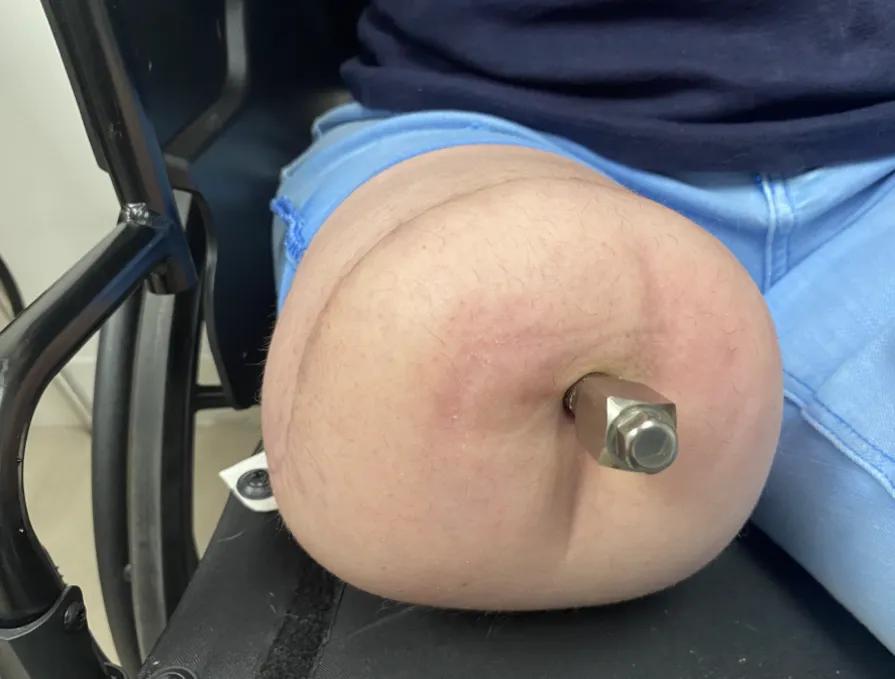
Image content: This image is available to view online.
View image online (https://assets.clevelandclinic.org/transform/9b586c11-bd2d-4383-9c90-73aac43e1c63/amputation-cqd1)
Metal rod sticking out of the upper leg after the lower leg has been amputated
Orthopaedic surgeons have long been taught to protect implant hardware from the outside environment to minimize infection risk. Yet bone-anchored prosthetics, a newer approach to limb amputation, challenge that conventional thinking.
Advertisement
Cleveland Clinic is a non-profit academic medical center. Advertising on our site helps support our mission. We do not endorse non-Cleveland Clinic products or services. Policy
Enabled by osseointegration, the approach places a metal implant within the residual bone and extends it through the skin to connect directly to an external prosthesis. For selected patients who struggle with a traditional socket prosthesis, the result can be improved comfort and prosthetic control.
First introduced for patients with lower-extremity amputations in Sweden in the 1990s, osseointegration has expanded globally as implant design and surgical technique have advanced.
“What makes a bone-anchored prosthesis different is that there’s no socket,” says Cleveland Clinic orthopaedic surgeon Lukas Nystrom, MD. “An implant inside the bone connects directly to the prosthetic limb. That direct connection eliminates many of the challenges associated with socket prostheses and allows forces to be transferred much more efficiently from the skeleton to the prosthesis.”
Socket prostheses remain first-line treatment for most patients with limb loss, Dr. Nystrom notes. But they can be difficult to tolerate or use effectively in certain clinical scenarios.
Common challenges include:
Advertisement
Osseointegrated, bone-anchored prostheses can help avoid these issues, but they require surgeons to think differently about infection risk.
“The traditional orthopaedic mindset is to place an implant under sterile conditions and then completely cover it with soft tissue,” says Dr. Nystrom. “Whether we’re talking about a joint replacement or fixation hardware for a fracture, we’re taught to protect that implant from exposure to the outside environment.”
Bone-anchored prostheses require a different approach. Rather than isolating the implant completely, surgeons create a controlled transcutaneous interface where the implant exits the skin and connects to the prosthesis. Bacteria may be present at the site, but the goal is to create a stable soft-tissue environment that prevents deep infection.
The concept is not entirely new, Dr. Nystrom notes. Dental implants rely on a similar principle, with fixtures anchored in bone and extending through soft tissue to support a prosthetic device.
“It’s just outside the way orthopaedic surgeons traditionally think about implants,” he says. “The key to success lies in careful patient selection, surgical technique and soft-tissue management.”
Patients who struggle with a conventional socket prosthesis may be candidates for osseointegration, particularly those with very short residual limbs or anatomy that makes a secure socket fit difficult.
“We’re generally looking for patients who have either failed a traditional socket prosthesis or are unlikely to succeed with one because of the nature of their amputation,” says Dr. Nystrom.
Advertisement
Because durable healing at the skin-implant interface is essential, the team carefully evaluates factors that increase the risk of wound complications. Active infection is a contraindication, and the procedure is generally avoided in patients who smoke or have other significant barriers to healing.
Body habitus also matters. Obesity alone is not necessarily exclusionary, but excess soft tissue can make it more difficult to create and maintain a stable transcutaneous interface.
“We don’t base the decision entirely on BMI,” Dr. Nystrom says. “We’re really evaluating the shape of the limb, the amount of soft tissue present and whether we can create the conditions needed for the tissue to heal appropriately around the implant.”
Successful osseointegration depends on more than implantation alone. According to Dr. Nystrom, the best outcomes come from a coordinated, multidisciplinary team that supports patients before, during and after surgery.
Psychologists and social workers may be involved to help assess patient goals, expectations and support systems. Physical therapists and prosthetists are central to postoperative adaptation and training. Home support is also critical, given the need for ongoing wound and skin-interface care.
“Osseointegration is new for everyone involved, not just surgeons,” Dr. Nystrom notes. “Physical therapists, prosthetists and other specialists all play an important role in helping patients adapt to a completely different way of using a prosthesis.”
The surgical procedure is typically performed in two stages separated by roughly two to three months. In the first stage, the implant is placed within the residual bone. Over time, new bone tissue will grow onto and around the surface of the implant, holding it in place.
Advertisement
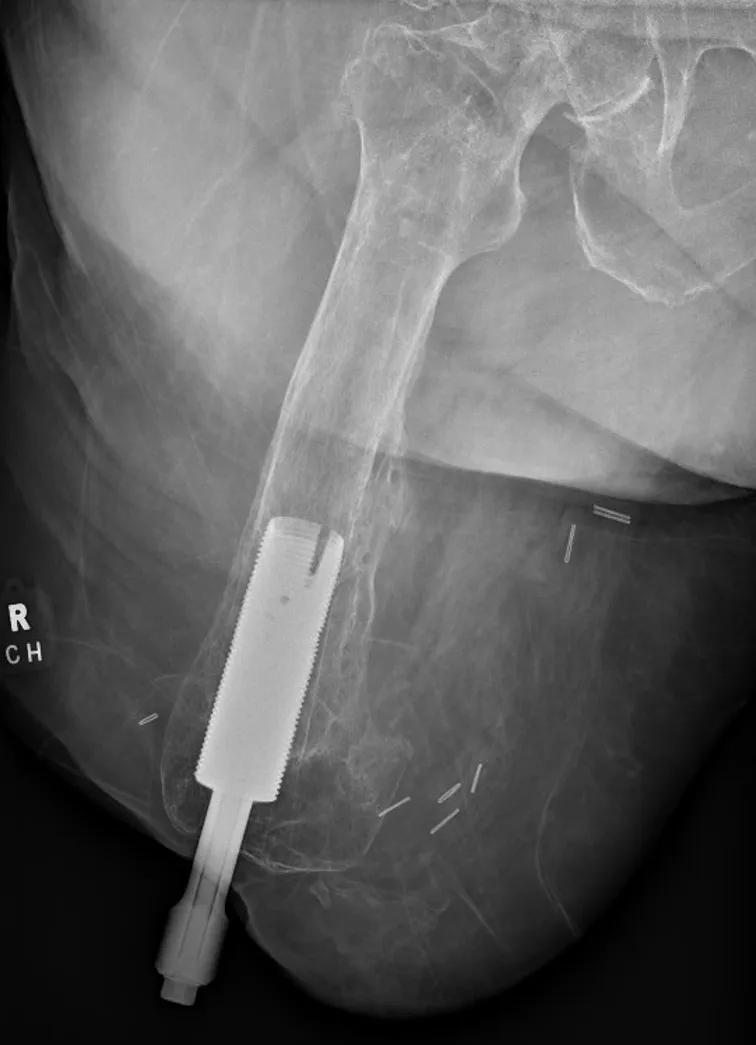
Image content: This image is available to view online.
View image online (https://assets.clevelandclinic.org/transform/4ce0efdf-215e-447f-b81a-9574bd33df8f/amputation-cqd2)
Lateral X-ray of a right residual limb demonstrating a well-fixed osseointegration device in the residual femur.
The second stage creates the skin opening through which the implant will connect to the prosthesis. This requires careful contouring of the soft tissues and strategic muscle attachment around the end of the bone to create a stable, durable interface.
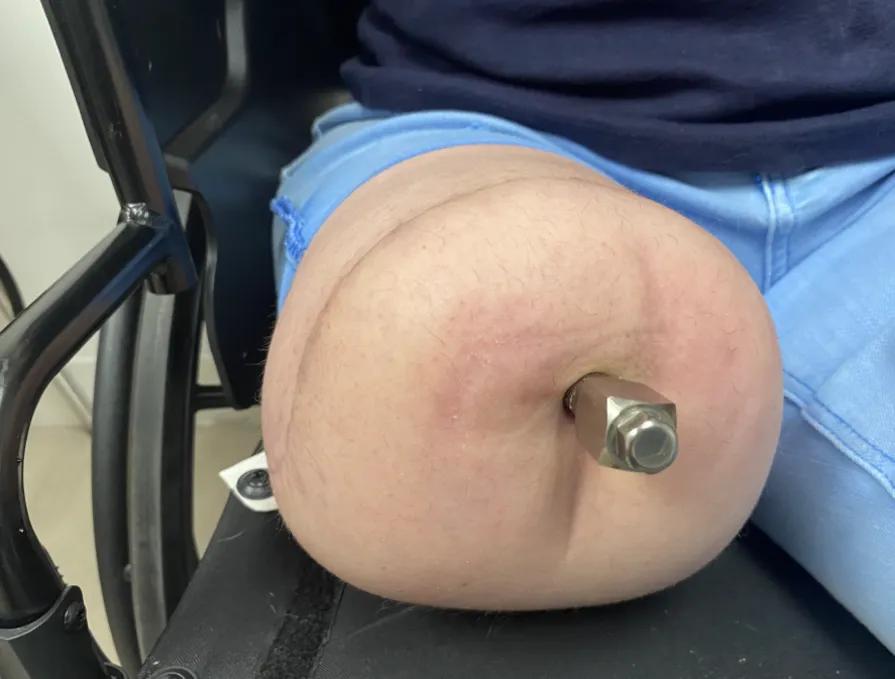
Image content: This image is available to view online.
View image online (https://assets.clevelandclinic.org/transform/9b586c11-bd2d-4383-9c90-73aac43e1c63/amputation-cqd1)
Residual right limb in a patient demonstrating good adherence of the skin to the bone at the site of the aperture. This ensures good soft-tissue stability, which prevents wound issues at the aperture site.
“The multidisciplinary approach is crucial to success,” says Cleveland Clinic plastic surgeon Steven Schulz, MD. “By working as a team, we can tailor the soft-tissue platform to each patient. While excess tissue helps support a traditional socket, it can interfere with an osseointegrated prosthesis. Careful soft-tissue management helps maximize prosthetic function and minimize complications.”
Rehabilitation differs substantially from standard postoperative protocols, particularly during the first three months.
“Most of these patients haven’t been loading weight directly through the bone for quite some time, so it can be an odd sensation at first,” Dr. Nystrom says. “We follow a gradual protocol that slowly increases pressure and weight-bearing as they adapt to the implant. For most patients, the tactile feedback of direct loading ultimately improves the overall ‘feel’ of ambulating with a prosthetic.”
Although osseointegration is most often discussed in the context of lower-extremity limb loss, the technique can be applied to any extremity.
The approach is not without risk. Infection at the skin-implant interface remains a central concern, making meticulous site care, structured rehabilitation and strong patient support essential to long-term success. Superficial soft-tissue infections can occur but are generally managed effectively with oral antibiotics.
Advertisement
“This is the first step toward the future of prosthetics,” Dr. Schulz says. “By combining osseointegration with nerve procedures, such as targeted muscle reinnervation and regenerative peripheral nerve interfaces, we’re moving toward prostheses with sensory feedback and more intuitive control. The potential to improve patients’ quality of life is tremendous.”
Advertisement
Relieves discomfort, reduces opioid dependency and improves quality of life
Trauma patients present with infected pilon and distal femur fractures
Research could lead to bionic devices that work more like the human body

Staged pivotal noninferiority study is comparing BrioVAD with HeartMate 3

New developments offer providers more sophisticated options

Study explores center volume and outcomes using the STS-Pedimacs database

Cleveland Clinic series supports its feasibility, especially with HeartMate 3
Recognizing mobility as a human right is instrumental to change
 Search