Locations:





Advanced surgical suite in our soon-to-open facility promises to redefine care standards

Image content: This image is available to view online.
View image online (https://assets.clevelandclinic.org/transform/f9e65b27-5505-487c-8a7b-17b27c9020a4/new-neuro-building-park-view)
rendering of a two-tower medical building
As neurosurgical care shifts away from traditional siloed approaches of conventional open surgery and minimally invasive or interventional procedures, Cleveland Clinic expects to accelerate the trend with a new state-of-the-art hybrid neurosurgical operating room (OR).
Advertisement
Cleveland Clinic is a non-profit academic medical center. Advertising on our site helps support our mission. We do not endorse non-Cleveland Clinic products or services. Policy
“Years ago the neurosurgery community shifted a lot of cerebrovascular cases into angiography suites for minimally invasive approaches like coiling of brain aneurysms,” says Cleveland Clinic vascular neurosurgeon Mark Bain, MD, MS. “More recently, we are seeing a blending of these procedures where certain complex cases really require both open and endovascular components.”
Such cases are among those that stand to benefit most from the forthcoming hybrid OR, a highlight of Cleveland Clinic’s new 1-million-square-foot Neurological Institute building (rendering shown above) that’s set to open on its Main Campus in Cleveland in early 2027.
“This new hybrid OR will combine the surgical functionality of a traditional OR with the high-resolution diagnostic imaging of an angio suite,” Dr. Bain notes. “It will allow us to combine techniques more seamlessly than ever before to promote more efficient workflows, greater patient safety and better clinical outcomes.”
With a design inspired by similar surgical suites at a few leading global centers, the space is expected to be one of the most advanced neurosurgical hybrid ORs in the nation, with uses ranging from cerebrovascular procedures to spine surgeries, brain tumor operations and more.
Historically, patients requiring both endovascular and open surgical interventions have faced significant logistical hurdles. For instance, a patient with chronic subdural hematoma might require middle meningeal artery embolization in an angiography suite followed by surgical decompression. This traditionally involves placing the patient under anesthesia in the angiography suite for a 45- to 60-minute procedure and then spending considerable time transporting them to a conventional OR.
Advertisement
“There are inherent safety risks with the additional transports between procedural tables and gurneys, moving all the lines involved and keeping the patient anesthetized for a longer period,” Dr. Bain says. “A case that involves only two hours of procedural time might take four hours due to transport time.”
The hybrid OR avoids these risks by allowing the clinical team to perform both stages of the procedure in a single setting and a shorter time frame. The team can get patients extubated and to the ICU faster, significantly improving their recovery trajectory.
The centerpiece of the hybrid OR will be a fixed imaging system that is mounted to a robot arm and provides diagnostic-quality angiography and CT capabilities within the surgical field. For many years, neurosurgeons have relied on mobile C-arms for intraoperative imaging, but Dr. Bain notes that these units often fall short when detailed visualization is needed.
“It’s the difference between a Polaroid camera and a modern high-resolution camera,” Dr. Bain says when comparing mobile units and the new fixed system. “You just can’t get the same level of quality with a mobile C-arm. The source and the image intensifier are both too large, and the power requirements are such that you can’t just plug it into a wall.”
In the hybrid OR, the robotic arm will move the imaging system into place, providing capabilities like 3D rotational angiography and CT perfusion imaging in real time. This will allow the surgical team to view the anatomy from every angle, pivoting and rotating 3D images to ensure, for example, that an aneurysm clip is perfectly placed or a vessel has remained patent.
Advertisement
The most immediate impact of this high-resolution imaging will be the ability to make definitive, real-time procedural adjustments. In most contemporary settings, neurosurgeons often need to rely on suboptimal mobile imaging to check their work before closing. “The team may be left staring at a poor-quality image, trying to infer whether a vessel is open or an aneurysm is fully occluded,” Dr. Bain says.
The lack of high-quality intraoperative imaging can lead to “takebacks,” or secondary surgeries required when a high-quality postoperative angiogram reveals a lesion remnant that was missed in the OR. “With this hybrid OR,” Dr. Bain says, “we will be able see right then and there any number of things: Is there a recurrence? Is the bypass open? Is there a stenosis? Having a high-quality machine in the room will save us from having to do reoperations down the road because we found a remnant aneurysm or an arteriovenous malformation that was still there.”
Beyond anatomical confirmation, the room’s ability to perform CT perfusion studies allows surgeons to monitor blood flow in real time. If a perfusion deficit is detected after an intervention, the surgeon can immediately act while the patient is still on the table, such as by moving an aneurysm clip, to help prevent a later stroke.
Dr. Bain stresses that it’s important to distinguish Cleveland Clinic’s new hybrid OR from the sort of makeshift hybrid ORs that some hospitals may improvise by performing surgery in modified angiography suites that lack the specialized surgical beds necessary for proper patient positioning for intricate procedures.
Advertisement
In contrast, the new hybrid OR will feature a high-quality surgical bed capable of custom positioning for complex approaches, fully integrated with stereotactic equipment and image guidance systems. The room is also being equipped with sensors and video cameras to record hand movements, recordings that Cleveland Clinic researchers hope to ultimately pair with artificial intelligence and machine learning to advance surgical accuracy.
While the hybrid OR will be invaluable for cerebrovascular cases, its utility extends to virtually any neurosurgical procedure where real-time imaging is important. For example, in spine surgery — particularly for minimally invasive procedures like kyphoplasties or operations involving instrumentation — the room’s high-definition fluoroscopy will provide detailed imaging guidance that far surpasses what’s achievable with current mobile C-arms.
“Any minimally invasive spine procedure that needs fluoro imaging is going to flourish in this room,” Dr. Bain says. Additionally, functional neurosurgeons will be able to use the suite to precisely verify placement of leads for deep brain stimulation.
Looking further ahead, Dr. Bain anticipates that the hybrid OR will be essential for emerging technologies like brain-computer interfaces. The implantation procedures for these technologies may require a combination of small open surgical access and catheter-based delivery, both of which demand high-end, real-time imaging.
“The ability to combine these two approaches is going to allow us to think more broadly and perform entirely new procedures down the road,” he predicts. “I don’t think we’ve realized yet what the full potential of this room could be. Once we get in there and start using it, there are going to be plenty of aha moments when we realize new ways to improve outcomes.”
Advertisement
Advertisement

Designed for digitization, distance health, discovery and more
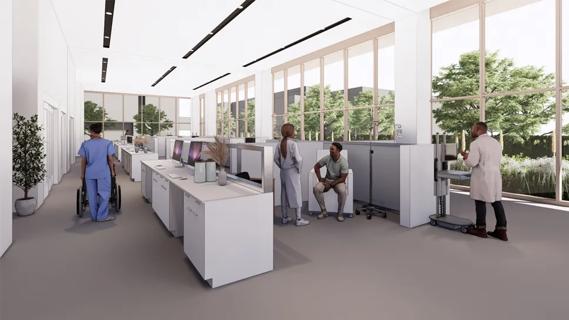
Combining customized care, research capabilities and flexibility for the future
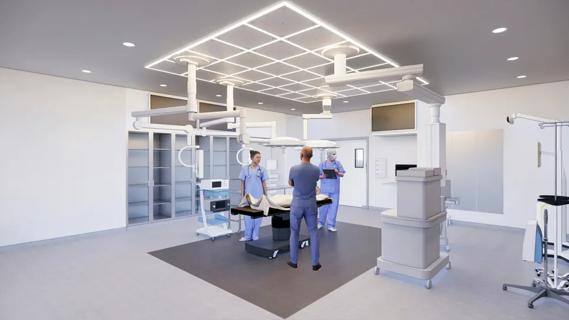
Expanded bevy of dedicated ORs will feature customized designs, leading-edge technology, optimized workflows

Routine capture of standardized neuroperformance data may expand and refine investigations

Reimagining the outpatient neurological visit with routine capture of neuroperformance data

Phase 3 STELLAR trial underscores role of molecular stratification in glioma care

A passionate specialist surveys the field’s past, present and future

Today’s research helps illuminate tomorrow’s needs
 Search