Locations:





Why definitive surgical closure is the gold standard, and new ways to make it possible
Podcast content: This podcast is available to listen to online.
Listen to podcast online (https://www.buzzsprout.com/2237537/18385453)
When reperfusion after myocardial infarction (MI) occurs too late or is not wholly successful, the underlying myocardium necroses, giving rise to a break in the wall between the heart’s ventricles. This rare mechanical complication, known as ventricular septal rupture, can lead to hemodynamic instability or circulatory collapse.
Advertisement
Cleveland Clinic is a non-profit academic medical center. Advertising on our site helps support our mission. We do not endorse non-Cleveland Clinic products or services. Policy
Surgical repair of the rupture is the definitive treatment but has traditionally been challenging due to the fragility of the necrotic tissue and the fact that patients often present with multiorgan failure. As a result, mortality for these complex repairs has historically been 30% to 50%.
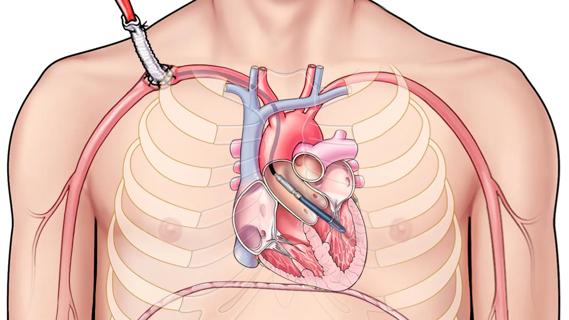
In recent years, Cleveland Clinic and a few other experienced centers have been placing modern micro-axial pumps in these patients via the axillary artery. The pumps are used to support the left ventricle, resolve heart failure, reduce shunting and improve organ perfusion. “Use of the mechanical pump buys us time in these critically ill patients,” says cardiothoracic surgeon Michael Tong, MD, MBA, Director of Cardiac Transplantation and Mechanical Circulatory Support at Cleveland Clinic. “The pump allows us to delay surgery for two or three weeks, enabling the ventricular wall to start healing and other organs to recover. This way, when we ultimately take the patient to surgery, the repair is much simpler and more reliable because the tissue quality is much better.”
In a recent episode of Cleveland Clinic’s Cardiac Consult podcast, Dr. Tong sits down with cardiologist Venu Menon, MD, Director of Cleveland Clinic’s Cardiac ICU, to discuss this and other aspects of caring for patients with post-MI ventricular septal rupture. Together they explore the following:
Advertisement
Click the podcast player above to listen to the 18-minute episode now or read on for an edited excerpt. Check out more Cardiac Consult episodes at clevelandclinic.org/cardiacconsultpodcast or wherever you get your podcasts.
Venu Menon, MD: This is such a rare complication that it seems particularly important that it be managed at a surgical center of expertise with a lot of consultants. One of the things we’ve done well, especially to support smaller community hospitals, is creating and operating a shock team for these cases. One piece of advice I’d like to give is that it’s really important for patients with this type of mechanical complication, whether they are stable or not, to be transferred to a highly experienced institution like ours.
This is now reflected in guidelines, which I think is quite favorable because some of these patients may appear to be doing relatively well under observation for a while, but then things can go south very quickly. When that happens, if they are at a smaller institution, it may be too late for their situation to be salvaged. What do you think about the concept of shock teams that can be called upon to advise on and triage these cases, including transferring them to a highly experienced center like ours or others around the country?
Michael Tong, MD, MBA: The ways we can support a failing heart in these cases have increased by leaps and bounds compared with only 10 years ago, when our tools were basically just the balloon pump and ECMO. There now are many other devices we can use in managing both short-term and long-term shock, but many hospitals don’t have those new technologies.
Advertisement
One of the things we’ve established here over the past seven or eight years is a shock team, as you mentioned. Any hospital can call us, call our transfer center, and say, I would like to activate the shock team. Within about two to three minutes, they will be on a phone call with a heart surgeon specializing in heart failure, an intensivist from the cardiac critical care unit, a heart failure cardiologist and an interventional cardiologist, all to discuss their patient with them.
If the group on the call feels the patient needs a higher level of care, they can decide on a transfer and get the patient to us very, very rapidly. We have helicopters and fixed-wing transport on standby at all times to bring critically ill patients here for advanced care. Also, if a hospital has a patient for which they just want some advice, our shock team can provide that advice. The other hospital may not necessarily have a good understanding of what's going on with the patient or how to think through the problem, and the shock team can guide them there as well. Of all the services we offer to our community hospitals, our surrounding hospitals and even hospitals that are further away, this is probably one of the best programs we have to serve the community.
For patients, it allows access to the highest level of care. Most centers may see only one or two patients with a ventricular septal rupture per year, if even that, so an individual surgeon may not have ever seen one of these patients in his or her whole career. In contrast, at Cleveland Clinic we see about 8 to 15 of these patients a year. That’s allowed us to develop expertise in really tailoring a strategy to the patient. That can include just treating these patients medically. That can include taking them to surgery right away. That can also include putting in a temporary mechanical pump to stabilize them and then take them to surgery. Whatever the case, the shock team will be equipped to develop tailored advice that’s specific to the patient to achieve the best outcome.
Advertisement
Advertisement
Cleveland Clinic series finds favorable long-term results with this high-risk operation
Transvalvular LVAD support transforms emergency surgery into urgent procedure
The benefits of multiarterial grafting are possible without opening the chest
How careful measurement, provocative testing and repeat assessment can maximize the diagnostic value of PAC
First prospective study shows early extubation and low vasoactive/inotropic medication use
CMR-CLIP outperforms general AI tools; may one day expand patient access to CMR
Cleveland Clinic reports first U.S. series focused on use in this challenging setting
Large series confirms early and long-term survival advantages over partial pericardial resection
 Search