Locations:





Podcast content: This podcast is available to listen to online.
Listen to podcast online (https://www.buzzsprout.com/2256206/18399007)
Nurses spend their careers caring for others, but rarely do they get the opportunity to experience healthcare from the other side of the bed.
Advertisement
Cleveland Clinic is a non-profit academic medical center. Advertising on our site helps support our mission. We do not endorse non-Cleveland Clinic products or services. Policy
When Cleveland Clinic nursing veteran Myra King, DNP, APRN-CNS, ACNS-BC, CCRN-CCS, was hospitalized following emergency surgery, she gained first-hand insight into what it feels like to be a patient. In the latest episode of Nurse Essentials, King shares the lessons she learned, which she believes have made her a better, more empathetic caregiver.
"Nurses spend a lot of time training to care for patients' physiological needs," King says. "Most of us are very comfortable analyzing vital signs, ECGs and lab work — but we may feel less confident when addressing our patients' psychological, emotional and spiritual needs. My personal health crisis prompted a powerful mind shift, however, that has made me focus on what nurses can be doing to provide comfort and healing — beyond the medications and treatments."
In the latest episode of Nurse Essentials, King discusses the power of personal connections, approaching patients with empathy and compassion, and the importance of being present.
Click the podcast player above to listen to the episode now, or read on for a short, edited excerpt. Check out more Nurse Essentials episodes at my.clevelandclinic.org/podcasts/nurse-essentials or wherever you get your podcasts.
Podcast host Carol Pehotsky, DNP, RN, NEA-BC: What small gestures or interactions really [made you feel] you were being cared for, or reminded you that you were in skilled hands?
King: I was very grateful for the interactions I had with several nurses...moments that made me feel as though I was seen, that I was heard and that I was cared for. And it was interesting because [those instances] weren't always what we would consider big.
Advertisement
There were things like a smile or a gentle touch, or the tone of voice they used...making eye contact...actually sitting down to talk to me, and not being distracted when we were having a conversation. Those things really, really let me know that they cared about me.
I also appreciated the frequent check-ins — coming in and saying, "I'm just here to see how you're doing. What can I do for you?" That meant a lot to me. I think it was about [the nurses] being fully present. Sometimes, as nurses, we feel like we don't have a lot of time. I'm really busy. I don't have time to spend with you. But it really isn't about the quantity of time — it's the quality.
So in those moments when the nurses weren't messing with the IV bag or my IV...or giving me a medication...but just stopped everything, made eye contact. It meant so much.
There was one [emergency department] nurse, in particular...I remember her looking at me. She took my hand and said, "You can do this. I am here with you. We're gonna do this together." And I immediately felt...I could gain strength from her.
Advertisement
Advertisement
Helping patients understand their options while navigating uncertainty
Nurse manager turns a patient safety concern into a data-driven effort to improve protocols and inspire innovation

Nurse draws on frontline experience and an engineering background to develop a new approach to incontinence management
How life experience, storytelling and a passion for service sparked a midlife nursing career
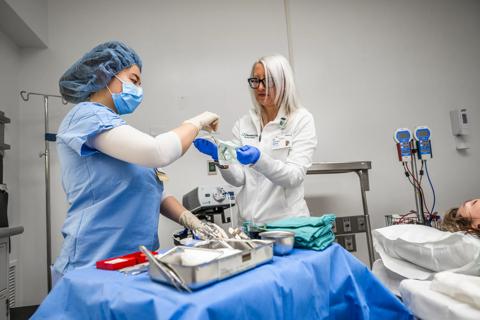
Plastic surgery nurses uniquely help patients meet medical, functional and aesthetic goals
Harnessing digital innovations to enhance nurse confidence and clinical outcomes
Regional organizations collaborate to address nurse faculty shortage
How wellness habits help nurses flourish
 Search