Locations:





CRNA careers offer challenge and reward
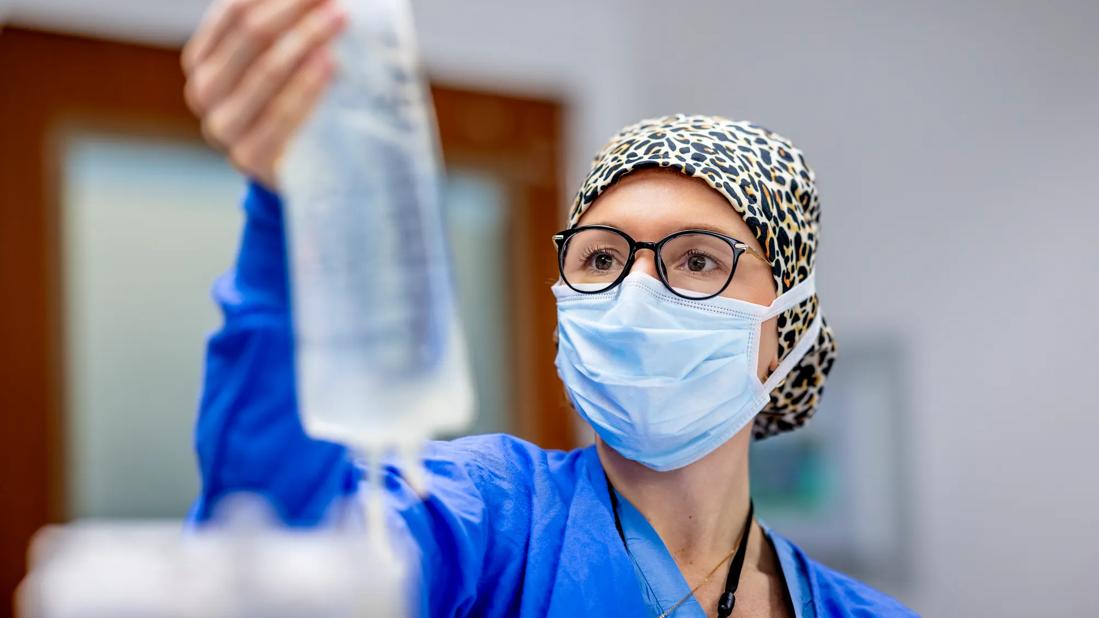
Image content: This image is available to view online.
View image online (https://assets.clevelandclinic.org/transform/4cc1527d-dc54-4f05-be29-177cc4ecc660/CCC_7541908_01-09-26_012_LDJ)
CRNA
When Brittany Irwin, MSN, APRN-CRNA, was in high school her physics teacher gave her an assignment to explore something that would impact her life.
Advertisement
Cleveland Clinic is a non-profit academic medical center. Advertising on our site helps support our mission. We do not endorse non-Cleveland Clinic products or services. Policy
“I had a sense that I was interested in healthcare and I shared that with my teacher,” she recalls. “He sent me to shadow his friend who was a physician. While I wasn’t incredibly intrigued by the procedure the physician was performing, I was fascinated by the young woman who was providing the anesthesia. The next day I went to the high school counselor’s office, researched it, and never looked back.”
For more than 20 years, Irwin has been a certified registered nurse anesthetist (CRNA) at Cleveland Clinic. She and others like her have a passion for providing anesthesia care to patients undergoing surgical and medical procedures. Nearly 72,000 CRNAs and student registered nurse anesthetists deliver an average of 58.5 million anesthetics each year, according to the American Association of Nurse Anesthetists (AANA).
CRNAs are educated, trained and experienced in managing anesthetics and emergency situations in a variety of settings. They provide safety and comfort before, during and after anesthesia, and have many responsibilities that contribute to excellent patient outcomes.
“CRNAs practice in every setting anesthesia is delivered,” says Irwin, who has served as Senior Director of CRNAs and certified anesthesiologist assistants (CAAs) since 2017. “We research, educate and lead — and we need to know every aspect of the care we deliver, including medications, cutting-edge technology and advanced procedures.”
CRNAs often provide anesthesia as part of an anesthesia care team, which may include general, regional anesthesia, sedation and pain management. “At Cleveland Clinic, we have multiple care delivery models,” explains Irwin. “We often use a care team model, but we also use CRNA-driven models in several areas.”
Advertisement
Care plans are individualized to each patient. Before delivering anesthesia, CRNAs meet with patients to review their plan of care, address concerns and offer reassurance, empathy and compassion. Although the interaction is brief, it requires CRNAs to quickly develop a good rapport with patients.
“We offer comfort when people are often afraid,” shares Irwin. “We devise a plan of care that is specific to each patient, and we advocate for them as individuals in their most vulnerable state.”
According to Irwin, the best CRNAs are those who are self-motivated, empathetic and intelligent. They are critical-thinkers, team players and good communicators. “Great CRNAs can read people and situations quickly,” she comments. “There has to be something within you that prioritizes the patient on the table.”
Throughout a surgery or procedure, CRNAs monitor a patient moment-by-moment, responding to physiologic needs, adjusting the anesthetic, and collaborating and communicating with the anesthesiologist, surgeon and other members of the perioperative team. “Once a patient becomes anesthetized, we are 100% focused on them,” explains Irwin. “And the CRNA is one of the first faces a patient sees when they wake up.”
Although most of Irwin’s time is spent in a leadership capacity, she maintains a clinical practice in pediatric anesthesiology. “Having that clinical time is important for me to keep in touch with the things frontline caregivers are doing on a daily basis,” she shares. “It makes me a better leader, keeps me grounded reminds me why I chose this career.”
Advertisement
CRNAs are currently in high demand, playing a critical role in healthcare. From 2024 to 2034, CRNA jobs are projected to grow by 9%, according to the U.S Bureau of Labor Statistics. With many perks, including a higher salary, it’s a rewarding career, but becoming a CRNA takes more time and education than most nursing specialties.
“This is a challenging career that requires individual motivation beyond the monetary benefits,” says Irwin. “You have to be driven and really want to care for patients as a nurse within an advanced area of practice.”
Those interested in the field must first earn an undergraduate nursing degree and average 3.5 years of experience in critical-care nursing. They can then apply to a nurse anesthesia education program, which is a minimum of 36 months of full-time study. According to the Council on Accreditation of Nurse Anesthesia Educational Programs, there are 154 accredited programs in the U.S.
“The admission process is rigorous and competitive,” says Irwin, who applied for her program as soon as she met her clinical experience requirement in the surgical intensive care unit at Main Campus.
As of 2025, entry into practice requires a doctorate-level nursing degree — a policy change from the previously needed master’s degree. Graduates must also pass the National Certification Examination (NCE), which is initially good for a 4-year period. After that, CRNAs meet ongoing continuing education requirements through the NBCRNA’s new Maintaining Anesthesia Certification (MAC) program, which was introduced at the start of 2026.
Advertisement
More than 500 advanced practice anesthetists work in Cleveland Clinic’s Anesthesiology Institute and roughly 70% of them graduated from Cleveland Clinic’s own School of Nurse Anesthesia, including Irwin.
The school, which was one of the nation’s first, prepares students for the full scope of anesthesia practice through a nationally recognized and accredited doctoral program that is affiliated with Case Western Reserve University. Students train with the latest technologies, including virtual reality and simulation. In 2024, 95% of Cleveland Clinic program graduates successfully passed the NCE on first attempt and obtained employment within six months.
“Our students complete a vast number of clinical hours,” says Irwin, who oversees the program. “You can’t go anywhere else and get what you get at Cleveland Clinic — in training or in practice. The complexity of cases here and the top of license work we offer are like none other.”
Cleveland Clinic also has a year-long internal RN-CRNA Mentorship Program that is highly sought after. Now in its fourth year, the mentorship is available by application to any Cleveland Clinic critical care nurse who is interested in a CRNA career. It provides insight into the role and showcases how CRNAs impact healthcare. Mentees are paired with both a CRNA and a CRNA student. “Spots are limited,” explains Irwin. “For those who aren’t able to get in, we offer a one-day intensive.”
Irwin says CRNA careers are abundant with opportunities that shape an important legacy. “You can be a clinical provider, leader, educator, researcher or lobbyist,” she says. “As CRNAs, every decision we make and every patient we touch becomes part of a legacy that outlives us.”
Advertisement
Irwin encourages CRNAs to leave a legacy of courage, compassion and excellence. “When we invest in education, innovation and advocacy, we shape a future where care is safer, smarter and more human,” she shares. “Your legacy isn’t just what you leave behind — it’s what you empower others to carry forward.”
Advertisement

Helping patients understand their options while navigating uncertainty
Nurse manager turns a patient safety concern into a data-driven effort to improve protocols and inspire innovation

Nurse draws on frontline experience and an engineering background to develop a new approach to incontinence management

How life experience, storytelling and a passion for service sparked a midlife nursing career
Plastic surgery nurses uniquely help patients meet medical, functional and aesthetic goals

Harnessing digital innovations to enhance nurse confidence and clinical outcomes
Regional organizations collaborate to address nurse faculty shortage

How wellness habits help nurses flourish
 Search