Locations:





Podcast content: This podcast is available to listen to online.
Listen to podcast online (https://www.buzzsprout.com/2256206/19909469)
Critical care transport nurses bring ICU-level expertise to some of the most unpredictable environments in healthcare — from helicopters and ambulances to accident scenes and neighboring hospitals. Working in small, coordinated teams, these highly skilled caregivers must be prepared to manage critically ill patients with limited space, equipment and personnel.
Advertisement
Cleveland Clinic is a non-profit academic medical center. Advertising on our site helps support our mission. We do not endorse non-Cleveland Clinic products or services. Policy
“The patients we meet may be having the worst day of their lives, so we do everything we can to put their worries at ease and let them know they’re in good hands," explains Chris Durkin, assistant nurse manager for Cleveland Clinic Critical Care Transport. "To do our best work, we have to succeed as one team — working with everyone from the sending facility to the receiving facility to make sure there’s continuity of care and no gaps or misunderstandings along the way.”
The mobile environment also requires caregivers to expand their skill sets beyond those typically needed in a hospital. Transport nurses may be expected to manage airways and ventilators, mix medications without pharmacy support and perform other tasks commonly handled by respiratory therapists and other specialists, says Holly O'Brien, an assistant nurse manager for Cleveland Clinic Critical Care Transport.
In this episode of Nurse Essentials, Durken and O'Brien emphasize the importance of planning ahead, share tips for adapting to the prehospital practice environment, and discuss the challenges of managing patients with a wide range of serious illnesses and traumatic injuries. They also describe their personal career journeys and what drew them to the high-octane field of transport nursing.
Click the podcast player above to listen to the episode now, or read on for a short, edited excerpt. Check out more Nurse Essentials episodes at https://my.clevelandclinic.org/podcasts/nurse-essentials or wherever you get your podcasts.
Advertisement
Podcast host Carol Pehotsky, DNP, RN, NEA-BC: Can you describe the clinical role of a critical care trasport nurse? What does a typical shift look like?
Durken: I think one of the best things about the specialty is that every shift is different. Anything can change — from how busy you are to what types of cases you're getting. You might be landing at another hospital to bring a patient back to Cleveland Clinic or landing on a highway to take care of somebody who's been in a car accident. We have a full range of opportunities on every shift...and get to use a blend of so many different skill sets.
O'Brien: We call our air and ground transport units mobile ICUs — and that's truly what they are. Anything you have in a hospital ICU, we have [on board]. Just as Chris said, you have no idea what you're walking into. It's very exciting and definitely keeps you on your toes.
Pehotsky: What communication techniques do you and your team members use to make sure everybody's on the same page in such stressful, potentially noisy situations?
O'Brien: Even if it's just a hand signal, we pride ourselves on being connected. We discuss how we're going to handle certain situations during the pre-planning phase, so we don't need to talk about it when we're out in the field. We're ready to execute based on the patient's needs.
Durken: People who have observed us often make comments like, "You guys didn't even say anything to each other, but everything seems so fluid." But achieving that fluidity takes time and a lot of repetition. Over time, you just develop...a way of going about things. You go into [every shift] understanding that things can change, but we do our very best to plan through whatever scenarios we could potentially face. There are times when you can't necessarily have a conversation because you can't hear [above the noise of the helicopter] or there's no time. But when you point to something and your partner responds with a thumbs up, you know you're on the same page right from the beginning.
Advertisement
Advertisement

Translating clinical questions into meaningful, sustainable change
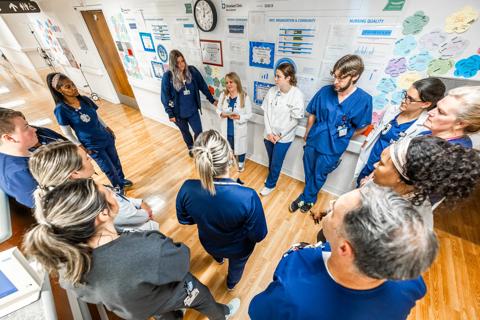
Guidance for creating a relevant framework that reflects organizational values, supports professional practice

Helping patients recognize respiratory changes, navigate treatment barriers and stay connected to their clinical team
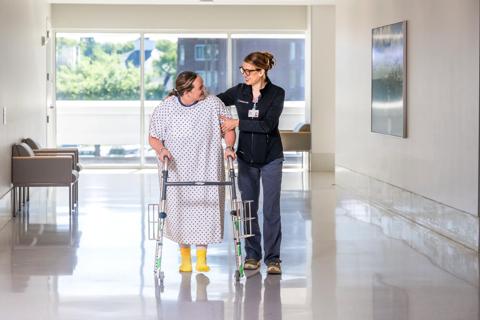
Initiative provides hands-on opportunities to promote early, progressive activity

Continuing to grow by following the right path at the right time

Teaching caregivers to recognize warning signs, de-escalate difficult situations and maintain professional boundaries

Veteran caregivers offer practical wisdom for building confidence and practicing with purpose
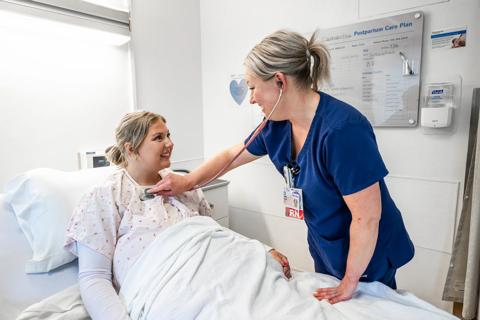
Skill, dedication and a passion for women and children inspire this joy-filled specialty
 Search