Locations:





Adequate dosing may improve outcomes in well-selected patients, large Cleveland Clinic series suggests
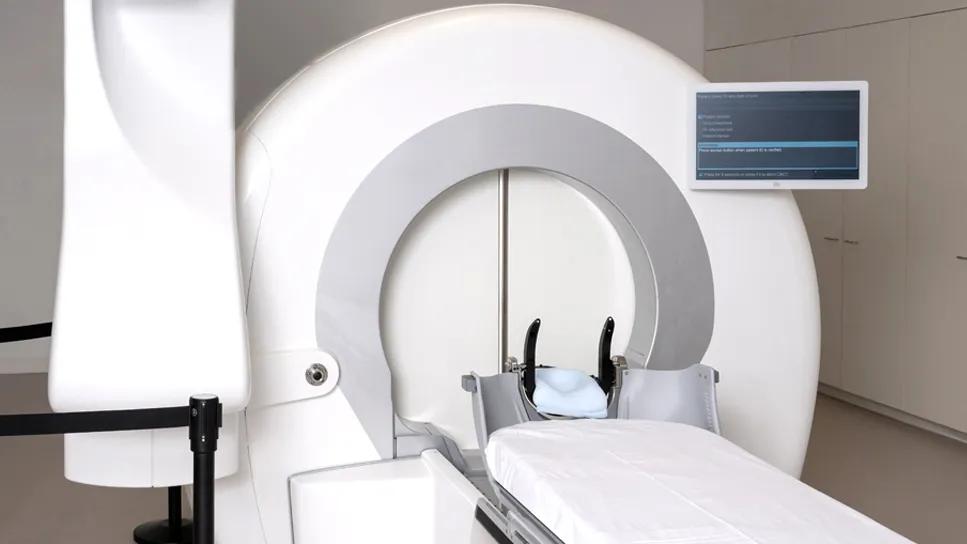
Image content: This image is available to view online.
View image online (https://assets.clevelandclinic.org/transform/133a23c3-fd1e-48f8-89e3-44c2b39fa2b1/gamma-knife-machine)
gamma knife machine
Stereotactic radiosurgery (SRS) is a safe and effective treatment for achieving local control in brain metastases from small cell lung cancer (SCLC), according to one of the largest single-institution studies of the modality in this setting to date. When possible, a prescription dose of at least 20 Gy or staged SRS to 30 Gy should be used to optimize local control, conclude the authors of the study, which was published in the American Journal of Clinical Oncology.
Advertisement
Cleveland Clinic is a non-profit academic medical center. Advertising on our site helps support our mission. We do not endorse non-Cleveland Clinic products or services. Policy
“These findings build on previous reports to support the growing shift toward focal therapy for brain metastases from small cell lung cancer,” says the study’s senior author, Samuel Chao, MD, staff radiation oncologist in Cleveland Clinic’s Rose Ella Burkhardt Brain Tumor and Neuro-Oncology Center. “Our study adds the insight that durable local control is possible with SRS even in a heavily pretreated population, as a full 85% of our patients had prior whole brain radiation therapy or prophylactic cranial irradiation.”
Thanks to its delivery of high-dose focal radiation, SRS is established as a standard treatment for brain metastases from non-small cell lung cancer, providing excellent local control while sparing healthy brain tissue. For SCLC, in contrast, whole brain radiation therapy (WBRT) or prophylactic cranial irradiation (PCI) have traditionally been favored over SRS, due in part to concerns about diffuse intracranial failure risk.
However, recent retrospective studies have indicated that SRS can achieve rates of local control in brain metastases from SCLC similar to those in other histologies. “This recent evidence has challenged the belief that WBRT is required in all patients with brain metastases from SCLC, prompting our group to review the Cleveland Clinic experience on this question, with a particular focus on patterns of local failure and the effect of radiation dose,” Dr. Chao explains.
Dr. Chao and colleagues retrospectively reviewed all patients with brain metastases from primary SCLC treated with SRS (delivered using Gamma Knife® technology) from 2002 to 2025. They identified 135 patients with a total of 429 SRS-treated brain metastases. Key details of this cohort included the following:
Advertisement
Patients’ overall treatment profiles were as follows:
Additionally, 32 patients with 122 brain metastases (26% of the total) received concomitant systemic therapy (chemotherapy, immunotherapy or both) within two weeks of SRS.
The median prescription dose of SRS was 22 Gy (interquartile range, 20 to 24 Gy), with 344 brain metastases (80% of the total) receiving ≥ 20 Gy.
Key outcomes for the overall cohort were as follows:
Rates of one-year local control were 92% for brain metastases receiving ≥ 20 Gy and 87% for metastases receiving 30 Gy (staged) compared with only 68% for metastases receiving < 20 Gy.
On proportional hazards analysis, prescription dose ≥ 20 Gy or staged SRS to 30 Gy was associated with improved local control (P = .01), whereas prior PCI/WBRT and concurrent systemic therapy were not.
“Despite the fact that SCLC is a relatively radiosensitive malignancy, our findings reveal a clear dose-response relationship for SRS in this setting,” Dr. Chao observes. “This underscores the importance of adequate dosing for durable lesion control.”
Advertisement
The authors point out that brain metastases receiving less than 20 Gy were larger, on average, due to clinical limitations related to toxicity or closeness to critical anatomy. Notably, staged SRS delivering a total of 30 Gy overcame these constraints, achieving local control at rates close to those for lesions treated with ≥ 20 Gy delivered in a single fraction. “This shows that staged treatment can be a safe and effective approach for larger tumors and that large lesion size need not rule out adequate dosing to achieve local control,” Dr. Chao says.
In their study report, the researchers identify factors that tended to predict freedom from distant brain failure and overall survival, thereby helping inform patient selection for SRS:
“This latter finding supports SRS as a good first-line strategy in judiciously selected patients,” Dr. Chao says, adding that it’s essential to keep in mind that SRS also can clearly improve outcomes even in previously irradiated patients.
“Taken together with prior evidence, our findings suggest that SRS — when delivered at adequate doses — appears to offer the most value in patients with limited intracranial disease, a controlled extracranial disease burden and good performance status, whether it is used as first-line therapy or as salvage therapy,” Dr. Chao concludes.
Advertisement
Advertisement

An update on the technology from the busiest Gamma Knife center in the Americas

Radiation oncology department finds weekly plan of care meetings have multiple benefits

Daily five-fraction partial breast irradiation (PBI) shows similar acute and late toxicity as every other day PBI

Study offers a foundation for additional research to examine radiation and immune response
Number of stent layers correlates with worse outcomes
Study uses molecular and clinical stratification to help guide patient selection

Large retrospective study suggests DOACs are safe, effective alternative to low-molecular-weight heparin in complex patient population

Advances in genomics, spinal fluid analysis, wearable-based patient monitoring and more
 Search