Locations:





Research findings offer clues for improving disease outcomes in men
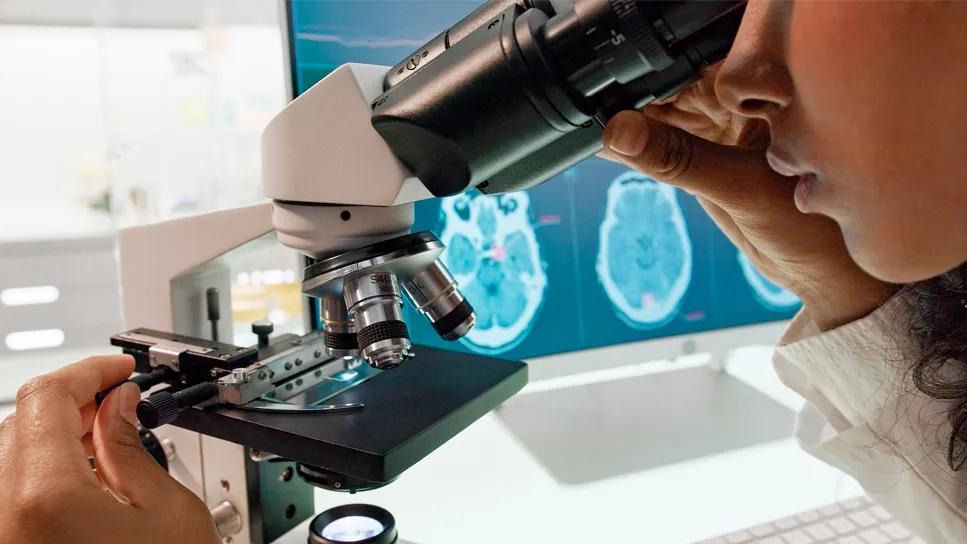
Image content: This image is available to view online.
View image online (https://assets.clevelandclinic.org/transform/25362bd9-fc39-43c6-b9a3-679e30388217/african-ethnicity-scientist-with-microscope-1275317121)
Researcher with microscope
Testosterone has long been known as a culprit for driving tumor growth, yet researchers now believe the opposite is true in glioblastoma and other brain tumors. Adding testosterone may actually curtail tumor growth.
Advertisement
Cleveland Clinic is a non-profit academic medical center. Advertising on our site helps support our mission. We do not endorse non-Cleveland Clinic products or services. Policy
The game-changing study findings were published in Nature.
Historically, men with glioblastoma tended to have more aggressive disease and poorer outcomes than women, but the reasons were unclear. Men experience progressive testosterone loss as they age, which may have an impact on cancer. The researchers sought to understand whether androgen loss such as testosterone impacted glioblastoma.
Limited experiments in preclinical models had shown that anti-androgens could kill tumor cells, but no one had investigated anti-androgens in the context of an intact immune system. The researcher team was the first to do so. “The systemic interaction between all the body’s systems need to be considered when we study any therapy or pathology of disease, especially in the brain because it’s not just one system that the brain is interacting with,” explains lead author Juyeun Lee, DVM, PhD, who is now Assistant Staff at Cleveland Clinic’s Florida Research & Innovation Center.
Using murine models, the researchers showed that androgen loss increases neuroinflammation, which elevates the HPA axis activation and increases glucocorticoids production. This results in immune suppression and poor tumor control in glioblastoma and metastatic brain tumor models.
“In many other systems, testosterone promotes tumor growth while suppressing the immune system,” says Dr. Lee. “But in our study, we saw the complete opposite. Removing testosterone actually accelerating tumor growth.”
When they removed testosterone by castration in murine models, they found faster tumor growth, which was quite unexpected. They replicated the models to confirm the findings, injecting exogenous testosterone to validate that the tumor activity was testosterone dependent.
Advertisement
“The team did a great job of repeating the experiments. They then used models putting the tumor not in the brain but in the flank and saw opposite results,” explains Justin Lathia, PhD, who oversees the Cleveland Clinic lab involved in the study. “The entire field of anti-androgen therapy and prostate cancer is based on the concept that when tumors are exposed to testosterone, they grow out of control. This work doesn’t discredit that. It shows that there are major differences in how the brain responds to cancer compared to the rest of the body.”
Building on their findings, the researchers conducted a retrospective analysis of a subset of patients from the Surveillance, Epidemiology and End Results (SEER) database to better understand the role testosterone played in cancer outcomes. A total of 1,333 men with glioblastoma underwent surgical resection and radiation therapy. The researchers discovered that the patients (N=61) who received supplemental testosterone and temozolomide had a statistically significantly longer survival (median survival of 16 months) to those patients (N=1,272) receiving temozolomide alone (who had a median survival of 12 months).
These findings have some in the medical community wondering if supplemental testosterone would benefit their male patients with glioblastoma. Drs. Lathia and Lee are now in discussions with their colleagues in neuro-oncology and endocrinology to potentially study this question in an early phase clinical trial. Additionally, they hope in the future to better understand the impact of testosterone on brain metastasis.
Advertisement
Advertisement
Advertisement

Adding 177Lu-PSMA-617 to ADT plus an ARPI cut the risk of radiographic progression or mortality by 28%

New program will help patients improve fitness and manage weight after cancer treatment

Cleveland Clinic hematologist highlights new guidelines and treatment advances in immune thrombocytopenia
NIMBLE replaces weekly tumor board delays with same-day multidisciplinary recommendations
Cleveland Clinic study provides validation for the test, which combines AI and pathological data to predict outcomes in postoperative patients
Advanced imaging technology catches metastases much earlier, allowing treatment with fewer side effects

Reduced radiation for lymph node areas reduces side effects

Large Cleveland Clinic analysis may help resolve a longstanding question over optimal fractionation
 Search