Locations:





Foundation model reveals latent risk structures in sleep physiology that elude conventional metrics
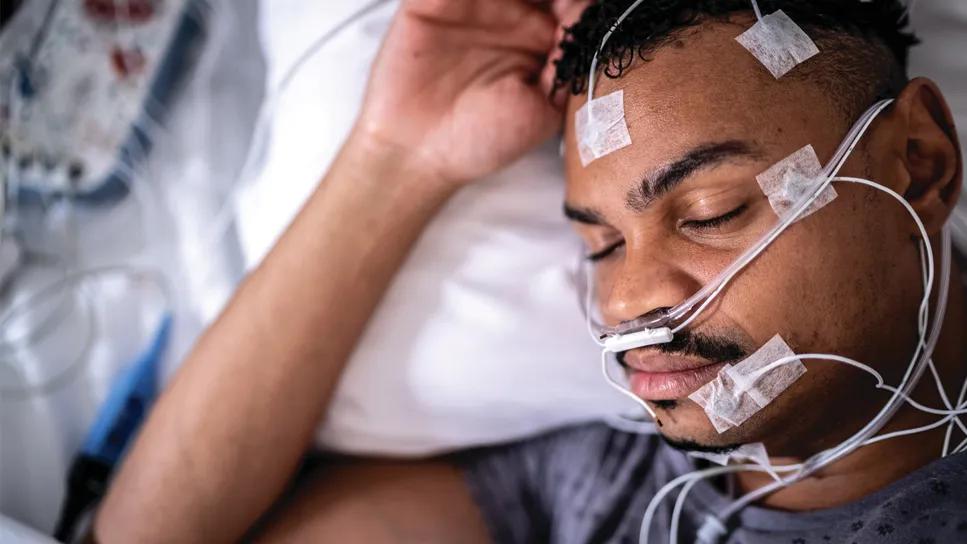
Image content: This image is available to view online.
View image online (https://assets.clevelandclinic.org/transform/91fb291f-d3ba-414b-93cf-c9c3ea68a86e/black-male-polysomnography-1361394326)
Man with polysomnography electrodes attached to his head
A multidisciplinary research team has developed a foundation model for sleep health that captures complex physiologic signals and extracts prognostic biomarkers that stratify risk for cardiovascular and neurologic disease and survival. The researchers, including Cleveland Clinic physicians and scientists, recently published study findings in Nature Communications validating the generalizability of the framework and providing what they describe as “a scalable path toward precision sleep medicine.”
Advertisement
Cleveland Clinic is a non-profit academic medical center. Advertising on our site helps support our mission. We do not endorse non-Cleveland Clinic products or services. Policy
“More than 70 million Americans live with chronic disorders of sleep and wakefulness, and these conditions impact overall health,” says study co-author Matheus Lima Diniz Araujo, PhD, a computer scientist with Cleveland Clinic’s Sleep Disorders Center. “This discovery potentially expands the value of routine sleep testing and reinforces the key role sleep plays in chronic disease.”
Clinical interpretation of polysomnography (PSG) — the gold-standard diagnostic test for sleep integrity — is typically limited to the apnea-hypopnea index (AHI). While the AHI is essential for diagnosing sleep apnea, it reflects only a narrow portion of sleep physiology. The goal of the research team was to apply the foundation model and tap into the full richness of PSG time-series data.
“During a PSG test, we collect eight hours of continuous information on brain activity, heart rate, breathing and airflow, movements and blood oxygen levels,” Dr. Araujo notes. “We wondered whether we could use that data to tell us more about patients, and if an artificial intelligence [AI] model could help us extract that information and go beyond sleep-related disorders.”
The foundation model was developed by sleep physicians, AI researchers, data scientists and neuroscientists assembled through the Discovery Accelerator, a 10-year joint research partnership between Cleveland Clinic and IBM aimed at advancing the pace of discovery in life sciences through AI and quantum computing.
The model leveraged 10,000 high-resolution PSG studies from the Cleveland Clinic STARLIT (Sleep Signals, Testing and Reports Linked to Patient Traits) Registry paired with electronic medical records spanning more than a decade to train a transformer-based model that produces high-dimensional embeddings of sleep physiology.
Advertisement
The researchers clustered the embeddings into five risk groups (RGs) ranging from RG1 and RG2, with minimal PSG abnormalities, to RG5, a high-risk group characterized by multiple comorbidities and PSG abnormalities consistent with severe sleep disruption.
Key study findings revealed:
These risk group-based findings were in contrast with findings based on AHI severity categories. “Patients of similar ages with the same average AHI were in different risk groups,” Dr. Araujo observes. “The AHI alone had limited prognostic utility, while the foundation model uncovered physiologic signatures with clear clinical implications using EEG data, ECG data and other information gathered during polysomnography.”
The findings were independently confirmed in a nationwide patient cohort.
The study highlights the ability of AI tools to enhance sleep studies, the investigators note.
“Technologists and physicians typically look at 30-second blocks of polysomnograms to identify patterns of data,” Dr. Araujo says. “But it’s hard for the human eye to find hidden patterns. An AI model can find these hidden patterns in data.”
He adds that the foundation model shows promise for clinical practice. “Approximately 30% of the population may develop sleep apnea and have their PSG data collected at a sleep center,” he says. “It would be great if they could come away with a comprehensive evaluation. Then, when we identify patients in higher-risk groups, we can refer them to the appropriate specialist — for instance, a cardiologist or a neurologist — rather than just diagnose them with sleep apnea.”
Advertisement
The next step, Dr. Araujo notes, is to validate the findings in heterogeneous populations and expand collaborations among medical and technical experts, industry partners and professional society stakeholders.
Advertisement
Advertisement

Nearly 80% of patients didn’t follow washout protocol, raising risk of misdiagnosis
For the first time, risk is shown after accounting for underlying contributions of pulmonary disease
Normal or inconsistent MSLT results should not rule out this debilitating disorder
Retrospective analysis finds “hypoxic and sleepy” subtype to confer greatest risk
Therapists and physicians collaborate to get medically stable patients moving

Designed for digitization, distance health, discovery and more

Combining customized care, research capabilities and flexibility for the future

Leading investigators outline a new roadmap for clinical trials and observational research
 Search