Locations:


Multidisciplinary, proactive approach also improved discharge outcomes
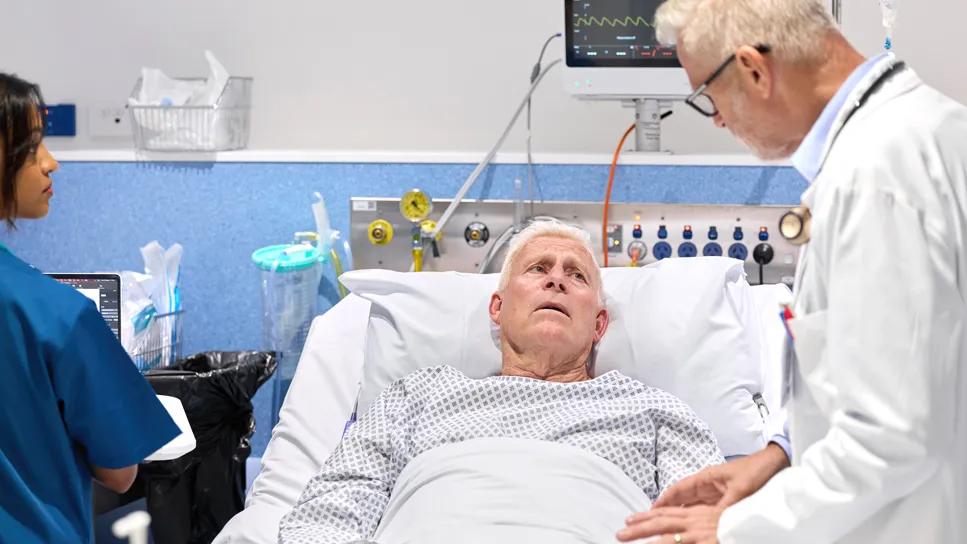
Image content: This image is available to view online.
View image online (https://assets.clevelandclinic.org/transform/f8b109b7-cda1-4589-8a97-8066a888923b/older-male-in-hospital-doctor-nurse-2206871282)
Doctor and hospital tech standing next to an older patient in a hospital bed
The number of people with Parkinson’s disease worldwide grew from 2.6 million to 6.3 million between 1990 and 2015, and cases are expected to continue rising exponentially. Research has shown that when hospitalized, these individuals have increased morbidity and mortality associated with medication-related deviations or errors.
Advertisement
Cleveland Clinic is a non-profit academic medical center. Advertising on our site helps support our mission. We do not endorse non-Cleveland Clinic products or services. Policy
To address that, Cleveland Clinic movement disorders specialists implemented a multifaceted program focused on putting Parkinson’s experts on the hospital floor, making Parkinson’s-specific updates to the electronic medical record (EMR) system, and providing specialized education to nursing and other staff.
Reductions in medication errors and improved discharge outcomes were observed among patients with Parkinson’s (PwP) after implementation. The program was funded by the Parkinson’s Foundation.
“Parkinson's is a fairly complex condition with complex medications,” explains Benjamin Walter, MD, MBA, Section Head of Movement Disorders at Cleveland Clinic. “These patients have worsening Parkinson's symptoms when they're ill, and they tend to have illness that brings them into the hospital, which then makes their Parkinson's symptoms worse.”
The team conducted a quality improvement study that compared medication error rates and related outcomes before and after the new protocols, which were introduced gradually over the 2023 calendar year. Results were published recently in Annals of Neurology.
From January to June 2024, 366 post-implementation admissions were monitored and compared to a 2018 pre-implementation cohort identified through medical records.
The findings:
Advertisement
Additionally, the number of PwPs discharged to non-home settings dropped from 44.8% to 38.3%. Discharges to skilled nursing facilities are associated with poorer outcomes.
The reductions in medication-related deviations are a positive outcome, but Dr. Walter notes that the goal cannot be to eliminate them altogether.
“We tend to talk about medication ‘deviations’ rather than errors,” he says. “There are instances when patients can't take meds by mouth and there's not an immediate alternative to their levodopa. For short periods of time, they might have to be off their medications or on a different schedule. So we don’t really want deviations to go to zero.”
Medication becomes an issue with Parkinson’s inpatients because alterations to timing and dosing can have a significant effect on symptom control, and the formulations can be confusing to caregivers unfamiliar with Parkinson’s care.
“The meds are very complicated. They're multiple times per day,” says Dr. Walter. “Levodopa has a half-life of 90 minutes. It doesn't last very long. We have lots of different approaches and formulations to try to give patients more steady levodopa or dopaminergic stimulation throughout the day, but when that timing is off, it's like cutting off their oxygen. They don't do well.”
Levodopa overdosing can cause psychosis, low blood pressure and dyskinesia. Inappropriately reduced medication can cause dysphagia, which can lead to aspirating.
“On top of that, when well-intending providers see a patient with Parkinson's who's not doing well in the hospital simply because they're sick, the natural inclination is to think it must be their Parkinson's, and they increase their meds,” says Dr. Walter. “But if they have a urinary tract infection and you increase their meds, they don't tolerate that overmedication very well either, and they still have the infection. This program helps guard against those errors.”
Advertisement
The program advances work begun in 2023, when the researchers developed a model to accurately capture data across many patients with different medication schedules. They looked at time-sensitive levodopa-containing medications and the average interval that patients were on during the day.
“We showed that about 43% of hospital days had a levodopa dose deviation, and patients had a contraindicated medication in about 10% of hospitalizations,” says Dr. Walter. “That’s not a poor performance, but there is lots of opportunity for improvement.”
For this study, the team implemented an inpatient Parkinson’s program built modifications to the electronic health record, establishment of a dedicated inpatient team, and focused education for residents and inpatient staff.
“People have tried to do this before, and there are studies that showed different aspects of improvement, but not really the kind of improvement that we're seeing here,” says Dr. Walter. “We took a multifaceted approach because we wanted to develop a program that worked, and we wanted to show that it worked.”
Electronic record. The team developed a live census to identify all patients with Parkinson’s disease. They also identified problems in the classification of drug-disease interaction alerts for Parkinson’s disease in Epic, which relies on a third-party medication knowledge base. After correcting these classifications in their local system, the team successfully petitioned the data vendor to revise its classifications, improving safety for people with Parkinson’s worldwide. Because medication delays can cause significant worsening of symptoms, levodopa preparations were also reclassified as time-critical, and the EHR was configured to flag any dose not administered within 15 minutes of its scheduled time.
Advertisement
The inpatient team. A multidisciplinary team — including clinicians specializing in movement disorders, a speech-language pathologist and a pharmacist — monitored all PwP admissions at two Cleveland Clinic hospitals.
“We found a way to bring our team into the hospital on a regular basis, where we proactively screened the charts of everybody who got admitted with Parkinson's,” says Dr. Walter. “We looked for errors and deviations, for patients who were suffering from Parkinson's-related symptoms, and we reached out to see if we could assist if the teams needed help getting those patients on track.”
Education for residents and staff. The team delivered educational sessions and materials to the nursing staff and residents.
While the goal of this work was to effect quality improvements for patients at Cleveland Clinic and demonstrate what might be done at other institutions, EHR tools have now been integrated into Epic Turbocharger, making them available to other institutions.
The work also has had national and international impact because the Cleveland Clinic researchers identified the effects of contraindications on Parkinson’s patients.
A third-party company supplies disease/drug contraindication lists fed into EHRs to help inform clinical teams, but the team noticed it wasn’t fine-tuned for Parkinson's, Dr. Walter says. “We petitioned the company to change that, and they did. So now that alert will be in medical records across the world that use that source.”
Further research includes a focus on managing dysphagia.
Advertisement
People with swallowing difficulties, especially those with Parkinson’s disease, are at high risk for aspiration and aspiration pneumonia, which can be fatal. In addition, most Parkinson’s medications must be taken by mouth. When swallowing ability is in question, medications are often held until screening and evaluation are completed. If those assessments are delayed, Dr. Walter says, patients may miss critical Parkinson’s medications.
“We've been implementing countermeasures to make sure that patients are identified early if they can't swallow, and to ensure the right expertise is brought in,” he says. “If they can swallow enough to take meds, we need to be sure that that's done. A well-intended pause can actually cause the problem that they’re trying to avoid.”
The team also hopes to geographically expand access to better care through technology.
“Small community hospitals may not have a neurologist, let alone a movement-disorders specialist,” Dr. Walter says. “So embedding these tools into the structure of the electronic health record, and providing that expertise through virtual means, can really help solve the problem.”
Advertisement

Designed for digitization, distance health, discovery and more
Combining customized care, research capabilities and flexibility for the future
Expanded bevy of dedicated ORs will feature customized designs, leading-edge technology, optimized workflows

Routine capture of standardized neuroperformance data may expand and refine investigations

Reimagining the outpatient neurological visit with routine capture of neuroperformance data

Advanced surgical suite in our soon-to-open facility promises to redefine care standards
Phase 3 STELLAR trial underscores role of molecular stratification in glioma care

A passionate specialist surveys the field’s past, present and future
 Search