Locations:





Expert shares insight on intrathecal baclofen pumps to treat spasticity
Image content: This image is available to view online.
View image online (https://assets.clevelandclinic.org/transform/b9ae96db-fa6d-4c57-94c0-7634bd344a45/painful-spine-2263270250)
Illustration of spine x-ray with radiating red light indicating pain
Each year, healthcare providers worldwide implant baclofen pumps in thousands of individuals to control severe spasticity. Francois Bethoux, MD, Chair of the Department of Physical Medicine and Rehabilitation at Cleveland Clinic, and his colleagues use the device to manage care for more than 200 patients.
Advertisement
Cleveland Clinic is a non-profit academic medical center. Advertising on our site helps support our mission. We do not endorse non-Cleveland Clinic products or services. Policy
“Baclofen pumps are not the first-line treatment for spasticity resulting from brain or spinal cord damage,” says Dr. Bethoux. “The indication for the baclofen pump is spasticity that is refractory to less invasive treatments. Either the standard treatments did not help, or the patient couldn’t tolerate them.”
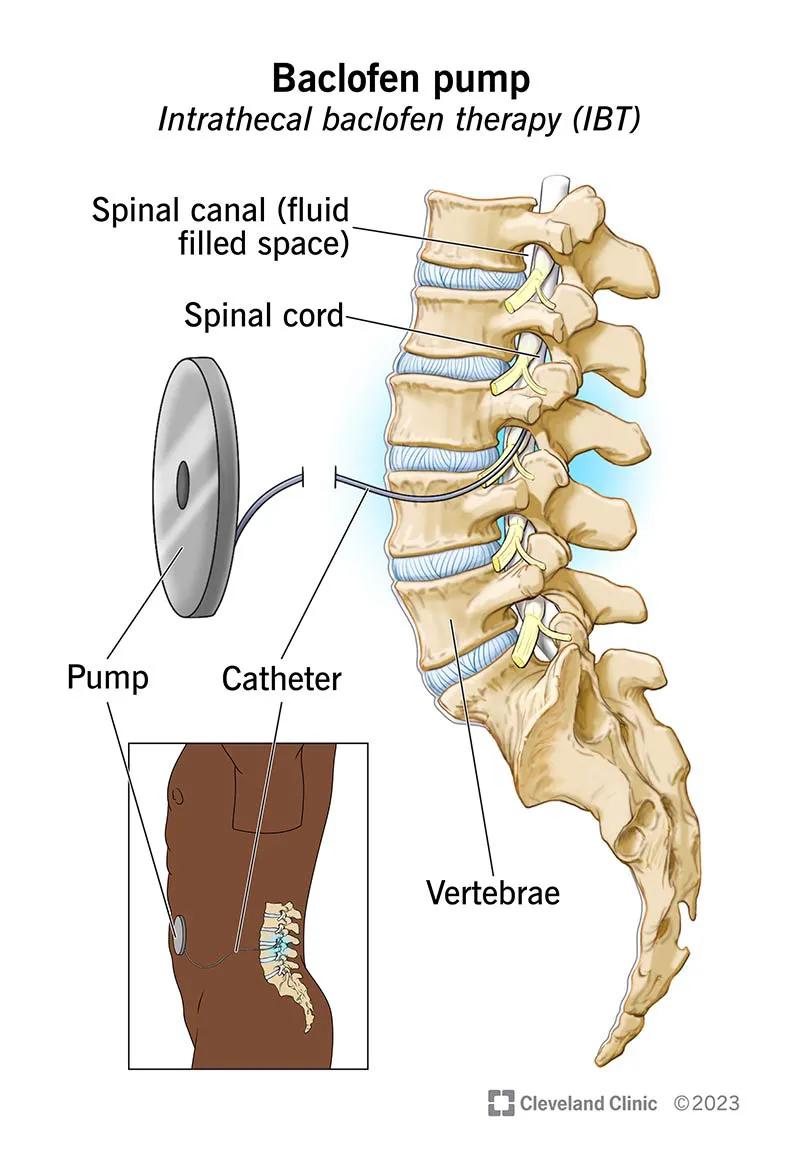
Image content: This image is available to view online.
View image online (https://assets.clevelandclinic.org/transform/bbb5b0e7-6418-41fe-baee-9321533e44d0/medical-illustration-baclofen-pump)
Intrathecal baclofen (ITB) pumps are implanted in the abdominal wall and connected to a catheter that is tunneled around to the lumbar area. The distal end of the catheter is then inserted into the spinal canal, where it continuously delivers baclofen to the central nervous system.
ITB therapy is indicated for a variety of diagnoses that can cause spasticity, including cerebral palsy, stroke, multiple sclerosis, traumatic brain injury and spinal cord injury. Dr. Bethoux estimates that less than 1% of people with spasticity are treated with ITB. First-line therapies include rehabilitation (particularly physical therapy and occupational therapy), oral medication (baclofen, tizanidine, dantrolene and benzodiazepines such as diazepam) and local injections (most commonly botulinum toxin and phenol).
“There are a range of treatments we can use, but if the spasticity is severe enough and other treatments have failed, then a baclofen pump may provide significant relief and help avoid complications from spasticity,” says Dr. Bethoux.
Risks associated with ITB therapy include surgical site infection, spinal fluid leakage, hematoma and pump or catheter malfunction, which can lead to baclofen withdrawal or overdose.
Advertisement
“As with most treatments, it’s a matter of balancing the risks and benefits,” says Dr. Bethoux. This is why a screening test is performed to assess whether a patient is a good candidate for a baclofen pump.
The test consists of a lumbar puncture and bolus injection of 25 to 100 micrograms of baclofen directly into the cerebrospinal fluid. After a few hours, providers assess the results and discuss the potential benefits and downsides of ITB therapy with the patient.
“The test doesn’t perfectly mimic what the pump will do, but it’s close enough that, based on the clinician’s experience, we can either recommend the pump or not,” says Dr. Bethoux.
Patients with ITB pumps often keep them for years – even the remainder of their lives, as spasticity is often permanent. In a 2026 longitudinal study published in the Journal of Neurosurgery: Spine, 22.4% of 281 patients who underwent intrathecal baclofen pump and catheter implantation experienced complications, including device malfunction.
“In our experience, the most common malfunction is with the catheter, and it could happen abruptly or gradually,” says Dr. Bethoux.
Abrupt malfunction places the patient at high risk for baclofen withdrawal, which requires inpatient management, sometimes in intensive care. When the malfunction is gradual, the loss of treatment efficacy causes adverse consequences but the management is mostly outpatient.
When there’s an abrupt or gradual worsening of spasticity, providers assess whether it is related to the patient’s underlying neurological condition, another factor that may increase spasticity (such as a urinary tract infection) or a device malfunction affecting the pump or the catheter. Catheter issues may include occlusions, tears with medication leakage, disconnection from the pump, migration out of the spinal canal and fractures.
Advertisement
If a patient’s spasticity gets worse, Dr. Bethoux and his team work through steps to rule out a possible device malfunction. They often begin by increasing the programmed dose in the pump. They also consider common causes of increased spasticity, such as urinary tract infections and any kind of stress on the body, which can be addressed.
“If we increase the dose several times and there is no benefit, and no other cause is found, then we start troubleshooting the pump and catheter,” says Dr. Bethoux. "We can also program the pump to deliver a bolus of medication, mimicking the initial screening test.”
Baclofen pump telemetry can reveal if the pump has stalled or if the battery is running low. Providers can also check how much medicine is left in the pump to determine if it is delivering the expected amount. In addition, they can order an x-ray to see if the pump and catheter are still in the correct position or if the catheter tip has moved out of the spine.
One of the ways Dr. Bethoux and his team check for catheter malfunctions is to place a needle in the catheter access port on the pump and withdraw cerebrospinal fluid. “If we can withdraw around 3 cc of spinal fluid without difficulty, then we conclude that the catheter is not occluded,” he says.
If none of these steps provides clear evidence of a problem and spasticity remains uncontrolled, then Dr. Bethoux may order imaging studies, such as an injection of dye into the catheter (through the catheter access port) coupled with x-rays or a CT scan, or an outpatient isotope test with SPECT imaging. For the isotope study, a small amount of radioactive material is injected into the pump, where it mixes with the medication.
Advertisement
“The isotope test, performed by our colleagues in Nuclear Medicine, provides a great way to see how the medication flows under the usual low pressure and low flow conditions,” he says. “You may see the isotope tracker leaking out of the catheter or traveling to a certain point and stopping. If all goes well, you see the tracker go into the spinal fluid and eventually get reabsorbed by the body.”
The physical medicine and rehabilitation team orders an isotope analysis for approximately 10% of patients with baclofen pump issues – about five or six a year. Dr. Bethoux recalls one patient who went to the Emergency Department complaining of episodic bouts of baclofen withdrawal followed by improvement of spasticity.
“That was very puzzling. Once a patient experiences baclofen withdrawal, spasticity typically remains worse until something is done to address the cause of the problem,” says Dr. Bethoux.
Early troubleshooting didn’t reveal any issues. Then the patient mentioned they had a spinal fluid leak years ago, and a surgeon placed a lumbar peritoneal shunt to drain excess spinal fluid into the abdomen.
“When we did the nuclear imaging study, we found out that the pump and catheter worked perfectly but most of the medication was siphoned into the shunt and washed into the abdomen,” says Dr. Bethoux. “Because the flow varied in the shunt, sometimes it caused a problem and sometimes it didn’t.”
A surgeon performed a ligature of the lumbar peritoneal shunt to address the problem. “Since then, the patient has been able to control their spasticity with much less medication and hasn’t had any withdrawal episodes,” says Dr. Bethoux.
Advertisement
“Because of the complexity of the nervous system, we don’t want to just assume the device is malfunctioning and perform a surgery to replace the pump and catheter,” says Dr. Bethoux. “We want to localize where the problem is before the surgeon goes in, then they know exactly what to fix.”
This patient story highlights the need to follow the steps of a troubleshooting algorithm, and to seek a nuclear medicine study when the more common troubleshooting procedures fail to identify the problem.
Advertisement

Therapists and physicians collaborate to get medically stable patients moving

Designed for digitization, distance health, discovery and more

Combining customized care, research capabilities and flexibility for the future

Leading investigators outline a new roadmap for clinical trials and observational research

The selective D1/D5 dopamine agonist provides symptom relief and improves daily function.
5-year funding award supports cohort expansion and deep phenotyping of AD and related dementias

Highest response rates seen with stress-lowering techniques like yoga, meditation and mindfulness
Digital subtraction myelography unveils often-overlooked but highly treatable underlying defect
 Search