Locations:





Helping clinicians manage cancer treatment in patients with complex biology
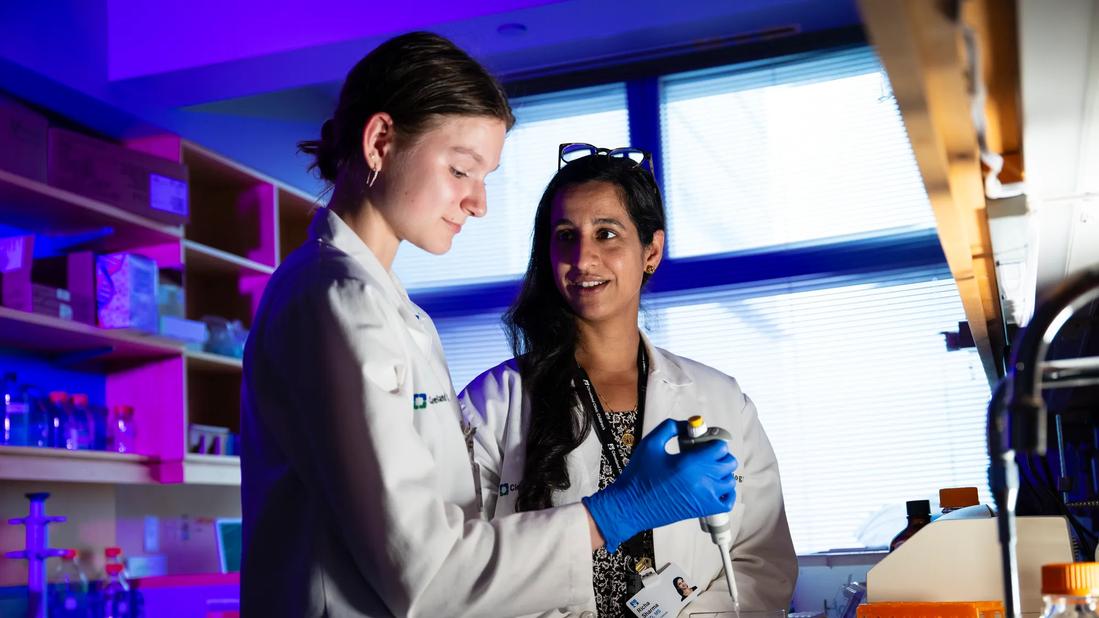
Image content: This image is available to view online.
View image online (https://assets.clevelandclinic.org/transform/ddeca6df-9f96-4022-a9f7-8046d2ba5061/LRI_6610608_07-16-25_052_DG)
Dr. Sharma speaks with colleague in the lab
A new national tumor board aims to support clinicians caring for patients with DNA repair and telomere biology disorders (TBDs). Though pathologically and phenotypically different, these disorders both significantly increase a person’s risk of developing cancer during their lifetime.
Advertisement
Cleveland Clinic is a non-profit academic medical center. Advertising on our site helps support our mission. We do not endorse non-Cleveland Clinic products or services. Policy
With no clear cancer treatment guidelines, managing these germline disorders—many contraindicated for traditional cancer therapies—can raise plenty of questions for oncologists. Or if undiagnosed, patients may respond to treatment with unexplained hypersensitivity.
“It can be difficult to treat these patients with really complex biology. Our job is to be a resource for clinicians by describing these unique manifestations and how they can affect cancer treatment and outcomes,” says pediatric hematologist/oncologist Richa Sharma, MD, the Cleveland Clinic physician leading the initiative.
Dr. Sharma is one of the few physicians worldwide investigating DNA repair disorders and TBDs. She is consulted by peers nationally and internationally about patients with these conditions and has made significant contributions to the field. Such discoveries include elucidating disease-causing mechanisms in TBDs, identifying causative genes in inherited bone marrow failure and osteosarcoma, and comprehensively reviewing the pathobiology and clinical manifestations of DNA repair disorders. In addition, she also characterized cancer outcomes in a large cohort of patients with ataxia telangiectasia (A-T), a classic DNA repair disorder, and more.
DNA repair disorders are characterized by severe dysfunction or absence of proteins encoded by genes that repair DNA damage and ensure genome stability. With over a dozen DNA repair disorders defined, clinical manifestations and cancer spectrums can vary considerably. Common DNA repair disorders include Fanconi anemia, A-T and Bloom syndrome.
Advertisement
“Fanconi anemia, as an example, commonly manifests in early childhood as bone marrow failure. These patients may later develop acute myeloid leukemia [AML], myelodysplastic syndromes [MDS] and solid cancers,” notes Dr. Sharma.
The clinical hallmark of A-T is completely different. “These patients usually present in childhood with neurological deterioration and ataxia and immunodeficiency. They have a higher risk for developing hematologic malignancies, most notably lymphoma, but can also develop solid tumors in early adulthood,” she says.
TBDs, caused by abnormal telomere shortening, typically present as bone marrow failure in young children. However, some patients will not experience this, and instead will develop pulmonary and liver fibrosis, immunodeficiency and other complications. “It’s a disease that spans the age spectrum,” says Dr. Sharma, “and predisposition to AML/MDS and solid tumors is commonly observed in adulthood.”
Dr. Sharma says it is difficult to claim expertise of rare disorders with multisystemic clinical manifestations. “You can be highly interested; you can provide care for many of these patients. But with so many unique disorders, situations and organ involvement, you must care for these patients within a multidisciplinary community.”
The tumor board will meet monthly on Thursday from 4-5 p.m. EST to discuss cases submitted at least a week prior. Dr. Sharma says participants can expect a panel of collaborators, clinicians and scientists across disease disciplines who will join the call to provide insight regarding cancer management.
Advertisement
She also works closely with TBD and A-T disease advocacy groups and existing tumor boards associated with some of the disease subgroups. She adds that the goal of her tumor board is not to be duplicitous but highly collaborative so that these complex patients get the best care possible.
“It’s a learning opportunity for all of us, but in my experience, I've found it incredibly helpful when someone says, ‘Yes, I have seen someone with this rare disorder and a related cancer and these were the outcomes and some things to expect,’” concludes Dr. Sharma. She welcomes any providers who are interested in presenting a difficult case or joining the tumor board to give insight and learn more.
For more information about submitting cases and participating in the tumor board, visit Cleveland Clinic’s Solid Tumor Program.
Advertisement
Advertisement
Despite safety concerns and mixed trial results, experts see potential for this indication
Introducing Prajwal Rajappa, MD, MS, Director of Pediatric Precision Oncology

How life experience, storytelling and a passion for service sparked a midlife nursing career

Key themes and insights into the family-caregiver experience
Pediatric specialists unpack new evidence, considerations for care and what’s ahead
What’s coming up at ASH and beyond
A preview for radiation oncologists
Nurses find unique challenges, profound rewards when managing children with cancer
 Search