Locations:





 Search
First U.S. implant at Cleveland Clinic signals another key shift away from transvenous leads
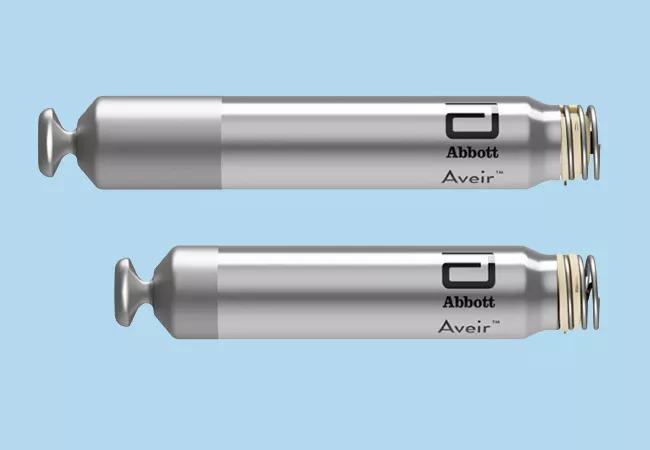
Image content: This image is available to view online.
View image online (https://assets.clevelandclinic.org/transform/f70f85dd-bafa-4f36-ba1a-8d9855083f75/22-HVI-2828108_dual-chamber-leadless-pacemaker_650x450_jpg)
22-HVI-2828108_dual-chamber-leadless-pacemaker_650x450
After seven years in development, the world’s first dual-chamber leadless pacemaker system — Abbott’s Aveir™ DR — is undergoing evaluation in an international clinical trial.
Advertisement
Cleveland Clinic is a non-profit academic medical center. Advertising on our site helps support our mission. We do not endorse non-Cleveland Clinic products or services. Policy
As part of that testing, Daniel Cantillon, MD, implanted the first device in a patient in the United States on March 1.
“Placing two leadless pacemakers in a heart is a significant technical achievement that has never been done before,” says Dr. Cantillon, Associate Section Head and Research Director of Cardiac Electrophysiology and Pacing at Cleveland Clinic and co-leader of the Aveir DR i2i Study. “There is enormous enthusiasm for this technology.”
The start of this trial brought Dr. Cantillon one step closer to helping to realize a dream nurtured since his fellowship days: eliminating complications caused by surgical pacemaker pockets and transvenous leads, which affect up to one in six patients by three years after implantation.
“Cleveland Clinic is a major referral center for lead extraction, and we saw horrendous infections, fractured leads and venous occlusive disease,” he says.
The Aveir DR system builds on earlier successes with a self-contained single-chamber leadless pacemaker first implanted in the U.S. in 2014 and the first leadless pacemaker-defibrillator combination, which entered clinical trials in December 2021. Dr. Cantillon and Cleveland Clinic colleagues played key roles in initial U.S. testing of those technologies, as detailed in prior Consult QD articles here and here.
The subcutaneous defibrillator that corresponds with an implanted pacemaker was an achievement Dr. Cantillon calls “extraordinary.” However, he finds the percutaneously implanted dual-chamber leadless pacemaker even more exciting.
Advertisement
“Patients who have not been well served by transvenous leads have been waiting for this type of technology,” he says.
The two components of the dual-chamber system are implanted via a catheter inserted in the femoral artery through the groin. One pacemaker is placed in the right atrium, the other in the right ventricle. They communicate beat by beat to regulate the heart rate.
According to Dr. Cantillon, there will be a learning curve for new operators. “From our experience with the single-chamber leadless pacemaker, we figure it will take 10 implantations to become proficient,” he says.
In particular, there are two aspects of the procedure that require special attention.
The first is the light hand required when attaching the pacemaker to the right atrium with its helix cinching device. “Because atrial walls are thinner than ventricle walls, great care must be taken to avoid causing a perforation or tear,” he explains.
Additionally, the two pacemakers must be positioned correctly for direct communication — “eye to eye,” as he puts it — before they are released from the catheter. This is what allows the two devices to work together to achieve synchronous contraction between the upper and lower chambers of the heart, an essential feature for a dual-chamber pacemaker system.
One distinct advantage to the Aveir DR system is that it was built for long-term retrievability and replacement. Each pacemaker contains a docking button that will facilitate retrieval and replacement down the road.
Advertisement
The Aveir DR i2i Study will enroll 550 patients worldwide. Although there is no enrollment target for each of the 80 participating centers, Dr. Cantillon expects the trial to be quickly filled.
“Interest is high because the wireless system is appropriate for the lion’s share of patients needing a dual-chamber pacemaker, including those with sinus node dysfunction,” he says. “No other dual-chamber leadless pacemaker is in or nearing clinical trials.”
Additionally, any patient who qualifies for a traditional dual-chamber pacemaker may choose to enroll in this trial, so long as all existing leads and fragments can be removed prior to implanting the study device.
“We have offered enrollment to patients who have already experienced problems such as clots, broken leads and venous occlusive disease, as well as to those who want to preempt such problems,” says Dr. Cantillon.
Eventual approval of the dual-chamber leadless pacemaker would allow the vast majority of patients who require pacing to have a wireless option.
“There’s still some work to be done to completely replace transvenous leads in patients requiring biventricular pacing and conduction system pacing,” Dr. Cantillon notes. “However, the dual-chamber leadless pacemaker is a major stepping stone.”
His colleagues agree. “The Aveir dual-chamber technology, with the ability for wireless communication between units, is a significant development for leadless pacemakers,” says Cleveland Clinic electrophysiologist Niraj Varma, MD, PhD, who recently joined the care team at Cleveland Clinic London. “For the first time, pacing therapy can be synchronized across separate chambers of the heart independently of wired connections. The potential impact on patient morbidity is tremendous, since dual-chamber pacemakers are the predominant form of CIEDs implanted in the United States.”
Advertisement
“This achievement represents a major advancement for our field, and a crucial milestone in the development of pacemakers,” adds Oussama Wazni, MD, Section Head of Cardiac Electrophysiology and Pacing at Cleveland Clinic.
Dr. Cantillon, a co-principal investigator of the Aveir DR i2i Study, reports financial interests in Abbott associated with speaking, consulting and service on scientific advisory boards.
Image at top courtesy of Abbott. The Aveir™ DR dual-chamber leadless pacemaker is an investigational device limited by federal (U.S.) law and medical device regulation for investigational use only.
Advertisement
Advertisement
Practical takeaways for the reality of overlapping cardiovascular, kidney and metabolic disease
First prospective study shows early extubation and low vasoactive/inotropic medication use
Height-indexed aortic measurements may better identify risk than diameter alone
Insights from an expert cardiologist and a transplant surgeon
Findings promise to shape future antiplatelet drug development and treatment strategies
How and why we're offering robot-assisted options for a full array of cardiac operations
Insights on common questions from referring providers
A snapshot of key stats from one of the world's busiest centers