Locations:





Collaboration with AI startup promises to reshape neurocritical care monitoring at scale
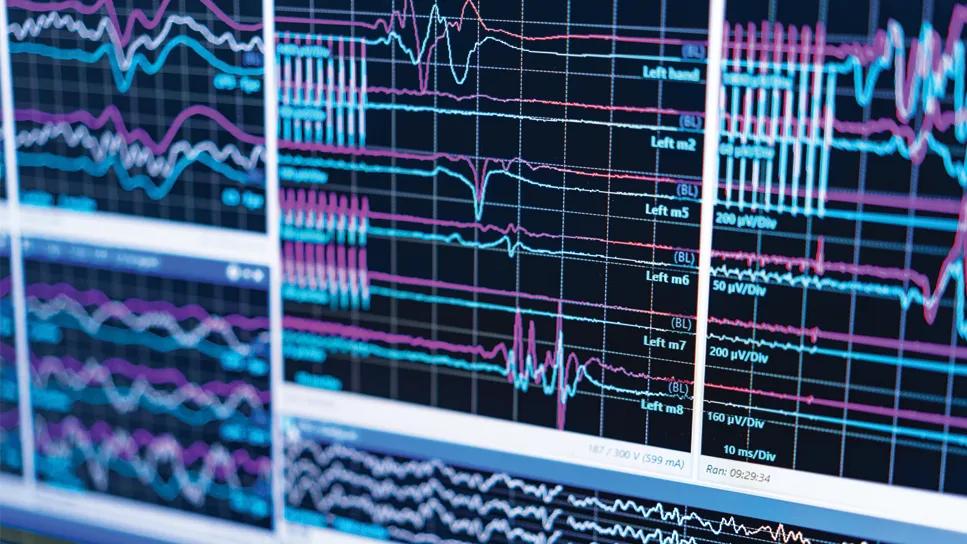
Image content: This image is available to view online.
View image online (https://assets.clevelandclinic.org/transform/6895a7aa-5ab3-41a3-8e0e-d47bb83e6207/eeg-monitoring-ai-large-scale)
screen showing EEG tracings from multiple patients
In the complex environment of the neurological intensive care unit (ICU), the ability to detect and respond to subclinical seizures and subtle neurological shifts is a cornerstone of critical care. However, the current gold standard — continuous EEG — is often hampered by significant logistical bottlenecks, including a reliance on manual, episodic EEG review and a global shortage of specialized readers for live monitoring of the recordings. To address these challenges, Cleveland Clinic is collaborating with Piramidal, a neurotech-focused artificial intelligence (AI) startup, to implement a foundational AI model designed to provide live, scalable and objective EEG interpretation for inpatient settings.
Advertisement
Cleveland Clinic is a non-profit academic medical center. Advertising on our site helps support our mission. We do not endorse non-Cleveland Clinic products or services. Policy
The initiative — led by Cleveland Clinic Epilepsy Center Director Imad Najm, MD, and colleagues — aims to transform EEG from a retrospective reporting tool into a proactive, real-time clinical assistant. “This serves as a proof of concept that using AI models will scale and create objectivity in live EEG monitoring, reading and interpretation,” Dr. Najm says.
The demand for bedside EEG monitoring has surged as clinicians have recognized its utility in diagnosing critical illness and guiding treatment decisions. However, the process is labor-intensive and difficult to scale, as an experienced technologist may spend up to two hours reviewing a 24-hour EEG recording, after which a physician takes roughly 15 minutes to finalize the report.
Additionally, current monitoring is rarely done in real time. Although data are recorded continuously, EEGs are typically reviewed by physicians and technologists in blocks every one to two hours. This delay can be critical in an ICU setting where seizure burden and duration directly impact neurological outcomes. “It is very costly, it is not scalable and interpretation can be very subjective,” Dr. Najm notes.
The collaboration with Piramidal leverages the company’s AI model trained to analyze EEG brainwave data and interpret neural signals broadly across diverse populations. Unlike AI systems that may be limited by specific hardware, this platform is vendor-agnostic, ingesting and translating data from various EEG machine manufacturers into a universal format for analysis.
Advertisement
The technology is designed to read 24 hours’ worth of EEG data in seconds. Beyond speed, the model provides a level of granular quantification that is difficult and time consuming to achieve manually, such as calculating the exact seizure burden (total minutes of seizure activity over a 24-hour period) and the precise timing of each event.
The algorithm was trained on a broad base of publicly available EEG data, fine-tuned on highly curated Cleveland Clinic EEG data, then tested and validated in a recent Cleveland Clinic pilot study. Leading up to the pilot, a team of three senior EEG readers and three expert physicians meticulously annotated thousands of hours of Cleveland Clinic EEG data. This team provided a consensus on seizure onset, timing and localization (e.g., left, right, frontal, generalized) as well as interictal epileptic activity type.
In the pilot study, performed retrospectively on past recordings, the system demonstrated approximately 90% sensitivity and 90% specificity for seizure detection and lateralization. Specifically, nine of 10 seizures were correctly identified by the algorithm, and nine of 10 events flagged by the algorithm as seizures were true positives, with only 10% being false positives triggered by patterns mimicking ictal activity.
The system is not limited to seizure detection and categorization. It also includes the ability to quantify seizure burden and to flag high-value clinical patterns relevant to the ICU setting, such as:
Advertisement
Dr. Najm notes that validation of the model’s performance for nonseizure patterns such as PLEDs and triphasic waves is ongoing and that the 90% figures at this stage apply specifically to seizure detection and localization/lateralization.
The ultimate goal of this technology is to move toward an EEG central monitoring unit model. Dr. Najm envisions a centralized hub featuring a massive 98-inch primary monitor surrounded by smaller displays connected to hundreds of monitored beds across the health system. In this “center stage” workflow, the AI software continuously monitors all patients. When the system detects a seizure or a significant pattern change during a recording, that patient’s EEG data is automatically pushed to the large central screen. This allows the monitoring technologist to focus their attention where it is needed most, enabling them to confirm or reclassify the finding in a timely way and decide whether to alert the treating team.
The model also generates graphical summary reports to display seizure frequency, timing and burden over any programmable time window, such as 10 hours, 24 hours or longer. Individual events are plotted as interactive markers that, when selected, link directly to the corresponding raw EEG tracing for physician review. As a result, EEG review that currently takes two to three hours of reader time is projected to take approximately 10 to 15 minutes. “The roles of our clinicians will shift from primary analysis to verification and final interpretation,” Dr. Najm observes.
Advertisement
As the platform nears FDA approval — expected within the coming months with support from data from the Cleveland Clinic pilot — Cleveland Clinic’s epilepsy team prepares for its use in actual clinical practice.
The centralized hub for large-scale EEG monitoring will be permanently housed in Cleveland Clinic’s new state-of-the-art Neurological Institute building on its Main Campus, set to open in early 2027. Additionally, every inpatient bed in the new building outside the epilepsy monitoring unit will be equipped to enable this AI-supported EEG monitoring if needed for a given patient. Thanks to existing interconnectivity across the Cleveland Clinic health system, these monitoring capabilities will be used for appropriate inpatients regardless of which hospital they are in.
While the current focus is on the ICU — where the primary clinical question is often a binary “seizure or no seizure?” determination — future applications will likely extend to the epilepsy monitoring unit, where deployment is more complex, requiring deeper localization and semiology analysis to guide management decisions.
Looking further ahead, Dr. Najm foresees a comprehensive “AI toolbox” for epilepsy management that will integrate EEG data with seizure semiology, neuroimaging, genetics and longitudinal outcome data to provide a comprehensive, highly validated platform for diagnosis, management and outcome prediction.
“This is the first baby step in a revolution in the way we manage patients,” Dr. Najm concludes. “Ultimately, any patient anywhere in the world may be able to get the same quality of objective, responsive neurological care through the use of these tools at scale.”
Advertisement
Advertisement
Where the field is moving and what Cleveland Clinic has in the works
Multicenter study offers guidance on when to consider extended monitoring
How ongoing efforts will be bolstered by Cleveland Clinic’s new Neurological Institute building
CMR-CLIP outperforms general AI tools; may one day expand patient access to CMR
An ICU pharmacist explains the impact of delirium on ICU patients and why there is a need for more research and improved screening tools
Collaboration includes clinical validation of predictive modeling tool, development of second-generation tool

LLM-driven system uses both structured and unstructured data, provides auditable justifications

New study highlights the need for plain-language prompting and human oversight in addiction care communication
 Search