Locations:





Pilot program addresses extended wait times for evaluation
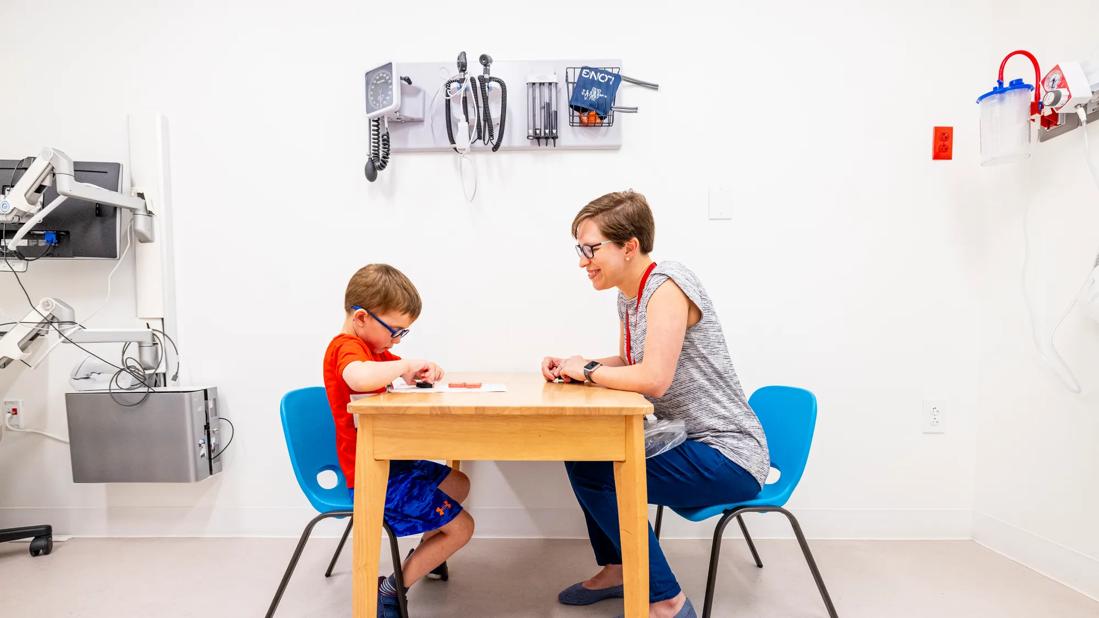
Image content: This image is available to view online.
View image online (https://assets.clevelandclinic.org/transform/114d7b83-41fe-4322-b954-20508fc93362/CHP_4959158_06-28-24_054_LDJ)
Clinician with child at table
Patient wait times are a problem nationally in developmental-behavioral pediatrics. Many children and families are waiting more than a year for a formal autism spectrum disorder (ASD) evaluation, delaying access to diagnosis and early intervention services.
Advertisement
Cleveland Clinic is a non-profit academic medical center. Advertising on our site helps support our mission. We do not endorse non-Cleveland Clinic products or services. Policy
The bottleneck reflects several factors, including a complex reimbursement structure, a shortage of specialists, and the intensive nature of ASD evaluations, explains Cleveland Clinic Children’s specialist Carrie Cuffman, MD. About 75% of the patients initially referred to her practice are seeking an autism evaluation.
For her, expediting their care is always top of mind. Dr. Cuffman and colleagues developed a new clinic model designed to offer a pathway for patients with clearer or higher-concern ASD features. They presented their initial experience at the 2025 American Academy of Pediatrics (AAP) Experience Conference.
The improved access approach involves collaboration with speech-language pathologists (SLPs) within Cleveland Clinic Children’s. The SLPs have completed formal Autism Diagnostic Observation Schedule (ADOS®-2) coursework and subsequent clinical training over six months. The ADOS-2 is a widely used standardized observational tool that can support a comprehensive ASD evaluation in children and adults.
Before the team implemented this model, patients had no contact with the SLP before their diagnosis. Now, they are integral to that process, completing the standard two-hour activity-based assessment.
“Instead of seeing a developmental pediatrician for three separate appointments, they see a developmental pediatrician for a medical and developmental history visit and a speech therapist for the ADOS-2 testing in the same morning,” explains Dr. Cuffman. “The developmental pediatrician then sees them for a follow-up about a week later to explain the evaluation results and provide recommendations.”
Advertisement
This change has freed up additional time for developmental-behavioral pediatric care. The team’s analysis found 16 hours of recovered availability with this new workflow. This time equates to time for 21.3 follow-up appointments or 3.8 ASD evaluations.
In a survey, both physicians and SLPs reported high satisfaction with the collaborative relationship, clinic structure, quality of communication in post-clinic conferences, and appropriateness of patients who were triaged to the clinic.
Sarah Rossi, MA, CCC-SLP, one of the program’s SLPs, emphasizes the educational benefits of the ADOS training.
“I highly recommend pursuing ADOS training if you are a therapist who has a strong interest in autism spectrum disorders, enjoys conducting evaluations and participating in the diagnostic process, and is passionate about serving children and their families,” Rossi says.
She adds that the training confers advantages beyond this program and is helpful for any clinician caring for children with suspected ASD or other developmental concerns. “This knowledge allows therapists to more effectively screen their own patients, recognize when additional evaluation may be warranted, and facilitate earlier referrals for diagnostic services,” she notes.
Rossi also says their approach has enabled some patients to receive an ASD diagnosis before entering preschool, ensuring families can begin necessary services earlier and better coordinate with their child’s educational teams as they transition into a school setting.
Advertisement
Although patient and family experience was not formally measured, the model may also improve convenience by allowing families to meet with both the physician and SLP on the same day for medical, developmental and speech-language components of the evaluation.
After families complete intake paperwork, the clinic coordinator screens the patient using the Autism Evaluation Clinic criteria, and the team works with the family to facilitate an early appointment. The inclusion criteria include:
According to Dr. Cuffman, institutions are developing a range of approaches to improve access to ASD evaluation, depending on local resources and care models.
“Sometimes it’s collaboration between a general pediatrician and developmental-behavioral pediatrician. Other practices make use of speech-language pathologists or psychologists as members of an interdisciplinary team to complete the autism evaluation,” she says. “There are a range of models across the country for how we can better use time and expand access.”
Another important consideration is state-to-state variability, largely driven by private and public insurance regulations, in what constitutes an ASD diagnosis. Many state Medicaid programs require a comprehensive, standardized assessment.
While the pilot program is fully implemented at Cleveland Clinic Stow-Falls, where the concept originated, the team is also replicating the model at the institution’s other developmental pediatric practice locations.
Advertisement
Katherine Myers, DO, MPH, a developmental-behavioral pediatrician, adds, “We are very proud of this initiative that Dr. Cuffman and Sarah Rossi have led as it continues to allow us to expand our services, particularly for younger children who can benefit the most,” she says.
“Ultimately, we look forward to the expansion of this program to maximize the number of children we are able to evaluate as a team, while continuing to provide quality autism assessments to our patients at Cleveland Clinic Children's and ongoing follow-up care to all of our patients,” says Dr. Myers.
An internal award, the Caregiver of the Future ASD Education Pediatric Therapy Services Grant, supported SLP training and the purchase of additional test kits.
Advertisement
Advertisement

Center for Autism to provide social, educational and skills-based program for families

Education for medical caregivers and families is part of the package
Cleveland Clinic Children’s Center for Autism offers comprehensive consultation services

Cleveland Clinic researchers receive $2 million grant from the National Institutes of Health

Realistic scenarios stress importance of soft skills

Early diagnosis, specialized assessment and high-frequency motor-based therapy can improve outcomes

Exploring the role of caregiver education and objective feedback on speech and language outcomes

What the discovery means for clinicians and patients
 Search