Locations:





Early diagnosis, specialized assessment and high-frequency motor-based therapy can improve outcomes

Image content: This image is available to view online.
View image online (https://assets.clevelandclinic.org/transform/8c8684d6-1dbe-4262-a5e0-6cae0c2b953b/childhood-apraxia-speech)
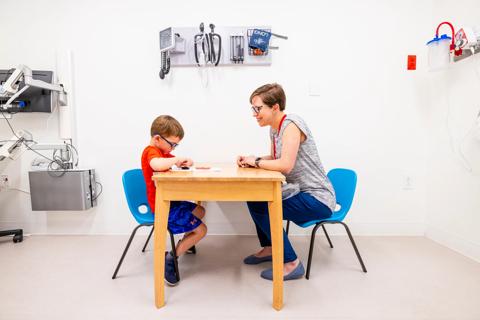
Child in speech therapy
Childhood apraxia of speech (CAS) is a motor speech disorder that can be mistaken for a general speech delay or other speech sound disorder. The distinction matters because treatment is very different. Of children with speech sound disorders, only about 4% have CAS. Experts at Cleveland Clinic Children’s say early diagnosis and referral to a speech-language therapist with specialized CAS training can significantly improve outcomes. The following case illustrates that potential.
Advertisement
Cleveland Clinic is a non-profit academic medical center. Advertising on our site helps support our mission. We do not endorse non-Cleveland Clinic products or services. Policy
A young patient, age 2 years, 8 months, was first seen at Cleveland Clinic Children’s Therapy Services in September 2024 for expressive language delay and to begin specialized CAS treatment. At the time, she had fewer than 50 words, limited intelligibility, a small consonant and vowel inventory, and difficulty combining sounds.
In the weeks that followed, Kelley Heine, a Cleveland Clinic Children’s speech-language therapist, increased the child’s treatment frequency to at least two visits a week. Over the next six months, the patient participated in a speech-intensive program at Cleveland Clinic Children's Therapy Services, Middleburg Heights and attended up to four visits weekly, in addition to a routine weekly visit with a speech center closer to the family’s home.
Heine developed a treatment plan focused on a small set of target words and functional phrases. She also implemented treatment principles from Dynamic Temporal and Tactile Cueing (DTTC), a motor speech-based approach to treating CAS.
By spring 2025, the child was re-evaluated for CAS and no longer met criteria for the diagnosis. Over the next six months, Heine’s treatment focused on phonological processes while still addressing some residual prosodic errors. Visit frequency decreased from twice weekly to once a week. The child was officially discharged in January of 2026 and continues to see a therapist closer to home to work on fluency and prosody.
Children with CAS have difficulty planning and producing speech movements, says Lisa Leonard, a speech-language therapist at Cleveland Clinic Children’s. “Children with CAS may have difficulty planning and coordinating the movements needed to produce speech. It may affect their ability to smoothly transition between sounds or syllables within a word,” explains Leonard.
Advertisement
These children may be able to produce sounds, but their speech is often difficult for families and others to understand beyond what would be expected for their age.
Leonard encourages pediatricians to become familiar with the common red flags associated with CAS that help differentiate this motor speech disorder from other speech sound disorders.
Inconsistent errors
Children with CAS often exhibit inconsistent and less predictable speech productions compared to children with other speech sound disorders. For example, a child with CAS may say the same word differently across repeated attempts, which can be confusing for caregivers.
“Caregivers of children with other speech sound disorders often learn to understand their child’s erred speech patterns, while caregivers of children with CAS may have more difficulty because of the inconsistencies in error patterns,” says Leonard.
She adds that they may have a few well-rehearsed “pop-out” words that are completely clear, such as “mom,” for example, but are not able to reproduce the “m” sound in a different context or in another word, such as “me.”
Disrupted coarticulatory movement between sounds or syllables
Children with CAS may experience difficulty moving from one sound to the next, which may result in a pause or space between sounds and syllables, Leonard explains. “In apraxia, the errors tend to increase as the length of utterance increases, whereas in other speech sound disorders, the errors tend to stay consistent regardless of the length of utterance.”
Advertisement
Lack of prosody
“Children with other speech sound disorders typically maintain the natural rhythm and melody of speech, while children with CAS often have difficulty with stress patterns, making their speech sound less natural,” says Leonard.
Speech-language therapists with specialized CAS training lead the assessment. In general, children must have prelinguistic communication skills, such as a basic understanding of imitation, to be evaluated. Leonard says diagnosing CAS involves evaluation of the following:
“Readiness to learn, movement-focused, and a cueing hierarchy underscore the principles of motor learning theory,” explains Heine.
These principles are paired with a high frequency of treatment, especially at the beginning. That may look like a 60-minute visit designed to trial as many productions of predetermined target words as possible within that session, with frequency tapered over time. However, she acknowledges that insurance coverage can be a barrier to this high-frequency approach.
Dynamic Temporal and Tactile Cueing (DTTC) and Rapid Syllable Transition Treatment (ReST) are two evidence-based, motor-learning approaches. DTTC is typically used for children with a smaller repertoire of consonant-vowel syllable structures, while ReST is used for patients with at least four consonants in their repertoire who produce longer utterances but remain highly unintelligible. PROMPT (prompts for restructuring oral muscular phonetic targets)-based cueing is another highly used and well-known approach to apraxia.
Advertisement
“Every child has a unique starting point, so that means our approach must be highly individualized, and sometimes that means we are choosing components of each approach in our treatment plan,” notes Heine.
Optimal outcomes are achievable in most children with CAS, as illustrated in the opening case vignette. However, it is not uncommon for some children to experience residual motor speech issues when they are tired, under stress, or working on a new, more complex word-structure target as they get older.
The speech therapists emphasize the importance of correctly identifying CAS versus a general speech sound disorder. “Providers may take them down a path of treatments based on articulation or phonological processing, and they're not being looked at from a motor planning perspective,” Leonard concludes.
Advertisement
Advertisement

Exploring the role of caregiver education and objective feedback on speech and language outcomes
Pilot program addresses extended wait times for evaluation

Key takeaways from the newest STS-Pedimacs report

Pediatric Syncope Clinic helps rule out serious disease and guide next steps
Cleveland Clinic findings highlight gains in stability, chest wall contouring and correction

What the discovery means for clinicians and patients

Why preparedness matters right now

Transplant centers vary substantially in how they assess, document and follow patients after allogeneic transplantation
 Search