Locations:





Mobility carts provide exercises and tools
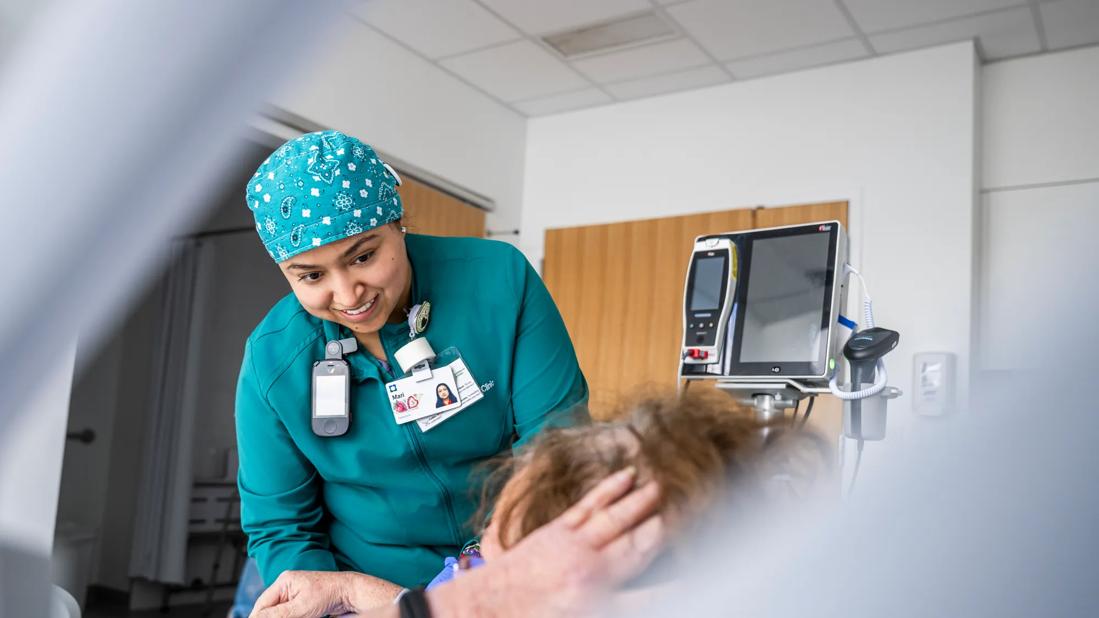
Image content: This image is available to view online.
View image online (https://assets.clevelandclinic.org/transform/d7b56587-110a-4ddf-a12e-77972d65a30c/CCC_7005948_10-14-25_149_MLC)
Patient mobility
As a clinical nurse in the ICU at Cleveland Clinic Avon Hospital, Cheryl Mooney, BSN, RN, understands the importance of mobility. She has cared for patients at risk of further debilitation from remaining in bed and only doing passive range of motion exercises with caregivers.
Advertisement
Cleveland Clinic is a non-profit academic medical center. Advertising on our site helps support our mission. We do not endorse non-Cleveland Clinic products or services. Policy
“Mobility impacts every single part of your existence,” says Mooney. “It is essential for everything from kidney and liver function to muscle and bone health.”
In 2023, Mooney collaborated with Maria Mepham, PT, DPT, manager of Rehabilitation Services at Avon Hospital, to launch a mobility project in the ICU to improve patient outcomes and reduce length of stay.
A year earlier, Mooney and Mepham had formed an interdisciplinary team including nurses, physical and occupational therapists, a speech language pathologist, a physician assistant and a respiratory therapist to address delirium management using the A2F ICU Liberation Bundle. The bundle focuses on six elements:
A — Assess, prevent and manage pain
B — Both spontaneous awakening trials and spontaneous breathing trials
C — Choice of analgesia and sedation
D — Delirium: assess, prevent and manage
E — Early mobility and exercise
F — Family engagement and empowerment
“The team focused on what nurses could do to improve care for critically ill patients in the ICU,” says Mooney. “We don’t have control of patient airways and sedation, but nurses do own the back end of the A2F bundle.”
After focusing on delirium management, the team shifted to early mobilization and family engagement.
Avon Hospital uses the 6-clicks mobility score, a validated tool for nurses and physical therapists to assess functional mobility for patients in acute care settings. Mepham created four groups of four exercises based on a patient’s 6-clicks scores, ranging from caregiver-assisted exercises for those with lower scores to exercises for functionally independent patients with higher scores.
Advertisement
Mepham originally placed a list of exercises and instructions in a binder in each patient room, but clinical nurses on the ICU Shared Governance Committee suggested another option – a resource center in the hallway where caregivers could access the exercise grouping that corresponds with individual patients’ 6-clicks scores.
Mooney and Mepham developed mobility carts to place in each of the 12 ICU rooms. They found sturdy carts with drawers in storage at the hospital and filled them with essential items to help get patients moving, including an exercise band, a gait belt and a PVC bar filled with sand that shifts weight as it moves. They also placed a walker in every room.
In addition, they attached a laminated "Movement Is Medicine" letter to each cart that highlights why mobility matters and provides tips for families to promote movement.
“Families love it. It gives them something to do while their loved ones are hospitalized and makes them part of the care,” Mooney says. “Our goal is to encourage safe and appropriate movement daily.”
The interdisciplinary team knew that educating ICU clinical nurses would be critical. They created a letter for nurses highlighting the importance of early mobilization and sharing tips on how to include family members, what to consider with different patient acuities, how to engage patients in activities of daily living as a form of exercise and more.
Mooney shared project details at morning huddles and during shared governance meetings. In addition, Mepham and Nicole Kodman, OTR/L, senior occupational therapist, rounded on the ICU to provide one-on-one education. They reviewed the items in the mobility cart and demonstrated opportunities to incorporate them into the nursing workflow.
Advertisement
“There was a lot of collaboration with nurses from the day and night shifts, getting their input and buy-in,” Mooney says.
The mobility carts, exercises and focus on “movement as medicine” remain a priority in the ICU more than two years later. Mooney says the project has been impactful on several levels.
“It helps get patients out of the ICU sooner, and it opens up bed space for the next patient,” she says.
More importantly, early mobilization is “simply the right thing to do,” Mooney says.
“These people did not spend their lives flat on their back having people do things for them. Every single person in our ICU came in with a life, and they deserve the opportunity to get back to that life,” she says. “Mobilization is one of the best tools we have to help them.”
Advertisement
Advertisement
Using meticulous preparation and teamwork to manage critically ill patients in constantly changing environments

Translating clinical questions into meaningful, sustainable change
Guidance for creating a relevant framework that reflects organizational values, supports professional practice

Helping patients recognize respiratory changes, navigate treatment barriers and stay connected to their clinical team
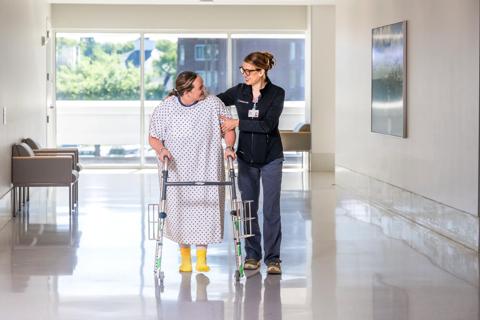
Initiative provides hands-on opportunities to promote early, progressive activity

Continuing to grow by following the right path at the right time

Teaching caregivers to recognize warning signs, de-escalate difficult situations and maintain professional boundaries

Veteran caregivers offer practical wisdom for building confidence and practicing with purpose
 Search