Locations:


Early results for ARO-DIMER-PA point to a more streamlined way to treat mixed hyperlipidemia
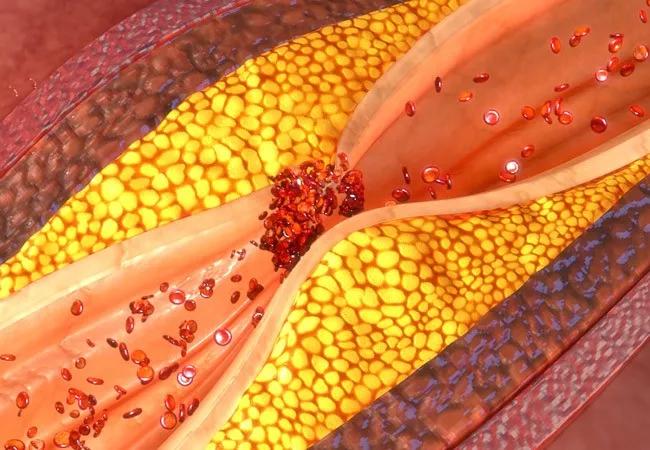
Image content: This image is available to view online.
View image online (https://assets.clevelandclinic.org/transform/0daa07bf-4ed3-44b0-9947-91786e23b59d/18-HRT-5813-Ahmed-hypertriglyceridemia-650x450-jpg)
yellow and red illustration of blood cells moving through a blood vessel
Treating mixed hyperlipidemia often takes separate therapies to lower LDL cholesterol (LDL-C) and triglycerides. Now, first-in-human findings suggest that a dual-function small interfering RNA (siRNA) therapeutic may be able to target both at once to help reduce the risk of atherosclerotic cardiovascular disease.
Advertisement
Cleveland Clinic is a non-profit academic medical center. Advertising on our site helps support our mission. We do not endorse non-Cleveland Clinic products or services. Policy
In the single-ascending-dose portion of a phase 1/2a trial, ARO-DIMER-PA sustained suppression of both PCSK9 and APOC3 proteins and substantially reduced LDL-C and triglycerides. It also was generally well tolerated across the doses evaluated.
The results were presented among other late-breaking clinical studies at the American Heart Association’s 2026 Scientific Sessions.
“siRNA is a new, rapidly expanding class of medications,” says Cleveland Clinic cardiologist Luke Laffin, MD, who presented the study. “There are siRNA drugs available now that target PCSK9 alone (inclisiran) or APOC3 alone (plozasiran), but this is the first-ever reported bifunctional therapy. It’s a single molecule that can silence both PCSK9 and APOC3 genes in the liver, potentially offering a more durable and streamlined approach to lipid management.”
It’s one of several siRNA dimers currently in development for cardiovascular disease, says the study’s senior author Steven Nissen, MD, Chief Academic Officer of Cleveland Clinic’s Heart, Vascular & Thoracic Institute, and leader of the Cleveland Clinic Coordinating Center for Clinical Research (C5Research).
“Mixed hyperlipidemia is the most common lipid disorder we see, and patients often have both high LDL cholesterol and high triglycerides,” Dr. Nissen says. “What’s novel here is that a single siRNA molecule has the potential to lower both by very large amounts.”
ARO-DIMER-PA is designed to suppress two liver proteins involved in atherogenic lipid metabolism: PCSK9 and APOC3. PCSK9 promotes degradation of LDL receptors, which limits LDL clearance, while APOC3 inhibits the breakdown and clearance of triglyceride-rich lipoproteins.
Advertisement
Through RNA interference, the drug targets the messenger RNA for both proteins in the liver and prevents their production. Less PCSK9 means more LDL receptors on hepatocytes and better LDL clearance. Less APOC3 means faster clearance of triglyceride-rich particles.
The study included 31 adults with mixed hyperlipidemia (triglycerides 150-499 mg/dL and either non-HDL cholesterol ≥100 mg/dL or LDL-C ≥70 mg/dL). Participants received one dose of ARO-DIMER-PA (25 mg, ≤50 mg, ≤100 mg, ≤200 mg or ≤400 mg) or placebo.
ARO-DIMER-PA was generally well tolerated. Treatment-emergent adverse events showed no clear dose-related pattern, and no serious adverse events were reported. The most common adverse event was injection-site erythema, affecting 95% of those who received the drug.
Platelet counts and HbA1c did not change in clinically meaningful ways, and there were no clear signs of hepatotoxicity. Occasionally, high-sensitivity C-reactive protein rose temporarily around the time of injection.
A single dose of ARO-DIMER-PA substantially reduced both target proteins and their associated lipids. Mean PCSK9 levels fell 50% to 89% from baseline, and mean APOC3 levels fell 43% to 95%. Mean LDL-C dropped 26% to 65%, and median triglycerides dropped 56% to 78%. Suppression of both proteins was sustained over time.
Durable Reductions in PCSK9 and APOC3 Over Time With ARO-DIMER-PA
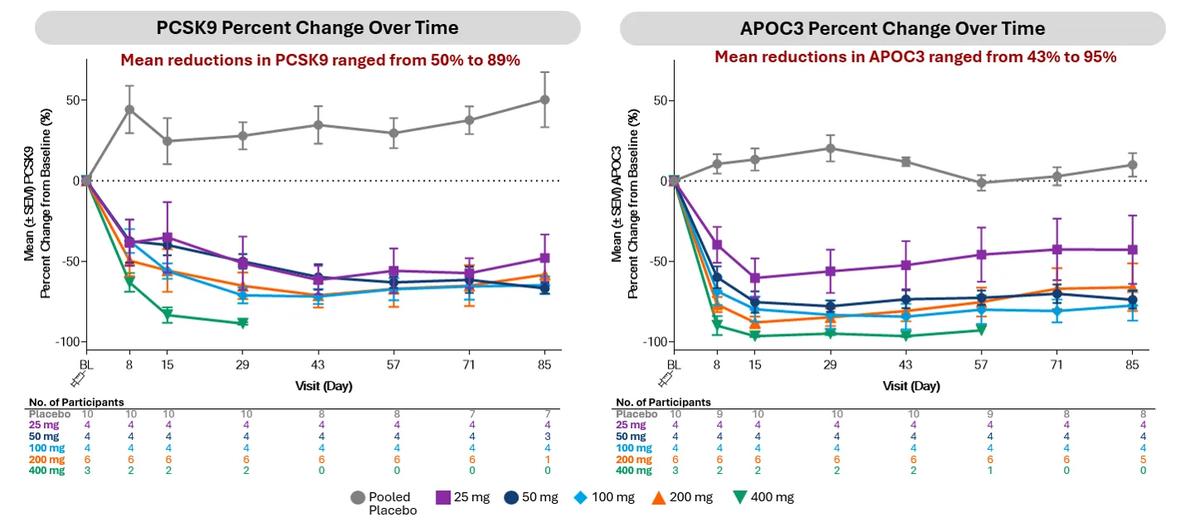
Image content: This image is available to view online.
View image online (https://assets.clevelandclinic.org/transform/c1a6b5f2-3fa2-4e7d-891b-5a812f45ba7d/26-HVI-9498336-graph1)
Reductions in LDL-C and Triglycerides Over Time With ARO-DIMER-PA
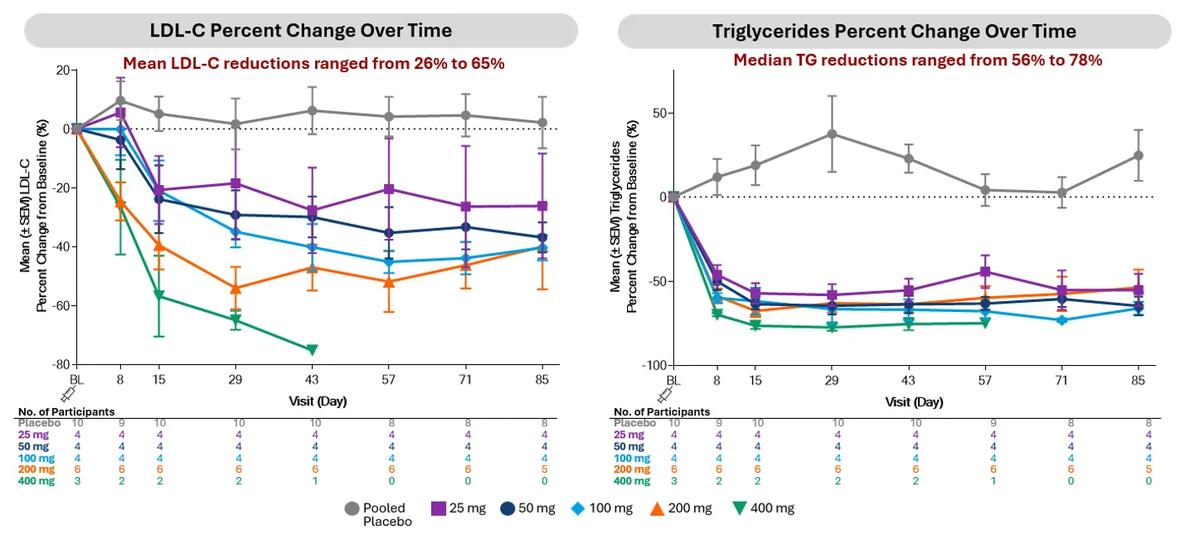
Image content: This image is available to view online.
View image online (https://assets.clevelandclinic.org/transform/10be28a4-4dc7-447d-a810-e2e5a0e49def/26-HVI-9498336-graph2)
The effects extended beyond LDL-C and triglycerides. Mean ApoB fell 32% to 66%, and mean remnant cholesterol fell 52% to 73%, suggesting broader effects on atherogenic lipoproteins. Whether those changes translate into lower cardiovascular risk will take further study.
Advertisement
PCSK9 and APOC3 have each been targeted before, but this study provides clinical proof of concept that a single siRNA molecule can modulate both pathways at once. It also supports further study of dual PCSK9/APOC3 inhibition as a single-agent strategy for mixed hyperlipidemia.
“What’s exciting is what this could mean with this particular drug and beyond,” Dr. Laffin says. “It suggests we may be able to design RNA interference therapies that address multiple pathways at once, whether they’re involved in one disease or in related cardiometabolic diseases.”
The multiple-ascending-dose portion of the phase 1/2a trial is now underway to evaluate the safety and efficacy of repeat dosing and help select a dose for pivotal studies. Investigators also want to understand the cumulative effects of treatment and how often it might need to be given.
“Whether that ends up being every three months, every six months or some other interval remains to be determined,” Dr. Laffin says. “It’s still early in development, but we’re enthusiastic about what we’ve seen so far and look forward to learning more as the program moves forward.”
This clinical trial was funded by Arrowhead Pharmaceuticals, which is developing ARO-DIMER-PA.
Dr. Laffin reports that he has served as a consultant to and/or on steering committees for Arrowhead Pharmaceuticals and other pharmaceutical and device companies.
Dr. Nissen reports that the Cleveland Clinic Coordinating Center for Clinical Research (C5Research) has received funding to conduct clinical trials from multiple biopharmaceutical companies, including Arrowhead Pharmaceuticals. He reports that he is involved in conducting these trials but receives no personal remuneration for his participation. He also consults for these companies but does not accept compensation.
Advertisement
Advertisement

Phase 1 trial shows up to 97% decrease through 48 weeks with good tolerability

Post hoc ALPACA analysis boosts biological rationale for ongoing outcomes trial of lepodisiran

How to talk about lifetime risk, treatment goals, Lp(a) testing, statin skepticism and more

Phase 3 TANDEM study may help pave way to first approval of a CETP inhibitor

Yet 21.4% of tested individuals had Lp(a) elevation
Small interfering RNA lowered lipoprotein(a) by 94% during six-month follow-up after a single dose

Phase 2 trial of zerlasiran yields first demonstration of longer effect with each dose of an siRNA

Reassurance from the lipid outcomes trial with the highest percentage female enrollment to date
 Search