Locations:





One pediatric urologist’s quest to improve the status quo
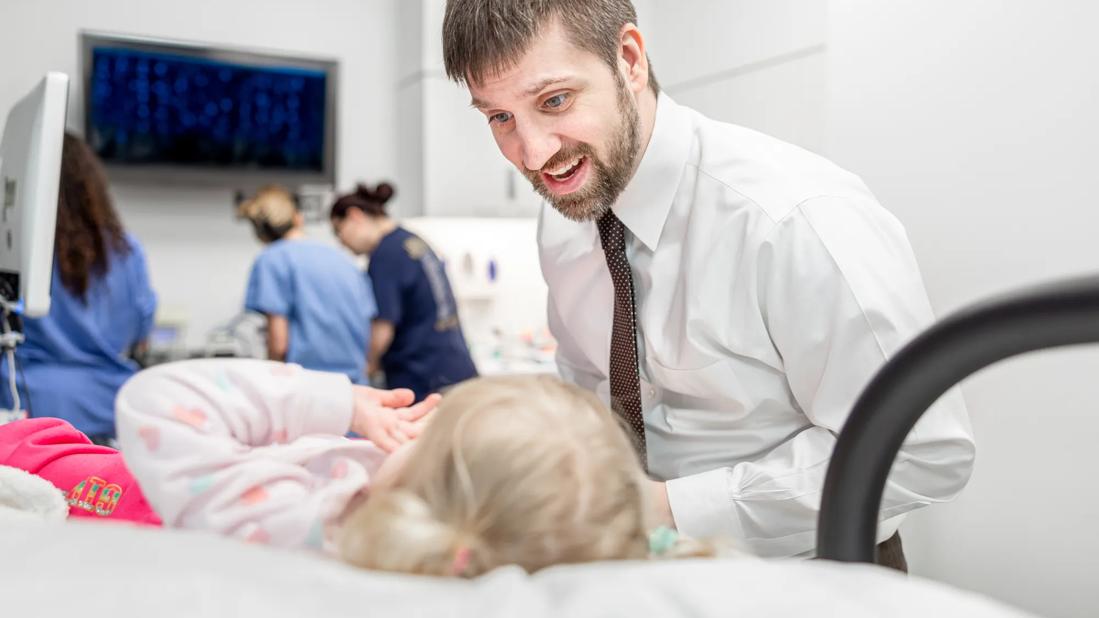
Image content: This image is available to view online.
View image online (https://assets.clevelandclinic.org/transform/31872dec-b24f-476d-b3c2-28d4acfa13b6/URL_4555358_01-25-24_1293_AMO-jpg)
Dr. Weaver smiling with a pediatric patient
Advertisement
Cleveland Clinic is a non-profit academic medical center. Advertising on our site helps support our mission. We do not endorse non-Cleveland Clinic products or services. Policy
Antenatal hydronephrosis (ANH) affects approximately 4.5% of all pregnancies and is the most common abnormality detected on a prenatal ultrasound. The condition, characterized by dilation of the upper urinary tract, restricts normal urine drainage from the kidney. If not appropriately addressed, the abnormality can significantly affect kidney function and result in irreversible kidney damage.
In many cases, the dilation resolves after birth within the first 18 months of life, but approximately 30% of these children will go on to receive a formal ureteropelvic junction obstruction (UPJO) diagnosis and may be indicated for pyeloplasty. Diagnostic imaging studies to evaluate obstruction include kidney ultrasound and mercaptoacetyltriglycerine (MAG3), a diuretic renal scan, but there is significant room for improvement, especially in an infant population.
Early and accurate identification is our goal, ultimately, as prolonged obstruction can greatly compromise kidney function. Because identifying the obstruction is often not immediately clear, many of these patients are subjected to repeat scans, which can delay a much-needed surgery or invite unnecessary exposure to radiation. In the context of our work, subjectivity and varied interpretations of results can lead to an elusive diagnosis and care plan.
Findings from our retrospective data highlight an urgent need to innovate in this space: 48% of patients from our study cohort who were not recommended for surgery initially later developed a kidney complication. In short, our hope is that a multimodal deep learning model will analyze clinical imaging data and predict, right then and there, if the patient is a candidate for pyeloplasty.
Advertisement
The primary aim of my research program, supported by a recent K08 Career Development Award, is to leverage computational and bioinformatics methods to improve surgical decision-making for pediatric urologists. As early as medical school, research has been an important aspect of my clinical practice. While completing fellowship training at the Children’s Hospital of Philadelphia and a graduate-level program at the University of Pennsylvania, I became interested in machine learning, which was then emerging as an exciting field.
In my clinical work, I was becoming aware of the need for improved imaging modalities for diagnosing kidney abnormalities and, specifically, how a more timely and accurate technique could improve patient outcomes and the patient-parental experience. Although machine learning was becoming increasingly established in the study of urodynamics, it remained relatively unexplored in hydronephrosis and obstruction. Support from mentors and a series of early grants converged at the right time, launching my initial work in this space.
These efforts eventually led to our initial machine learning model, which includes data from MAG3 renal scans from a single-institution cohort of patients with clinically significant obstruction. Deep learning techniques have demonstrated utility for predicting clinical outcomes, but the model’s specificity, particularly in a higher-risk cohort, is an area for improvement.
The K08 Award will enable our team to build and train a multimodal model that includes both MAG3 renal scans and kidney ultrasound data. It will also incorporate a larger, multicenter cohort of 250 children with suspected UPJO. Our center collaborators include Children’s Hospital of Philadelphia, SickKids and Case Western Reserve University. A multi-institutional partnership is essential to capture and train the model on diverse presentations, enabling it to achieve broad clinical applicability.
Advertisement
We will compare the performance of the new multimodal model with that of the existing MAG3 model. Additionally, we will assess how and if the model influences pediatric urologists’ diagnostic performance.
Outside of this investigation, I am hopeful we can apply similar machine learning techniques to kidney ultrasound, the first-line imaging modality for a suspected kidney abnormality. Precluding the need for a renal scan would spare our young patients and their families a great deal of stress and discomfort. Not only are they expensive and only available at larger centers, but they also require IV access and urethral catheter placement. This area is largely untapped at the moment, but it holds great promise for how we care for future patients.
About the author. Dr. Weaver is a pediatric urologist at Cleveland Clinic. He is associate staff in the Department of Urology.
Advertisement
Advertisement
Study finds exome sequencing can uncover additional diagnoses after nondiagnostic panel testing
First single-port renal vein transposition reduces recovery time and improves outcomes
Fully-automated process uses preop CT, baseline GFR to estimate post-nephrectomy renal function
Belzutifan superior to everolimus in phase 3 clinical trial
Management of high-risk RMSK in the pre-and current eras of neoadjuvant therapy
NIH-funded study explores novel MRI technique to stage cystic kidney disease
AI-generated model bests predictive abilities of human experts
Study highlights benefits of nephrologist-led urine sediment analysis
 Search