Locations:


Cleveland Clinic Weston Hospital offers single-port robotic surgery for selected urologic procedures, with additional indications on the horizon
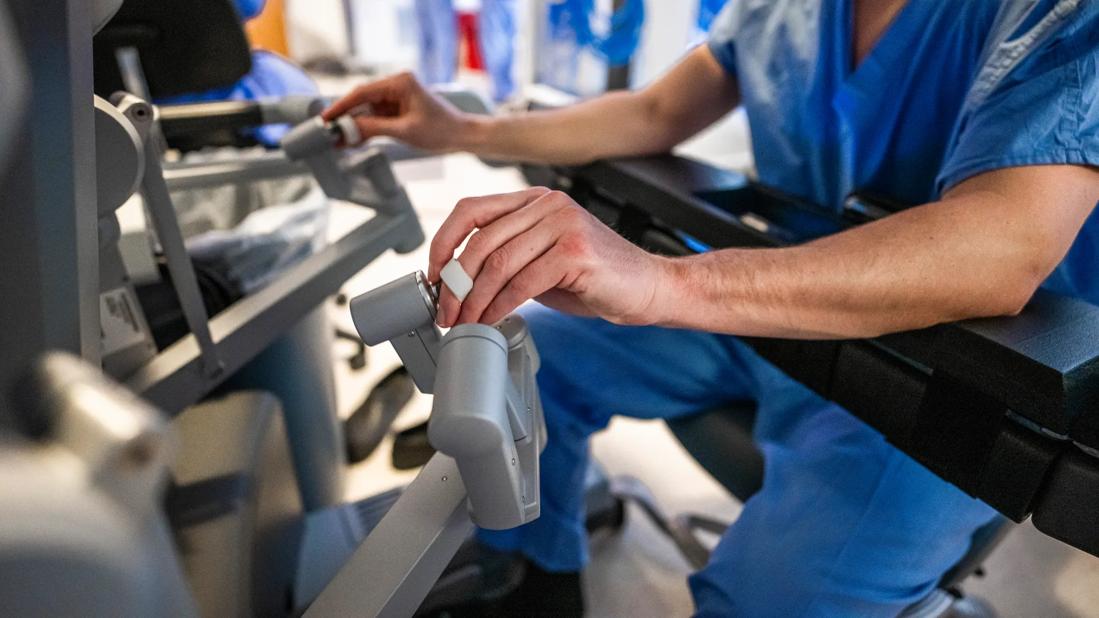
Image content: This image is available to view online.
View image online (https://assets.clevelandclinic.org/transform/0107e39f-1dfa-4bf6-b851-60e870cebb40/URL_4417259_11-20-23_166_MLC-jpg)
Sutures thinner than a human hair are used to connect ultra-small microvessels and lymphatics during supermicrosurgery
One incision, multiple applications. Single-port (SP) robotic surgery is expanding the possibilities for minimally invasive urologic procedures, offering an alternative to conventional multi-port robotics for selected patients and surgical scenarios.
Advertisement
Cleveland Clinic is a non-profit academic medical center. Advertising on our site helps support our mission. We do not endorse non-Cleveland Clinic products or services. Policy
Nationally recognized urologic oncologist Chad R. Ritch, MD, MBA, FACS, is a pioneer in the use of the da Vinci single-port system in South Florida and has introduced the approach at Cleveland Clinic Weston Hospital.
“We now have four urologists credentialed to use the single-port system at Weston Hospital,” reports Dr. Ritch, Chair of the Division of Urology for Cleveland Clinic in Florida. “The approach is applied to select prostate and kidney surgeries, as well as other reconstructive and specialized procedures.”
The SP platform was first approved by the Food and Drug Administration (FDA) in 2018. It has one robotic arm with a multi-channel cannula that contains three independent, bi-articulated surgical tools and a fully wristed, flexible high-definition endoscope.
“All the instruments are introduced through a single incision which minimizes tissue trauma and leads to less pain and scarring,” says Dr. Ritch.
The single-port platform is currently being used at Weston Hospital for retroperitoneal partial nephrectomy, extraperitoneal partial and radical nephrectomy, extraperitoneal prostatectomy, transvesical prostatectomy and simple prostatectomy.
Dr. Ritch also performs single-port inguinal lymphadenectomy in selected patients with penile cancer. “The minimally invasive approach replaces the larger open groin incision with a much smaller thigh incision and same-day discharge,” he notes.
Though penile cancer is rare, with approximately 2,260 new cases diagnosed annually in the United States, Dr. Ritch receives approximately a dozen referrals each year for single-port inguinal lymphadenectomy.
Advertisement
Application of the SP system is also expanding. In the coming months, Cleveland Clinic’s transplant team in Florida is expected to apply single-port robotic surgery to kidney transplantation, an approach pioneered by colleagues in Ohio.
Single-port robotics is not intended to replace multi-port robotic surgery. Rather, Dr. Ritch views the two approaches as complementary, with the single-port platform offering potential advantages for particular surgical scenarios.
At Weston Hospital, single-port cases largely include reoperative patients, patients with difficult posterior kidney tumors, and patients who place a high priority on cosmetic considerations or same-day discharge.
Patients who have undergone multiple abdominal surgeries, for example, may have adhesions that make entering the abdominal cavity more challenging. A retroperitoneal or extraperitoneal approach for kidney or prostate surgery allows the surgeon to avoid the abdominal cavity and associated scar tissue, potentially reducing the risk of bowel injury.
This may expand surgical options for some patients with hostile abdominal anatomy who otherwise might not be considered candidates for prostatectomy. “In selected cases, the transvesical or extraperitoneal single-port approach may allow these patients to undergo surgery if they decline, or are not candidates for, radiation therapy,” explains Dr. Ritch.
For prostatectomy, the SP approach creates one incision measuring approximately 2.5 to 3 cm that can be concealed within the umbilicus, compared with the four to six small, keyhole incisions typically associated with multi-port surgery.
Advertisement
The approach may also support earlier discharge in appropriately selected patients highly motivated to return home. Dr. Ritch has performed procedures followed by discharge approximately four or five hours after surgery rather than an overnight stay. These patients generally require limited inpatient care and can recover with rest and over-the-counter pain medications.
For small renal masses discovered incidentally on CT, the platform can be particularly useful when tumors are located posteriorly or when patients have a history of abdominal surgery. A retroperitoneal or extraperitoneal route can provide access through a smaller incision, facilitate partial nephrectomy and allow selected patients to leave the hospital the same day.
As adoption of SP robotics grows, research is helping define where the approach may offer meaningful clinical advantages.
Weston Hospital is now part of the Single-Port Advanced Research Consortium (SPARC), a multi-institutional collaborative research group established to collect data, conduct multicenter studies and evaluate clinical outcomes associated with SP robotic surgical platforms.
According to studies comparing single-port and multi-port prostatectomy, including a SPARC study published in 2023, single-port surgery is associated with a shorter hospital stay, less opioid use and a shorter duration of Foley catheterization.
Dr. Ritch is also a co-author of a recently published propensity score-matched analysis comparing extraperitoneal and transvesical single-port robotic radical prostatectomy.
Advertisement
In that analysis, the transvesical approach was associated with improved patient comfort, reduced opioid use, higher rates of same-day discharge, shorter Foley catheter duration and earlier recovery of urinary continence. Perioperative safety and oncologic outcomes were comparable between the single-port approaches.
The findings add to an evolving body of evidence defining how different single-port approaches may be used for specific patient and disease characteristics.
The expansion of robotic surgery also highlights the importance of surgical training and experience.
Approximately 90,000 radical prostatectomies are performed annually in the United States, with the vast majority performed using a robot-assisted technique. An analysis of the American Urological Association Quality (AQUA) Registry, which captures data from 2,100 urologists nationwide, found that the proportion of prostatectomies performed robotically increased substantially from 83% of procedures in 2014 to 94.8% in 2021.
Studies also have demonstrated associations between greater surgical experience and higher prostatectomy volumes with better overall survival, fewer complications and improved functional outcomes. Yet, the same analysis of AQUA Registry data found that 60% of urologists performing radical prostatectomy perform fewer than five procedures annually and only 20% perform 15 or more prostatectomies per year.
“Patients may remain with local community urologists because of access and convenience, even when those physicians are not robotics-trained or urologic oncologists,” says Dr. Ritch.
Advertisement
At Weston Hospital, robotic surgery is incorporated into both advanced and residency training. The hospital offers a one-year specialty fellowship focused on open, laparoscopic and robotic surgery for urologic malignancies, while residents in its ACGME-accredited Urology Residency Program also receive robotic surgery training.
“This year’s residents and fellows are the first to have access to the single-port system at Cleveland Clinic in Florida,” Dr. Ritch adds.
The clinical role of single-port robotics is continuing to evolve.
General and colorectal surgery received FDA indications for single-port use in 2024 and 2025. At Weston Hospital, two colorectal surgeons are now credentialed in SP robotic surgery and have begun performing transanal local excisions and resections.
Active evaluation is underway for additional clinical indications within urology and related surgical specialties, including transvesical partial prostatectomy, kidney transplantation, certain bladder cancer procedures, and gynecologic surgery.
For urologic surgeons, the emergence of single-port robotics adds another option to an already expanding minimally invasive surgical toolkit. The approach is not a replacement for multi-port robotics, but rather another platform that may be particularly suited to selected patients, including those with reoperative anatomy, challenging kidney access or specific prostatectomy considerations.
Advertisement

Cleveland Clinic researchers in Florida explore tech-enabled mental health interventions
Cleveland Clinic in Florida explores extended reality for multimodality image guidance

The American Society of Clinical Oncology (ASCO) recently released updated guidelines

Cleveland Clinic's transplant team in Florida is using circulatory-death donor hearts to expand transplant opportunities for patients.
Repair of tiny lymphatic vessels offers big relief for patients with lymphedema after cancer surgery
AI-enhanced mammography improves cancer detection and may support more personalized screening strategies
The Center for Neurological Restoration offers a structured, multidisciplinary approach to conditions that often require longitudinal management and escalation beyond first-line therapies
Multidisciplinary expertise provides advanced evaluation, second opinions and personalized treatment planning for patients with challenging cerebrovascular disorders
 Search