Locations:





Compassion, communication and critical thinking are key
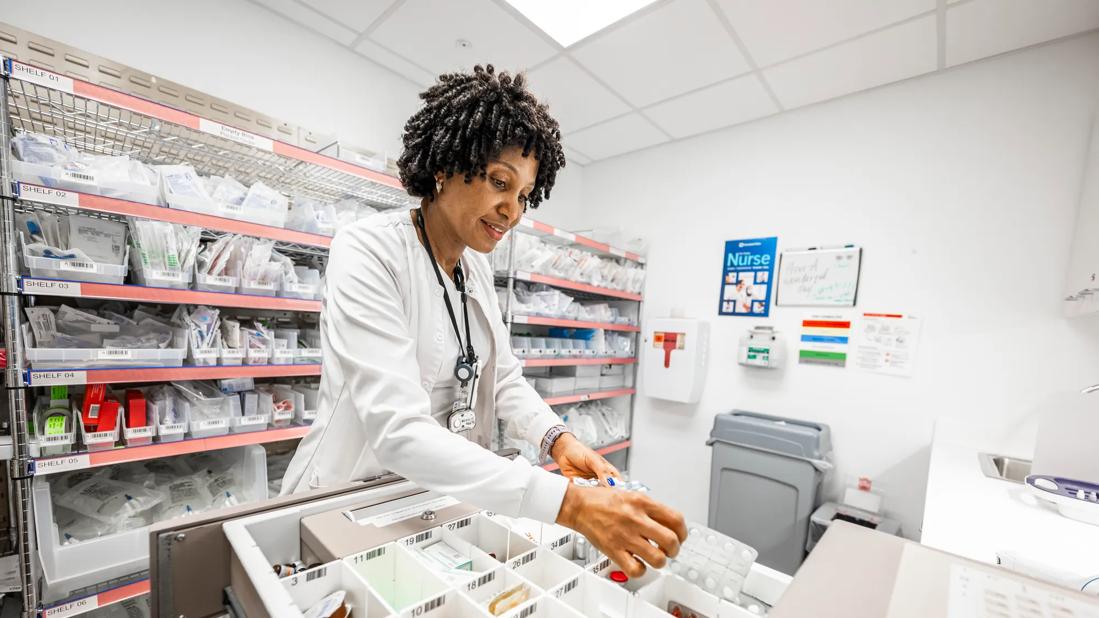
Image content: This image is available to view online.
View image online (https://assets.clevelandclinic.org/transform/08ac2a67-bedf-42ca-ad5f-9ccb553335a7/NUR_4283376_10-20-23_037_MLC)
Nurse managing medications
It’s a commonly overlooked fact that millions of people live with daily pain. In 2023, the Centers for Disease Control and Prevention (CDC) estimated that 24% of adults in the U.S. have chronic pain and another 8.5% suffer from a high-impact form of it, restricting their ability to work and perform daily activities.
Advertisement
Cleveland Clinic is a non-profit academic medical center. Advertising on our site helps support our mission. We do not endorse non-Cleveland Clinic products or services. Policy
“Having chronic pain can be devastating for a lot of people,” says Jeanne Kloock, BSN, RN, Assistant Nurse Manager for the Cleveland Clinic Pain Management Center at Hillcrest Hospital. “Pain hurts, it makes you tired and it brings you down. Patients become very frustrated and upset because simple tasks are hard for them.”
Pain management nurses like Kloock specialize in assessing pain and identifying the best ways to reduce, eliminate or manage it. They work in various settings, including hospitals, outpatient clinics, doctor’s offices, nursing homes, rehabilitation centers, oncology departments and sports medicine clinics. At the Pain Management Center, patients are seen for office visits or receive pain-relief procedures. Most suffer from chronic pain, but some have short-term or acute pain caused by an injury or surgery.
“Patients typically come to us because the pain is so bad that they have a hard time sleeping at night, or they have neuropathy, or can’t walk or move like they once did,” Kloock says. “They need us to help manage their pain so they can have a better quality of life.”
Dawn Smiley-Hearn, BSN, RN, who has worked in the Pain Management Center for 17 years, says ensuring the best patient outcomes begins with patience and listening.
“It’s important to listen and understand where your patients are coming from,” she advises. “Everybody deals with pain differently. My pain level two might be someone else’s level seven. You need to be open-minded and put yourself in their shoes.”
Advertisement
Kloock adds, “Pain management nursing takes a great deal of compassion.” She recalls a patient who was ashamed to use a rollator at an amusement park with her grandchildren. “I empathized with her, encouraged her to not let using it get her down and explained why it’s always good to be safe,” she shares.
Arthritis or joint pain, pain in the back or neck, nerve pain and headaches are some of the most common types of chronic pain. Patients who suffer from these may utilize pain management support for many months or years — forming strong bonds and relationships with their nurses.
“Our patients become very familiar,” says Kloock. “We have a continuity of care for them. We triage them, take cake care of them in the office, are there for them before, during and after procedures, and communicate with them on the phone and electronically between visits. We build rapport with our patients, and they trust us.”
Smiley-Hearn agrees, “The patient-nurse relationship in this specialty is so unique. We have one patient who has been coming here as long as one of our doctors has been here. Patients feel comfortable with our team because they know us. They become like family.”
Pain management nurses have extensive knowledge of biological sciences and pain management pharmacology, issues and treatments. They specialize in balanced, holistic care that often includes a combination of therapies. Care plans are individualized and consider patient input and concerns.
In addition to medications and procedural injections, treatments may include exercise, diet and lifestyle changes, acupuncture, chiropractic medicine or stress and relaxation techniques such as yoga and meditation. Explaining the intended goal of pain management strategies and educating patients and their families on coping with and managing pain is crucial.
Advertisement
“Many think medication will be all they need,” says Smiley-Hearn. “Opioids are not an ideal solution for chronic pain, and we have to keep in mind the opioid crisis, so we work closely with patients on alternatives that are healthier.”
According to both Kloock and Smiley-Hearn, helping patients shift their perceptions on what could help them manage their pain is one of the biggest challenges in this line of work.
“Patients want a quick fix and that rarely happens,” notes Smiley-Hearn. “Some will have relief after two weeks and others won’t see changes for six months. No matter what we do, unfortunately, we won’t be able to make every patient happy.”
Kloock adds, “When you talk to patients on the phone and they are upset, your job is to assure them, help them and educate them.”
Nurses in the Pain Management Center utilize Cleveland Clinic’s H.E.A.R.T.® (Hear. Empathize. Apologize. Respond. Thank.) service excellence model, which is centered on establishing compassionate communication with patients and responding effectively to manage difficult interactions. “You have to be good at re-directing patients as needed and communicating with H.E.A.R.T.,” states Kloock.
Pain Management Center nurses also refer patients to the team’s pain psychologist, which is highly beneficial for many.
“It’s rewarding when you can see that you are helping patients understand that they need to follow through with imaging or therapy or the other recommendations you make, and they continue to come back,” shares Kloock.
Advertisement
Smiley-Hearn agrees, “For the 10 that you make feel good to the five you don’t, it’s worth it. You’ve done something good for them.”
A key trait of pain management nurses is quick critical thinking. “You are always on your toes and definitely use your nursing critical skills,” says Smiley-Hearn. “The nurse is the go-between from doctor to patient. There’s a lot of investigating needed to bring the care team up-to-speed on the patient’s history.”
There’s also ample opportunity for autonomy. “In many instances, you make decisions and respond to patients,” she says. “You run it past the physician, but you are really using good nursing skills and clinical judgement in the best interest of the patient.”
Nurses in this specialty have extensive clinical training and education. “A patient may come in with abdominal pain, but the injection received is in their back — you should know clinically why an injection is in a certain spot or what an x-ray result means,” explains Smiley-Hearn. “Being knowledgeable on all the different procedures, treatments and therapies is really important.”
In addition to formal education and training, Smiley-Hearn says one of the best ways to garner knowledge and skill is shadowing. “Anyone looking to try pain management nursing should definitely shadow and see first-hand how to care for patients pre- and post-procedure, during procedure, in the office rooms and when triaging,” she suggests. “There’s so much variety to what we do and it’s a lot to learn, but you can’t be afraid to learn new things.”
Advertisement
Smiley-Hearn found her love for the profession through a shadowing experience and admits that after almost two decades, she’s still learning. “There are always ways to understand it better, adapt to changes like with medications, or explore alternative therapies, such as anti-inflammatory diets, vitamins or supplements,” she says.
Pain management nursing certification is a good way to advance one’s skillset. Kloock is currently working toward earning her master’s degree. “I love pain management — the nurses, the patients, the work — and I want to stay in this career.”
Smiley-Hearn adds, “I was in my forties when I became a nurse, and I wasn’t even the oldest person in nursing school. It’s never too late, and pain management nursing is an ideal career with flexibility for full-time 8-hour schedules as well as great part-time PRN options.”
Advertisement

Helping patients understand their options while navigating uncertainty
Nurse manager turns a patient safety concern into a data-driven effort to improve protocols and inspire innovation

Nurse draws on frontline experience and an engineering background to develop a new approach to incontinence management
How life experience, storytelling and a passion for service sparked a midlife nursing career
Plastic surgery nurses uniquely help patients meet medical, functional and aesthetic goals
Harnessing digital innovations to enhance nurse confidence and clinical outcomes
Regional organizations collaborate to address nurse faculty shortage
How wellness habits help nurses flourish
 Search