Locations:





Device may offer a practical middle-ground option for some patients

Image content: This image is available to view online.
View image online (https://assets.clevelandclinic.org/transform/db73af45-7912-4cb7-b2ef-5985c0a83997/URL_Valleriano_4394052_Dr-Goldman_11-14-23_MLC)
Dr. Goldman speaking with patient
Overactive bladder (OAB) is common, affecting about 1 in 6 adults in the U.S. Treatment options range from lifestyle interventions and medications to botulinum toxin, tibial nerve stimulation and sacral neuromodulation. However, no single therapy is right for every patient, and many continue to struggle with symptoms despite treatment.
Advertisement
Cleveland Clinic is a non-profit academic medical center. Advertising on our site helps support our mission. We do not endorse non-Cleveland Clinic products or services. Policy
“Even with the best medications, only about 50% of patients tend to respond favorably,” says Howard Goldman, MD, a pelvic medicine and reconstructive surgery specialist at Cleveland Clinic.
A new sock-based nerve stimulation device may offer a practical middle-ground option for patients with OAB, particularly those who do not improve with first-line therapy and wish to avoid surgery or repeated office visits. The device has fabric-embedded electrodes, wiring and a grounding pad to complete the electrical circuit. It targets the tibial nerve at the ankle, using neural pathways connected to the sacral nerves that help regulate bladder function.
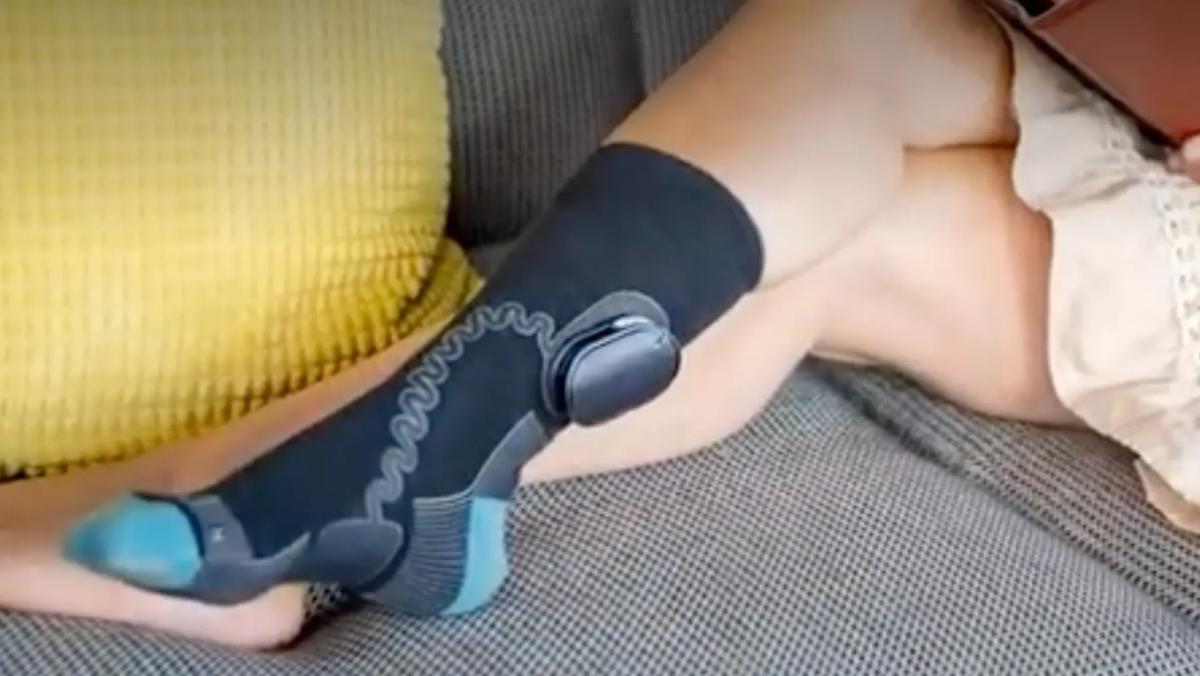
Image content: This image is available to view online.
View image online (https://assets.clevelandclinic.org/transform/6c5d0ac6-089d-49c3-a6b7-d354a1350cee/goldman-livezida-cqd)
Courtesy of ZIDA
Tibial-nerve stimulation itself is not new. In-office percutaneous tibial nerve stimulation (PTNS) to treat OAB has been used for decades, while implantable tibial nerve stimulation devices have entered the market more recently. Dr. Goldman says the sock-based device is conceptually similar to those devices but differs in an important way: it’s completely noninvasive and can be used at home.
PTNS is widely viewed as effective, but treatment can be burdensome for patients. Treatment typically requires weekly office visits for 12 weeks, followed by monthly maintenance. Additionally, successful treatment depends on consistently identifying the precise location near the ankle.
Implantable tibial nerve stimulating devices are another option, but they require a procedure and can be expensive. Sacral neuromodulation or botulinum toxin also remain important therapies for OAB, especially for patients with more severe symptoms, but both have tradeoffs. Botulinum toxin requires office visits every six months, and sacral neuromodulation requires surgery. Both can be costly or otherwise undesirable for some patients.
Advertisement
“That leaves a sizable group of patients who want something beyond medications but are not ready for an implant or repeated in-office treatment,” explains Dr. Goldman, adding that a wearable tibial nerve stimulation device may fill an important gap.
The device was evaluated in a sham-controlled study of 63 participants who used it weekly for 12 weeks. Treatment success was 80% in the intervention arm, compared with 39% in the sham-controlled arm. Participants using the device reported a greater decrease in urgency, incontinence, and total voids per day.
Dr. Goldman emphasizes that the study was small and did not compare the device head-to-head with another OAB therapy. Still, he says, the appeal is clear. The device offers a noninvasive, low-risk option that is easy for patients to use and providers to prescribe.
“I tell all patients undergoing a tibial nerve therapy, implantable or not, that it will take a few weeks and maybe even multiple sessions to notice the improvement—it’s different from botulinum toxin or sacral neuromodulation, where the effects are much quicker,” says Dr. Goldman.
The published study evaluated once-weekly 30-minute sessions for 12 weeks. In practice, he typically recommends using the sock device one to three times weekly for about 30 minutes. While adherence hasn’t been studied yet, Dr. Goldman suspects it will be manageable for most patients as wearing the device can be easily incorporated into an at-home routine, like relaxing in the evening.
“I let them know that this might not eliminate all OAB symptoms, but it’s encouraging that 70% of the patients in the study reported a clinically meaningful improvement,” says Dr. Goldman, a figure that is comparable to the early data reported for implanted tibial nerve devices.
Advertisement
Cleveland Clinic urologists have begun prescribing the device and tracking patient outcomes, although institutional data have not yet been reported.
“We are eager to assess our institutional experience with this device,” says Dr. Goldman. “We have prescribed this device to many of our OAB patients in the past several months and are beginning to better understand patient outcomes.”
For Dr. Goldman, the larger issue is that OAB remains significantly undertreated, and many patients stand to benefit.
“Medication might not work for everyone, which can discourage patients from pursuing additional treatment,” he says. “But there is a considerable number of patients with OAB who are not getting the help they need.”
Disclosures
Dr. Goldman reports advisory or consulting relationships with multiple companies involved in OAB therapies, including Zida, Medtronic, BlueWind Medical, Boston Scientific and AbbVie.
Advertisement
Advertisement

Study shows a simplified three-factor model performed comparably with the standard five-factor framework

Investigators evaluated ambient air toxins and emission sources

Findings underscore the importance of a multifaceted prevention strategy

Innovative single-port technique results in no visible scarring

The new application that could augment cancer detection, improve efficiency

Pediatric urologists lead quality improvement initiative, author systemwide guideline

Fixed-dose single-pill combinations and future therapies

Reproductive urologists publish a contemporary review to guide practice
 Search