Locations:





Infants with > 30° of cervical tightness were also more likely to be younger at evaluation

Image content: This image is available to view online.
View image online (https://assets.clevelandclinic.org/transform/ce72eac3-f18f-46fe-baa0-2e74815c3d32/torticollis)
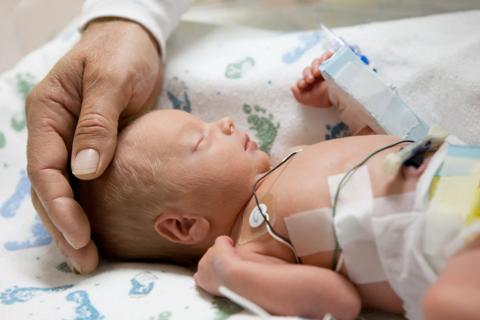
Baby with torticollis lies on back
Breech positioning at birth is the only intrauterine constraint factor that correlated with congenital muscular torticollis (CMT) severity, according to a Cleveland Clinic-led study. Other factors examined included birth weight, length, sex, multiparity and delivery method. The authors say these findings should serve to increase surveillance for possible CMT in breech-born infants.
Advertisement
Cleveland Clinic is a non-profit academic medical center. Advertising on our site helps support our mission. We do not endorse non-Cleveland Clinic products or services. Policy
The study findings were published in the Journal of Pediatric Physical Therapy.
CMT is a muscular condition characterized by ipsilateral head tilt, contralateral cervical rotation and decreased cervical range of motion. Though reports vary, the estimated incidence is about 2 in 100 live U.S. births. The condition typically presents in the first 6 months of life.
Causal evidence for CMT severity has been thin, to date, say study authors and pediatric physical therapists Deborah Bercik, PT, and Melissa Zreny, MPT. Intrauterine constraint factors, such as birth weight, length, and breech presentation, are commonly accepted as contributing factors to CMT. However, the link between these and CMT severity remains poorly understood. Alongside Cleveland Clinic biostatistician Wei Liu, MS, Bercik and Zreny powered a study to examine potential correlations.
The study authors used an institutional database of 1,239 infants age 6 months or younger who were diagnosed with CMT over a five-year period (2017-2021). The study reflects data from six hospital-based outpatient clinics. The researchers examined birth weight, length, breech presentation, sex, multiparity and delivery method in relation to CMT severity.
The authors used the Cleveland Clinic-based torticollis severity scale to capture infants 6 months and younger with mild, moderate and severe forms of CMT. The severity scale defines Grade 1 as postural/muscle tightness < 15°; Grade 2 as muscle tightness 15° to 30° and Grade 3 as muscle tightness >30° and presence of a shortened sternocleidomastoid muscle mass (SCM). The authors excluded infants with an SCM mass from the study.
Advertisement
Their analysis revealed that breech positioning was the only intrauterine constraint factor that correlated with the severity of CMT. Its prevalence increased across the severity Grades 1-3, at 7.7%, 11%, and 14%, respectively. Infants with Grade 3 CMT had almost twice the prevalence of breech presentation compared to Grade 1 infants, the authors write.
“Consensus within the field has been largely that male babies, larger babies or multiple birth status as contributors to severity. But in our sample of over 1,200 infants, none of those factors correlated with severity,” says Bercik.
Additionally, they found that younger age was associated with more severe CMT (3.2 vs 2.9 vs 2.6 months, P < .0001), as was right-sided torticollis. Of the 138 infants with Grade 3, 82 had right-sided torticollis, compared with only 56 with left-sided torticollis.
Zreny says the relationship between younger age and severity reflects their clinical experience and is “not at all surprising.”
“Parents are simply more likely to observe more severe forms by the baby’s head tilt or obvious range of motion issues and, therefore, engage earlier with a pediatrician to address the problem.”
Zreny and Bercik are hopeful that the study raises awareness among pediatricians about early intervention practices for children born in the breech position.
“Whether or not a deficit is noticed early on, CMT could still develop, and so it’s important that pediatricians and parents can keep an eye on it and know what to look for,” says Bercik. She adds that departmental outcomes data reveal a trend of babies with torticollis being referred earlier overall, which she calls “beneficial for everyone involved.”
Advertisement
Conventional thinking has shifted over the past 20 to 30 years on when to refer, says Bercik. The ideal time is during the 2-month well-visit. “Historically, a pediatrician may have recommended a wait-and-see approach, but the paradigm has shifted to ‘Let’s do a PT referral now.’”
Advertisement
Advertisement

A host of factors shape when to intervene and which of three primary procedures to use


PTs’ roles as educators and translators make them a natural fit for informatics

Physical therapy before surgery is intended to optimize outcomes after surgery

Recognizing mobility as a human right is instrumental to change

Cleveland Clinic findings highlight gains in stability, chest wall contouring and correction

What the discovery means for clinicians and patients
Why preparedness matters right now
 Search