Locations:





Systemwide program harnesses competency-based design to develop strong nurse managers

Image content: This image is available to view online.
View image online (https://assets.clevelandclinic.org/transform/68cf132a-18d1-47d0-8a03-e9048f29dcfd/online-learning-monitor-student-1475255539)
Student computer monitor
More than 75 new nurse managers at Cleveland Clinic gathered in the spring for a specialized four-hour course aimed at identifying, implementing and achieving results. The event, made possible through the institution’s Nurse Manager Transition to Practice Program, taught participants how to interpret and connect key nursing performance metrics to actionable decisions; develop a data-informed action plan for a unit, location or team improvement opportunity; and prioritize and delegate initiatives to balance personal and team workloads and promote a culture of shared governance.
Advertisement
Cleveland Clinic is a non-profit academic medical center. Advertising on our site helps support our mission. We do not endorse non-Cleveland Clinic products or services. Policy
“We believe all nurses are leaders in healthcare, from the time they transition to practice all the way to taking on executive leadership roles,” says Lisa Baszynski, DNP, RN, NEBC, Executive Director and Associate Chief Nursing Officer (ACNO) for Nursing Education and Professional Development. “The strategic intent of our efforts is to provide the tools, resources, competencies and support to prepare nurse leaders for today and tomorrow.”
Colleen Carroll, MBA, MS, CPTD, Senior Director of Leadership and Learning in the Jack, Joseph and Morton Mandel Global Leadership & Learning Institute (GLLI), agrees.
“Our goal is to provide a comprehensive leadership infrastructure designed to prepare nurses to influence innovation, digital transformation, policy and the future of care delivery,” she says.
Designed for all nurse managers at Cleveland Clinic with less than one year’s experience in their role, Transition to Practice provides a curated curriculum focused on each caregiver’s individual needs. Participants, who complete the 6-to-12-month hybrid course at their own pace, engage in both synchronous and asynchronous virtual learning sessions and in-person events. The program also provides interactive online community spaces for peer engagement.
New nurse managers enter the program as they onboard at Cleveland Clinic. One of the first tools they receive is an inpatient checklist, which includes information about the many tasks associated with nurse management, from navigating the human resources system to communicating effectively with staff.
Advertisement
“The checklist is part of being a high-reliability organization,” Baszynski explains. “It creates structure around onboarding.”
With the support of a peer mentor, each participant is expected to complete a competency-based project that is relevant to their practice.
“Most leadership courses include a lot of theoretical classroom learning, but nurse managers must address the clinical leadership component of their roles right away,” Baszynski says. “They are responsible for so much — safety, quality, patient experience, team building. We try to incorporate all those areas.”
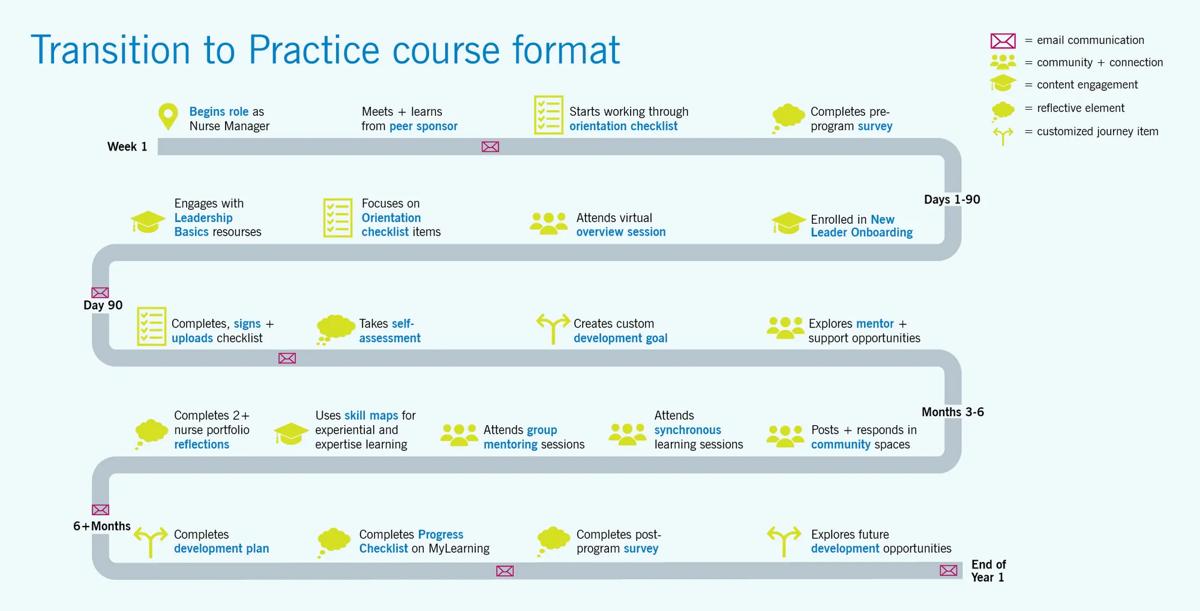
Image content: This image is available to view online.
View image online (https://assets.clevelandclinic.org/transform/d5cb65ef-0e0a-46d0-8a94-379de757ae54/transition2Practice-course-format)
The one-year Transition to Practice course takes participants through a series of virtual and in-person learning experiences.
The Nurse Manager Transition to Practice Program is more than a one-time professional development opportunity. The course is part of a larger initiative — the Cleveland Clinic Nurse Leadership Academy (NLA) — launched in September 2025 by the GLLI.
The NLA is designed to combine expertise in nursing education, leadership and learning to provide a holistic, research-informed program tailored specifically to the needs of nurse leaders.
“Our goal is to provide a comprehensive leadership infrastructure designed to prepare nurses to influence innovation, digital transformation, policy and the future of care delivery,” explains Carroll.
The academy’s three major components revolve around a competency-based framework designed to ensure leaders develop measurable skills:
• Cleveland Clinic leader behaviors – Lead change, drive results, inspire and coach, and connect teams.
• American Organization for Nursing Leadership’s Nurse
Leader Competencies Model – The model features five core domains: business skills and principles; communication and relationship building; knowledge of the healthcare environment; professionalism; and leadership.
Advertisement
• Patricia Benner’s “novice to expert” theory – The theory outlines the stages of clinical competence and describes how nurses develop skills through education and experience.
“Our nurse leaders come to us with a wealth of professional and life experience,” Baszynski says. “We meet the learners where they are, so they know what areas they need to work on and what is relevant to them clinically and professionally.”
Academy elements include competency assessments as well as professional development opportunities, coaching and mentoring, experiential learning, peer connection and shadowing experiences, and talent and succession planning.
“Ultimately, the academy helps us ensure that every nurse leader has the clarity, support and tools to lead with confidence and impact,” Carroll adds.
Carroll emphasizes that collaboration between the Nursing Institute and GLLI is crucial to the success of the Nurse Leadership Academy.
“The Nursing Institute brings world-class nursing practice, education and professional development expertise,” she says. “Our GLLI team complements those elements with its ability to provide engaging learning experiences, build leadership pipelines and develop leaders at scale across a global enterprise.
By joining forces, we’re able to intentionally blend nursing excellence with advanced leadership science — something neither entity could have achieved alone.”
Carroll says the team will continue to build on the program’s content and concepts to provide education and development for other levels of leadership.
Advertisement
Later this year, the academy plans to introduce its next program: a fellowship for nurse managers with more than one year in the role. The team is also in the process of finalizing an advisory council to further support the goals of the academy.
“We are looking at every layer of leadership as we continue to build the academy — directors, senior directors, ACNOs and executives,” Baszynski says.
Carroll adds, “This is how we strengthen the caregiver experience, elevate the practice of nursing and deliver the highest-quality care for our patients.”
Advertisement
Advertisement

Translating clinical questions into meaningful, sustainable change
Guidance for creating a relevant framework that reflects organizational values, supports professional practice

Helping patients recognize respiratory changes, navigate treatment barriers and stay connected to their clinical team
Initiative provides hands-on opportunities to promote early, progressive activity
Continuing to grow by following the right path at the right time

Teaching caregivers to recognize warning signs, de-escalate difficult situations and maintain professional boundaries

Veteran caregivers offer practical wisdom for building confidence and practicing with purpose
Skill, dedication and a passion for women and children inspire this joy-filled specialty
 Search