Locations:


Integrating research and clinical care can yield reciprocal rewards
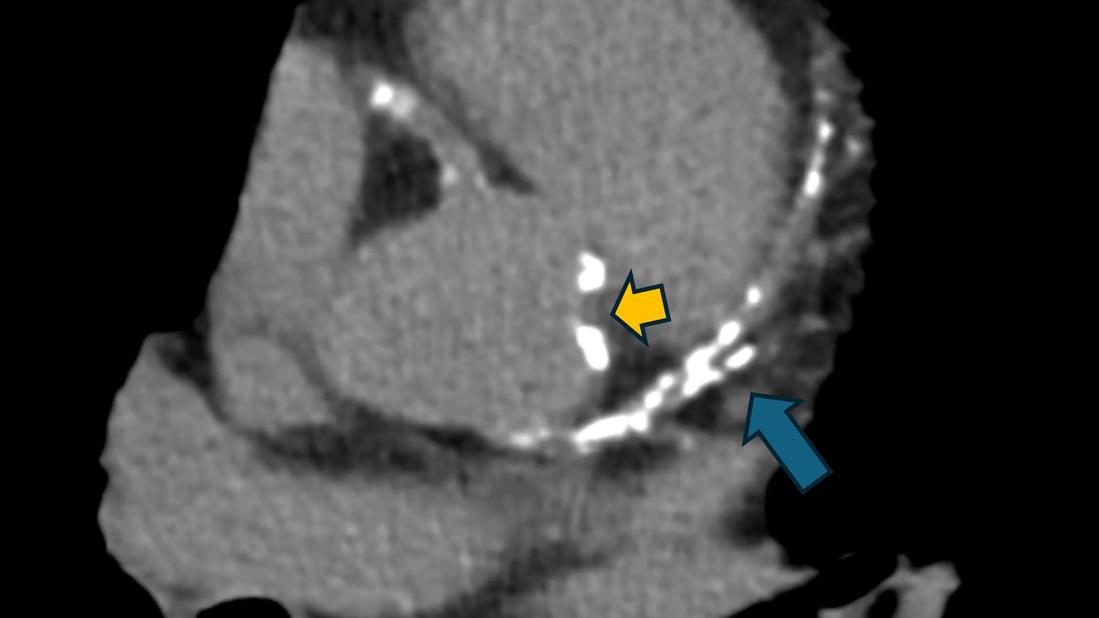
Image content: This image is available to view online.
View image online (https://assets.clevelandclinic.org/transform/86622648-892e-41f9-960c-fe10055459a0/CT-showing-heart-calcification)
heart scan with blue and yellow arrow overlays
A 73-year-old man with a history of hypertension and asthma was found to have a cardiac murmur during a routine medical visit in May 2026. Questioning of the patient revealed progressive exertional dyspnea that had likely developed over several months. He also reported the start of brief episodes of chest pain around this time.
Advertisement
Cleveland Clinic is a non-profit academic medical center. Advertising on our site helps support our mission. We do not endorse non-Cleveland Clinic products or services. Policy
Despite these symptoms, the patient remained active in his business and travel activities as an entrepreneur, but he did pursue further cardiac evaluation at another institution in his home state. Echocardiography demonstrated a severely calcified and restricted aortic valve with a mean transvalvular gradient of 60 mm Hg, consistent with severe aortic stenosis. His clinicians suspected possible broader aortic issues as well.
Cardiac CT revealed a coronary artery calcium score of 1,050 Agatston units (AU), indicating a very high degree of calcification. This prompted cardiac catheterization with angiography in August, which showed significant multivessel coronary artery disease (CAD).
A friend who had previously undergone successful cardiac surgery at Cleveland Clinic recommended he seek an additional assessment there, and the patient arranged to see Christine Jellis, MD, PhD, the cardiologist who had managed his friend’s care before and after surgery.
The patient traveled to Cleveland and underwent an expedited evaluation with Dr. Jellis later in August. Repeat echocardiography confirmed the severity of the valve disease and, in conjunction with cardiac CT (Figure), ruled out associated aortopathy. These imaging studies revealed preserved left ventricular function as well.
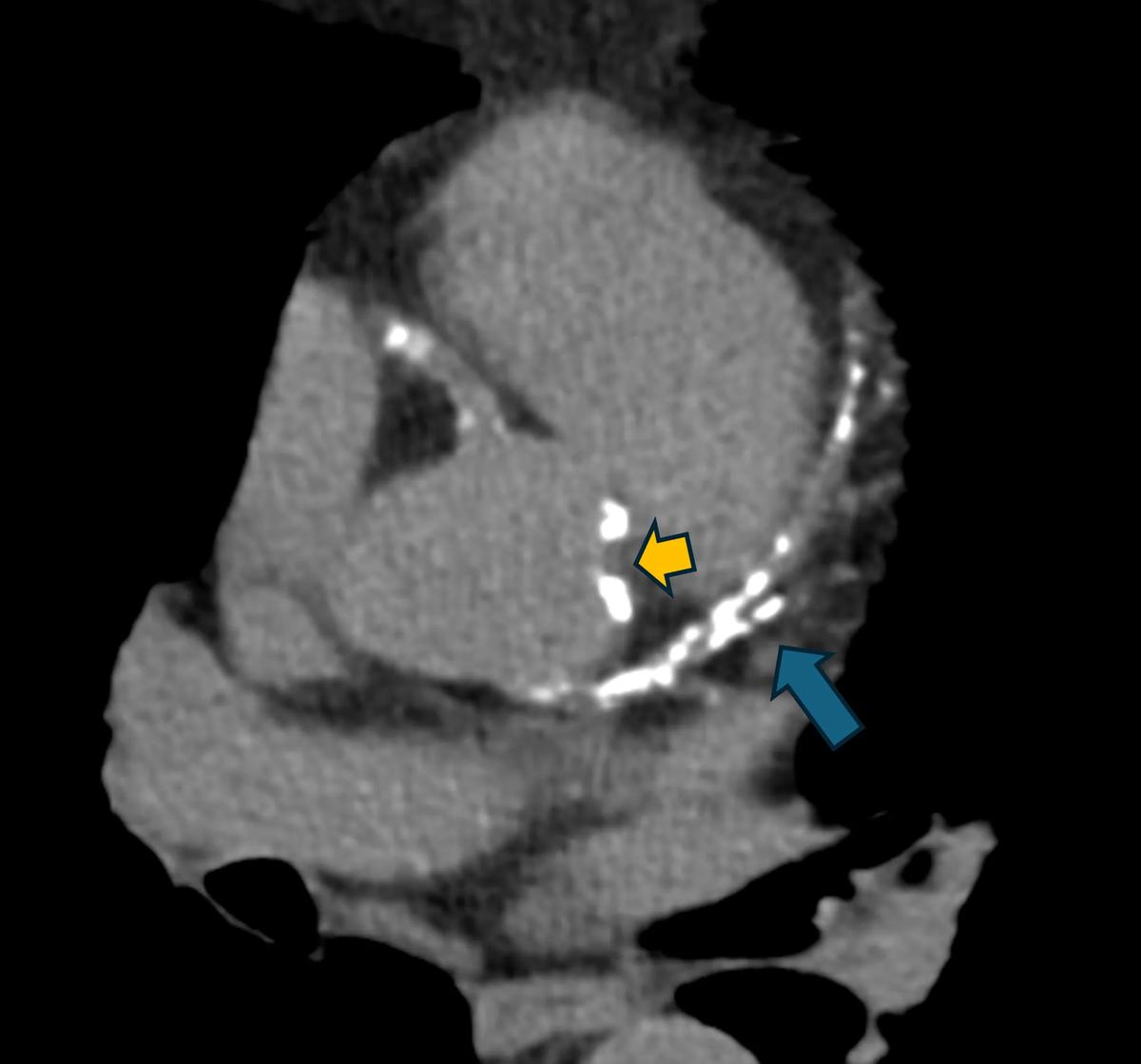
Image content: This image is available to view online.
View image online (https://assets.clevelandclinic.org/transform/86622648-892e-41f9-960c-fe10055459a0/CT-showing-heart-calcification)
Figure. Non-contrast cardiac CT demonstrates severe coronary artery calcification (blue arrow), along with severe aortic valve calcification (yellow arrow) in the setting of severe aortic stenosis.
“The timing of the patient’s presentation was good,” Dr. Jellis observes, “because it enabled treatment before his significant aortic stenosis and CAD led to long-term damage to the left ventricle.” She advised the patient that prompt intervention was clearly indicated, in view of his mean aortic valve gradient of 60 mm Hg and multivessel CAD as well as his symptoms of progressive dyspnea and chest pain.
Advertisement
Although transcatheter aortic valve replacement (TAVR) would be a potential treatment for isolated aortic stenosis, it was not the best option for this patient because of his additional need for multivessel coronary revascularization, which couldn’t be adequately addressed by percutaneous coronary intervention.
So Dr. Jellis recommended combination surgery — aortic valve replacement (AVR) plus multivessel coronary artery bypass grafting (CABG) — and referred the patient to Lars Svensson, MD, PhD, the cardiothoracic surgeon who operated on the patient’s friend who had suggested Cleveland Clinic.
The cardiac CT and echocardiography studies helped inform operative planning, as did additional preoperative studies including ultrasonography of the carotid arteries and lower-extremity veins and chest radiography. All these studies were completed on the day of the patient’s appointment with Dr. Jellis, due to her advance review of his outside studies and proactive coordination. The patient was able to secure a surgery date with Dr. Svensson a few days after seeing Dr. Jellis.
The patient underwent open surgical AVR with concomitant three-vessel CABG. The replacement valve used was the Inspiris Resilia bovine pericardial bioprosthesis. CABG was performed using the left internal mammary artery as a conduit to the left anterior descending artery (LIMA-LAD) along with saphenous vein grafts for the other two bypasses.
The surgery and postoperative course were uncomplicated. After initial care in the intensive care unit, the patient progressed routinely through a step-down unit and was discharged home on postoperative day 7.
Advertisement
At follow-up six weeks after surgery, he was recovering ahead of the anticipated trajectory and echocardiography showed a normally functioning prosthetic aortic valve and preserved left ventricular function. The sternotomy was healing well, and he had resumed gentle physical activity and work-related travel. He planned to participate in cardiac rehabilitation near his home.
His long-term management plan includes annual clinical and echocardiographic follow-up and aggressive modification of cardiovascular risk factors to protect the bypass grafts.
Although this case is just one of hundreds of combination cardiac surgery cases Cleveland Clinic successfully manages each year, the physicians involved feel it has a few points of distinction.
To Dr. Jellis, it exemplifies the efficiency and patient trust that come with the team-based structure and approach of Cleveland Clinic’s Heart, Vascular & Thoracic Institute. She notes that while the patient’s ability to undergo surgery and discharge within less than a month of first reaching out to her cannot always be replicated, it speaks to the seamlessness of the program’s care coordination. “When there is potential for a patient to deteriorate quickly, as in this case, we typically are able to rally as a team and rapidly align our processes to deliver expedited care as needed,” she says.
“This case also underscores the fundamental value of personal trust that’s involved in caregiving,” she adds. “As clinicians, the best compliment we can receive is if another patient recommends us to a friend or family member in their time of need. We do not take that for granted.”
Advertisement
In Dr. Svensson’s view, this case is also notable for how it was shaped by past research at Cleveland Clinic while simultaneously being illustrative of a clinical need that Cleveland Clinic aims to address with newly launched research.
“Our use of the LIMA-LAD graft in this patient was based on the landmark Cleveland Clinic study published in the New England Journal of Medicine 40 years ago that established a clear survival benefit for CABG patients receiving an IMA-LAD graft, particularly for those needing multiple bypasses,” says Dr. Svensson, Chief of Cleveland Clinic’s Heart, Vascular & Thoracic Institute.
Similarly, his choice of the Inspiris valve for the AVR was based on that valve’s incorporation of a specialized anticalcification tissue technology (known as Resilia) in whose development Cleveland Clinic played a key role. Treatment of valve leaflets with this technology confers greater resistance to calcium buildup and structural degradation compared with traditional tissue valves.
“Historically, biological valves have not been used in younger, healthier patients because of their greater deterioration over time relative to mechanical valves,” Dr. Svensson explains. But he notes that long-term data from the multicenter COMMENCE trial, which he recently presented at the 2026 annual meeting of the American Association for Thoracic Surgery, showed an impressive 97.5% rate of freedom from structural valve deterioration at 10 years with an aortic valve bioprosthesis combining the Resilia tissue technology with the Edwards Perimount Magna Ease stent platform. “The risk of deterioration was consistently low across the study’s full range of patient ages, from 50 to 85 years,” Dr. Svensson notes.
Advertisement
“If we impute those COMMENCE data to this patient who received the very similar Resilia-treated Inspiris valve,” he continues, “his risk of structural valve deterioration over the next 10 years is likely around 2%. But if his valve should deteriorate after, say, 15 years, then he is well suited for TAVR at that time since the Inspiris valve has an expandable base that allows for controlled, predictable expansion during a valve-in-valve procedure.”
Additionally, Dr. Svensson notes, the initial patient evaluation in this case is relevant to a clinical scenario that heart teams now encounter with increasing frequency. “Many patients are asking for CT-based calcium scoring, but that raises the question of what to do in the event of an elevated calcium score,” he says. “Do you send patients for cardiac catheterization — with its small but not negligible risk of death, stroke or other complications — or do you just maximize medical treatment? For this patient, the catheterization was vindicated because it revealed significant coronary artery disease, but in many cases the decision isn’t an easy one.”
Noting that the best approach to this scenario is not likely to be studied by industry, Dr. Svensson says Cleveland Clinic is launching an investigator-initiated prospective clinical trial to do so. The study, INVEST-CC, is randomizing 4,000 asymptomatic adults with a coronary artery calcium score ≥ 600 AU and at least one predefined risk factor to evaluate whether early invasive coronary angiography improves clinical outcomes over initial optimal medical therapy alone.
“We now do a lot of calcium scoring, and this is an increasingly widespread question in clinical practice,” Dr. Svensson says. “We’d like to shed more light on how best to use these scores to guide patient care — in cases like this and many others.”
Advertisement

AHA statement details nuanced, evidence-based strategies
The benefits of multiarterial grafting are possible without opening the chest
Collaborative citywide initiative reshapes protocols to boost cardiac arrest survival
For severe cases, complete unroofing of the bridge is imperative
Lower threshold expanded revascularization candidacy without raising early complication rates

Elevated levels of the gut microbial metabolite predict prevalence and adverse outcomes in community-based study
They generally depend on the mutated gene, clone size and clinical setting
Large analysis adds to evidence that absolute diameter alone may miss vulnerable patients
 Search