Locations:





Even patients with reported penicillin allergies can receive it without increased complications

Image content: This image is available to view online.
View image online (https://assets.clevelandclinic.org/transform/236c8960-7af2-42db-96b1-75f7e74f7d94/iv-closeup-1402832091)
Intravenous medication in an operating room
Cefazolin is the preferred first-line prophylactic antibiotic for total joint arthroplasty, yet many patients don’t receive it. Patients with a reported penicillin allergy are often given second-line agents, despite strong evidence linking these alternatives to higher rates of periprosthetic joint infection.
Advertisement
Cleveland Clinic is a non-profit academic medical center. Advertising on our site helps support our mission. We do not endorse non-Cleveland Clinic products or services. Policy
This practice is driven largely by long-held concerns about cross-reactivity between penicillin and cephalosporins (like cefazolin). However, growing evidence suggests this risk is overstated, and many patients believed to be allergic to penicillin can safely receive cefazolin.
At Cleveland Clinic, this evolving understanding prompted a cefazolin-first prophylaxis strategy for total joint arthroplasty, reserving alternative antibiotics for patients with a true contraindication. In a retrospective analysis of nearly 13,000 hip and knee arthroplasties, this approach significantly increased cefazolin use, including among patients with reported penicillin allergy, without increasing complications.
Findings were presented at the American Academy of Orthopaedic Surgeons (AAOS) 2026 Meeting.
“Data from our study may reassure others that using cefazolin more broadly can be safe, even in patient groups that have traditionally not received it,” says senior author Nicolas S. Piuzzi, MD, Vice Chair of Research for Orthopaedics and Rehabilitation at Cleveland Clinic.
According to Dr. Piuzzi, cefazolin is preferred for infection prevention after total hip arthroplasty (THA) and total knee arthroplasty (TKA) due to its favorable safety profile, cost-effectiveness and optimal coverage of skin flora. Use of cefazolin in these procedures has been associated with a 32% lower rate of periprosthetic joint infection compared with alternative antibiotics.
Cefazolin is administered intravenously within one hour before incision (1 g for patients weighing less than 60 kg; 2 g for 60-120 kg; 3 g for more than 120 kg).
Advertisement
“Historically, cefazolin was avoided in patients reporting certain antibiotic allergies due to concerns about beta-lactam cross-reactivity,” says Cleveland Clinic allergist and immunologist Ruchi Shah, MD, coauthor of the recent study. “There were very generalized avoidance measures. Updated literature suggests that there is more nuance to these allergies, and strict avoidance may not be necessary.”
In 2022, updated practice parameters published in The Journal of Allergy and Clinical Immunology recommended that for patients with unverified, nonanaphylactic penicillin allergy, cephalosporins can be administered without testing or additional precautions. Even patients with prior anaphylaxis to penicillin may receive non-cross-reactive cephalosporins, such as cefazolin.
Following this guidance, in August 2023, Cleveland Clinic changed its protocol for hip and knee arthroplasty procedures.
“Now we have a ‘cefazolin-for-all’ strategy, excluding only patients with known cephalosporin allergy,” Dr. Piuzzi says.
Since 2023, more than 90% of patients having THA or TKA at Cleveland Clinic have received cefazolin, including 85% or more of those with reported penicillin allergy.
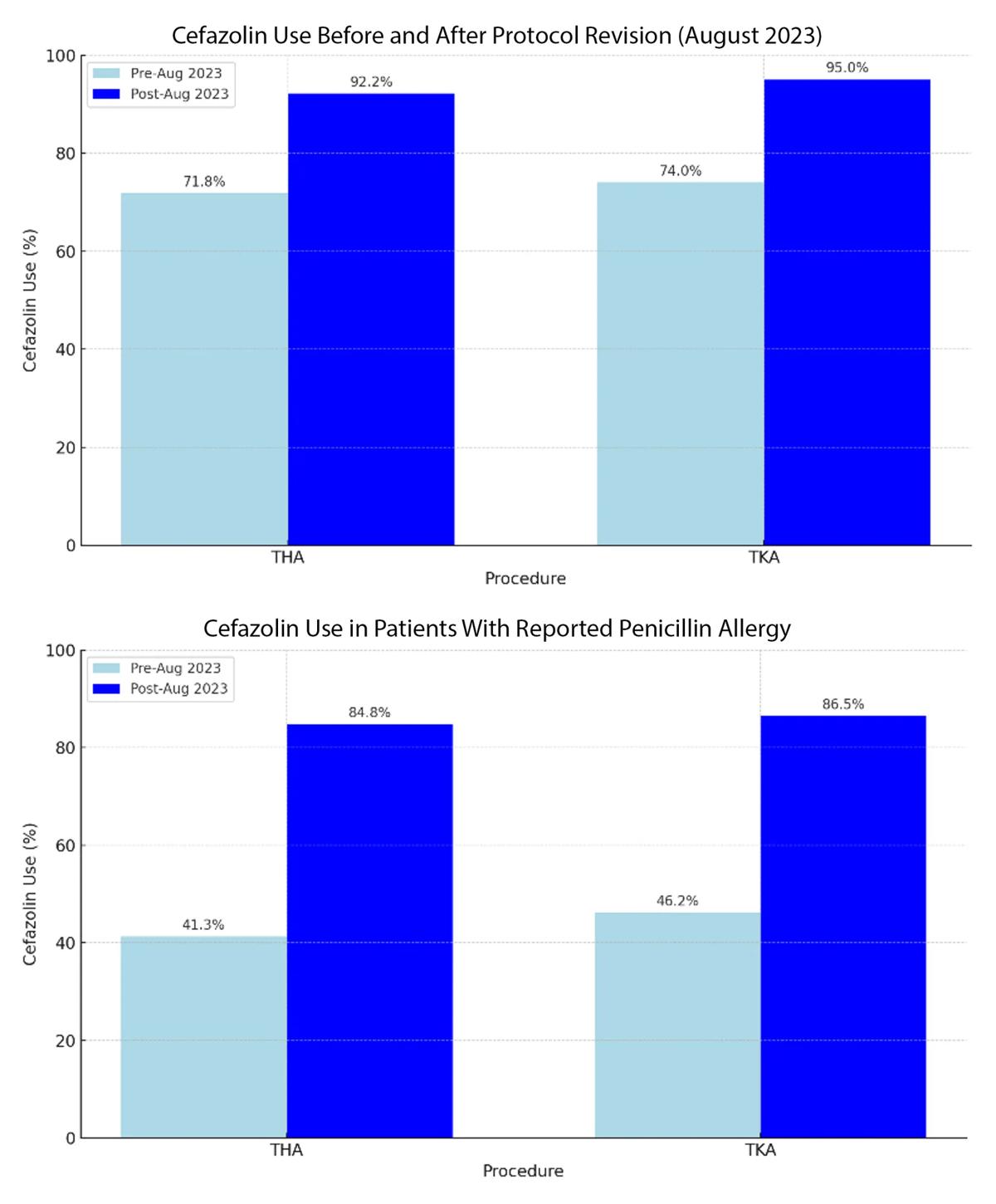
Image content: This image is available to view online.
View image online (https://assets.clevelandclinic.org/transform/a49acffc-3829-422d-8657-0c6d9c7e74f2/Cefazolin-table-cqd)
Cleveland Clinic’s study presented at AAOS included nearly 6,000 patients who had primary THA and more than 7,000 who had primary TKA between 2016 and 2024. Safety outcomes, including hypersensitivity, 90-day readmissions and one-year mortality, were evaluated before and after the August 2023 implementation of the “cefazolin-for-all” strategy.
Advertisement
Broader cefazolin use was associated with lower hypersensitivity and lower one-year mortality, without clinically meaningful increases in readmissions.
THA Safety Outcomes
| Before August 2023 (n = 4,102) | After August 2023 (n = 1,531) | P value | |
|---|---|---|---|
| Hypersensitivity | 16 (0.40%) | 1 (0.07%) | 0.04 |
| 90-day readmission | 191 (4.66%) | 87 (5.68%) | 0.131 |
| 1-year mortality | 50 (1.22%) | 5 (0.33%) | 0.004 |
| Hypersensitivity | |||
| Before August 2023 (n = 4,102) | |||
| 16 (0.40%) | |||
| After August 2023 (n = 1,531) | |||
| 1 (0.07%) | |||
| P value | |||
| 0.04 | |||
| 90-day readmission | |||
| Before August 2023 (n = 4,102) | |||
| 191 (4.66%) | |||
| After August 2023 (n = 1,531) | |||
| 87 (5.68%) | |||
| P value | |||
| 0.131 | |||
| 1-year mortality | |||
| Before August 2023 (n = 4,102) | |||
| 50 (1.22%) | |||
| After August 2023 (n = 1,531) | |||
| 5 (0.33%) | |||
| P value | |||
| 0.004 |
TKA Safety Outcomes
| Before August 2023 (n = 5,269) | After August 2023 (n = 1,947) | P value | |
|---|---|---|---|
| Hypersensitivity | 20 (0.40%) | 1 (0.05%) | 0.03 |
| 90-day readmission | 253 (4.80%) | 101 (5.19%) | 0.539 |
| 1-year mortality | 56 (1.06%) | 7 (0.36%) | 0.007 |
| Hypersensitivity | |||
| Before August 2023 (n = 5,269) | |||
| 20 (0.40%) | |||
| After August 2023 (n = 1,947) | |||
| 1 (0.05%) | |||
| P value | |||
| 0.03 | |||
| 90-day readmission | |||
| Before August 2023 (n = 5,269) | |||
| 253 (4.80%) | |||
| After August 2023 (n = 1,947) | |||
| 101 (5.19%) | |||
| P value | |||
| 0.539 | |||
| 1-year mortality | |||
| Before August 2023 (n = 5,269) | |||
| 56 (1.06%) | |||
| After August 2023 (n = 1,947) | |||
| 7 (0.36%) | |||
| P value | |||
| 0.007 |
“Expanding cefazolin use in patients undergoing hip or knee arthroplasty has been both safe and effective,” says coauthor Matthew Deren, MD, Director of the Adult Reconstruction Fellowship at Cleveland Clinic. “We observed fewer hypersensitivity reactions and improved survival without compromising surgical safety.”
The research team now is preparing to track long-term impacts of cefazolin use on periprosthetic joint infection rate, implant survivorship and patient-reported outcome measures.
“This study adds to the growing evidence that cefazolin can be safely administered to most patients, including many with reported penicillin allergy,” Dr. Piuzzi says. “We advocate for broader cefazolin use in hip and knee surgeries, but also in other arthroplasty procedures.”
If a patient is concerned about a reaction due to a presumed penicillin allergy, evaluation by a board-certified allergist may be appropriate. Of patients in a 2019 study who received allergy testing before THA or TKA, 97% were cleared to use cephalosporin antibiotics.
“Allergies can change over time,” Dr. Shah says. “And many reactions attributed to a penicillin allergy, including rash and gastrointestinal symptoms, may have been misinterpreted and may not have been actual allergic reactions. About 10% of the U.S. population reports a penicillin allergy, but when evaluated, more than 90% can actually tolerate penicillins.”
Advertisement
Advertisement
Advertisement

Recognition could help guide health policy, workforce development and resource allocation worldwide
Fellows’ research shows quality of arthroplasty training

Cleveland Clinic orthopaedic surgeons share their best tips, most challenging cases and biggest misperceptions
Protein expression in synovial fluid indicates patients’ immune factors may be involved

Physical therapy before surgery is intended to optimize outcomes after surgery
Collaboration must cross borders and disciplines

Multidisciplinary care can make arthroplasty a safe option even for patients with low ejection fraction

Clinical complexity demands personalized care strategies
 Search