Locations:





Study looked at mobility measures and safety
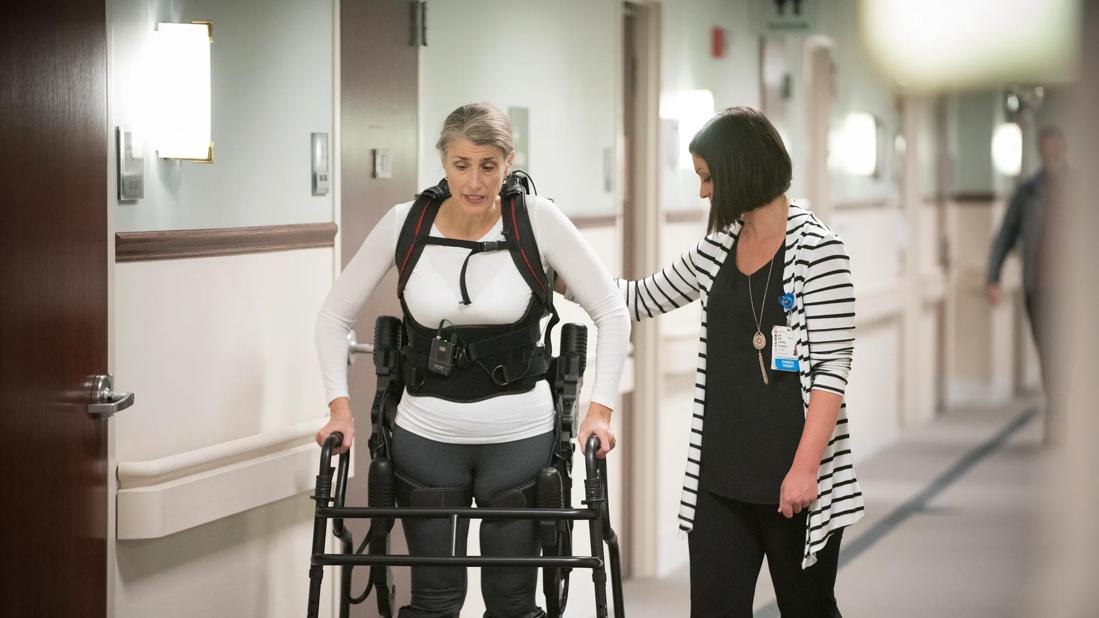
Image content: This image is available to view online.
View image online (https://assets.clevelandclinic.org/transform/94e58689-e711-4484-b7ef-545a453ed832/CCM-1750352_10-16-19_202_RN-jpg)
Physical therapist helping patient walk with a powered exoskeleton and walker
Mobility issues affect an estimated 50% to 80% of people with multiple sclerosis (MS), increasing fall risks and significantly reducing quality of life. The use of powered exoskeletons in physical therapy for patients with MS is still emerging, but a recent Cleveland Clinic study found the technique is safe and feasible, opening the door for deeper inquiry.
Advertisement
Cleveland Clinic is a non-profit academic medical center. Advertising on our site helps support our mission. We do not endorse non-Cleveland Clinic products or services. Policy
The researchers reviewed medical records of 21 individuals with MS who participated in physical therapy gait training with the assistance of a powered exoskeleton (PES) at Cleveland Clinic’s neurorehabilitation clinic. The cohort was 76% female with an average age of 56, and most had progressive MS and required use of a mobility aid.
Patients completed between three and 85 training sessions (median: 11). Five of the patients experienced adverse effects during the study period, but none were serious nor prevented them from continuing the training.
Results of study measures varied widely from patient to patient. Francois Bethoux, MD, Director of Rehabilitation Services at Cleveland Clinic’s Mellen Center for Multiple Sclerosis, underscores that the study of PES use in patients with MS is relatively new compared to use in stroke and spinal cord injury. While he knows of no research that shows PES to be superior to traditional gait-training methods, Dr. Bethoux says it might prove to be the right tool for certain patients.
“We're still exploring the possibilities for added benefit in using the exoskeleton,” says Dr. Bethoux. “It's really part of rehabilitation management.”
In the context of MS, PES use is typically for people who can walk but with difficulty.
“The big goal here is improved gait pattern,” he says. “We're not necessarily trying to increase the speed that people are walking. We are hoping to improve the distance that people can walk, without injuries, and to allow their steps to come more easily and efficiently. And so we're hoping to trigger brain plasticity by providing variable assistance to make steps.”
Gait training with or without an exoskeleton can provide temporary improvement of walking in most people with MS, says Dr. Bethoux, but it can present different challenges than for those who have had strokes or spinal cord injuries. MS is progressive, so patients experience disease-related changes over time, and even variability from one day to the next or between morning and afternoon. MS-related fatigue also limits how much gait training they can do.
Dr. Bethoux notes that he has seen individual cases in which a person who had had little success with traditional therapy experienced more benefit with PES-assisted training.
Advertisement
“When you look at a group on average, the disclaimer ‘results vary’ applies. So we're trying to tease out the predictors of people who have more benefit,” he says.
The researchers looked at two groups of measurements: those pertaining to patients’ mobility before and after the PES-assisted period, and exoskeleton training measures as recorded at the first and the final therapy sessions.
Exoskeleton measures – The average number of steps taken at each session was 517.7 during an average of 21 minutes of walk time. A statistically significant increase was found between the first and final gait-training sessions in walking time, number of steps and programmed step length. Step height and swing time (the time the foot spends off the ground during a step) did not change significantly.
Mobility measures – Clinical outcomes available on a subset of patients showed no significant changes in performance of a timed 25-foot walk test (T25FW) or a five-times sit-to-stand test. These tests were performed without PES. Patients also did not change the mobility devices they used in daily life at the end of the intervention.
At the end of the study training period, there was a statistically significant increase in the time participants took to complete the timed up and go exercise (TUG), which measures how long it takes the person to rise from a chair without using their hands, walk three meters, return to their chair and sit down.
Number of training sessions – Compared to patients who had fewer than 10 training sessions, patients who did 10 or more had a larger mean increase in walk time and step length with PES during treatment sessions. No significant differences between the two groups were evident in walking and mobility outcomes without PES.
Advertisement
Since Cleveland Clinic first piloted five patients with MS on PES gait training at the Mellen Center, the use of this technology has become more frequently integrated into the therapy.
“We wanted to reflect on our experience with using the exoskeleton in routine practice in people with MS who had completed therapy, with a variable number of sessions,” says Dr. Bethoux. “Our paper confirmed that there were no major adverse effects with the exoskeleton. A study like this doesn’t prove benefit, but it shows that in some people, the intervention seems to work better than others, so we can try to tease out ideas for future studies.”
Advertisement
Advertisement

Inflammatory protein eotaxin-1 may be a marker of future cognitive decline

Therapists and physicians collaborate to get medically stable patients moving

Designed for digitization, distance health, discovery and more
Combining customized care, research capabilities and flexibility for the future

Leading investigators outline a new roadmap for clinical trials and observational research

The selective D1/D5 dopamine agonist provides symptom relief and improves daily function.
5-year funding award supports cohort expansion and deep phenotyping of AD and related dementias

Highest response rates seen with stress-lowering techniques like yoga, meditation and mindfulness
 Search