Locations:





Procedure places the center among only a handful worldwide to offer the minimally invasive approach
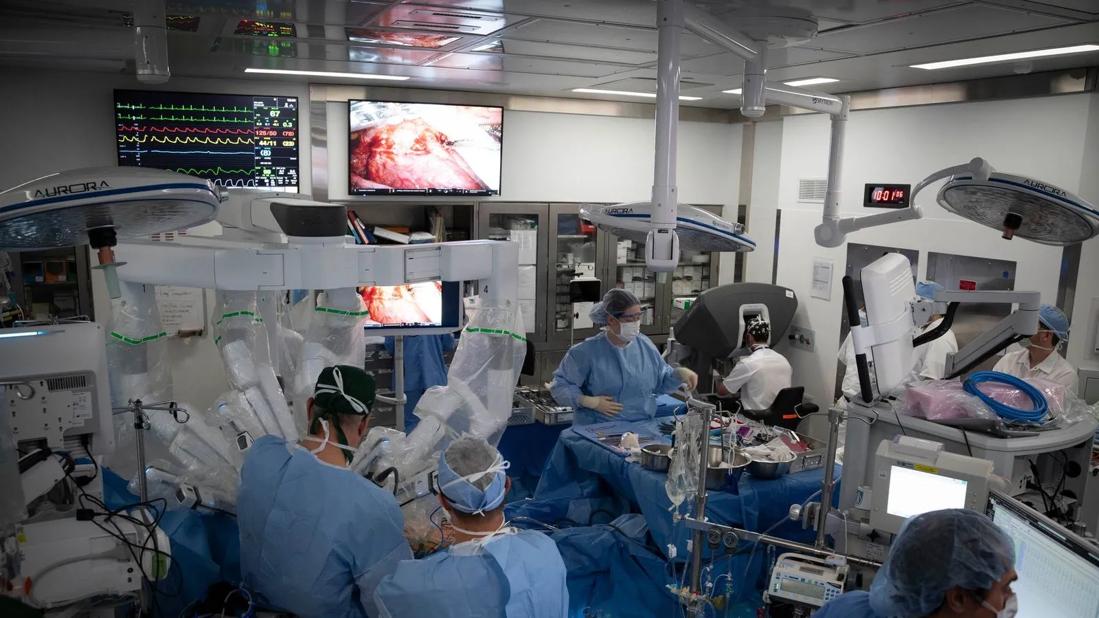
Image content: This image is available to view online.
View image online (https://assets.clevelandclinic.org/transform/d730001f-101b-45fe-b95b-1f2b74843f36/Robotic-lung-image)
operating room during robotic lung transplant surgery
Above: The operating room during Cleveland Clinic's first robot-assisted lung transplant case, with lead surgeon Gregory Jones, MD, at the console at top right.
Advertisement
Cleveland Clinic is a non-profit academic medical center. Advertising on our site helps support our mission. We do not endorse non-Cleveland Clinic products or services. Policy
Earlier this year Cleveland Clinic successfully completed its first robotically assisted lung transplant in the U.S. The procedure was performed by a surgical team led by thoracic surgeon Gregory Jones, MD, and supported by Kenneth McCurry, MD, Surgical Director of Lung Transplantation.
The case was a single-lung transplant involving the right lung. The patient was a 74-year-old man with progressive idiopathic pulmonary fibrosis requiring continuous oxygen support. Both lungs were affected, but the disease burden was more significant in the right lung. “In such cases, we often offer single-lung transplant in patients over age 70,” Dr. Jones notes.
The patient was placed on the transplant waiting list in February 2026, around the time Cleveland Clinic was finalizing its plans to begin offering robotically assisted lung transplantation on its Main Campus.
“We identified this patient as an ideal candidate for a robotic transplant because his larger chest size provided the space needed to safely and effectively perform the procedure,” Dr. Jones says. “He also was highly motivated and in excellent functional status, which further made him a good candidate.”
When an appropriate donor lung became available in May 2026, Dr. Jones and team performed the 7.5-hour robotic lung transplant with the da Vinci Xi platform that’s used for other robotic thoracic surgery procedures at Cleveland Clinic. Peripheral venoarterial ECMO was used for circulatory support, with arterial access via the right axillary artery and venous access via the right femoral vein.
Advertisement
The robotic platform was docked using five ports requiring small (1-cm) incisions. Right pneumonectomy and introduction of the donor lung were accomplished through a 5.5-cm incision between the ribs, avoiding rib fractures or extensive retraction.
The patient was ambulatory and off oxygen support within 24 hours after surgery. He experienced remarkably low postoperative pain, reporting zero pain from his incisions by postoperative day 1. He was discharged from the ICU within 48 hours after surgery and discharged from the hospital to his home within two weeks.
The patient was faring well at two months after the transplant. He reported that his breathing improved dramatically and that his incisions “all healed up quickly.” Follow-up testing has revealed excellent lung function, and he no longer requires oxygen support.
The case places Cleveland Clinic among a very small number of centers worldwide that perform robotic lung transplantation. One of those other centers is Cleveland Clinic Abu Dhabi, which completed two robotically assisted lung transplants in 2025. “This milestone reflects an important step forward in how we approach lung transplantation, adding another option for some patients who may benefit from a minimally invasive approach.” Dr. Jones says.
The expected benefits of robotic assistance for patients include reduced postoperative pain and easier postoperative breathing, decreased analgesia needs, shortened recovery time and improved cosmesis through avoidance of sternotomy and other large incisions. For surgeons the benefits include magnified 3D visualization and greater maneuverability enabled by the robot’s articulated instruments.
Advertisement
“With the robot we can use the camera inside the patient to visualize the surgical field in a way that would require significant rib or sternal spreading in an open transplant, which often can result in substantial postoperative pain,” Dr. Jones notes.
“This achievement reflects the outstanding collaboration and innovation across our lung transplant surgical and medical teams,” adds Dr. McCurry, who serves as Cleveland Clinic’s Enterprise Director of Transplantation in addition to directing the surgical lung transplant program. “While not all the complex patients referred to us for lung transplantation will be eligible for a robotic approach, we expect to expand the indications as our experience grows and the technology and technique evolve. We are confident that robotic surgery will play an increasingly important role not only in lung transplantation but also in kidney, liver and even uterus transplantation, resulting in improved patient outcomes and greater patient satisfaction. Cleveland Clinic is investing heavily in this technology and is at the forefront of robotic transplantation and advancing the future of transplantation.”
His colleague Marie Budev, DO, MPH, Medical Director of Lung Transplantation, concurs. “Our lung transplant program remains committed to providing innovative approaches, whether medical or surgical, for patients with end-stage lung disease,” she says, “with an emphasis on patient safety , rapid recovery and successful early and long-term outcomes.”
Advertisement
The lung transplant team has identified several anatomic characteristics that make a patient a candidate for a robotically assisted procedure:
Generally, these criteria translate to possible consideration of robotic assistance for transplant candidates with chronic obstructive pulmonary disease, those with idiopathic pulmonary disease or other forms of interstitial lung disease, and those with combined pulmonary fibrosis and emphysema.
Dr. Jones expects patient selection criteria to expand somewhat as experience with robot-assisted transplantation grows. Similarly, while the initial case took somewhat longer than a traditional open lung transplant, ongoing refinements in technique and workflow are expected to streamline the procedure and bring operative times closer to those of conventional lung transplants.
Advertisement
Post-transplant care is generally the same as after an open transplant. “We don’t change any medications, and we’re not changing any of the pathways apart from everything being a bit more expedited, which will be determined on a case-by-case basis,” says Dr. Jones, who was struck by the speed of recovery for this first patient. “His freedom from pain on the morning after surgery exceeded my expectations. His discharge from both the ICU and the hospital was faster than we experience for many patients who receive a lung transplant.”
Dr. Jones’ experience with open lung transplants and with various robot-assisted thoracic surgery procedures prepared him for this case, along with discussion and collaboration with other centers to develop a protocol for the robotic approach. He and others on the lung transplant team then performed cadaver lab simulations and spent many hours in the simulation lab, where the team could practice every step to streamline their process for efficiency and as much predictability as possible.
“One of the biggest challenges has been the lack of standardized protocols for port placement, instrument usage and similar considerations, which is simply due to this being such a novel approach,” Dr. Jones says.
The lung transplant team plans to perform several more single-lung robotic transplants — ideally of both right and left lungs — to gain additional experience before proceeding to full robotic assistance for bilateral procedures.
Future investigations will explore alternative donor lung extraction and insertion approaches, including transdiaphragmatic incisions that may facilitate implantation of larger donor lungs while preserving the procedure’s minimally invasive nature. “Further down the road, there may be an opportunity to use a single-incision robot for lung transplantation,” Dr. Jones says.
Meanwhile, additional Cleveland Clinic lung transplant surgeons will be trained to gain proficiency in the robotic approach as experience grows.
Advertisement
Dr. Prabhu discusses mentorship, collaboration and her vision for the future of the department
Multidisciplinary collaboration is fueling breakthroughs in endoscopic and surgical technology
Join us in Cleveland July 17 for a practical, first-of-kind course

As robotics in the OR grows, so does the role of nurses
Center touts the benefits of neonatal MIS, trains others on the approach
Applications, outcomes and untapped potential
Study finds that fracture and infection are rare
Our new head of pediatric general and thoracic surgery shares his passion and vision
 Search