Locations:





Multidisciplinary collaboration is fueling breakthroughs in endoscopic and surgical technology
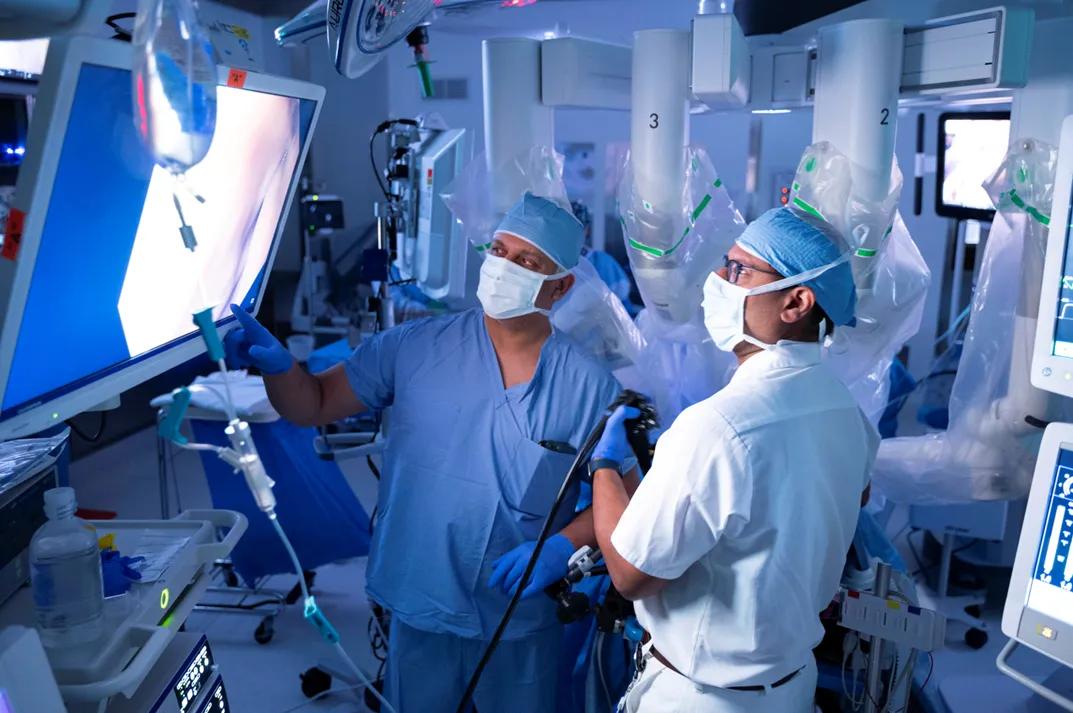
Image content: This image is available to view online.
View image online (https://assets.clevelandclinic.org/transform/c92f015c-7693-4387-89cb-e41d89aa79a9/Bhatt-endoscopy)
Dr. Bhatt with clinician
Advances in endoscopy are permitting more complex procedures, allowing more patients to avoid open surgery and have minimally invasive care. However, as the complexity of endoscopic procedures has grown, the technology to support these endeavors has not.
Advertisement
Cleveland Clinic is a non-profit academic medical center. Advertising on our site helps support our mission. We do not endorse non-Cleveland Clinic products or services. Policy
“These types of endoscopic procedures have become akin to surgery,” says Amit Bhatt, MD, a gastroenterologist and Co-Director of the Endoluminal Surgery Center at Cleveland Clinic. “The main issue is that the endoscope has no stability, triangulation or second hand, and it’s extremely technically challenging for us to emulate what we want to do surgically with the current endoscopic technology. The technical difficulty makes the procedure time-consuming and difficult, limiting the number of people performing them, and thus, fewer patients have access to these minimally invasive endoscopic approaches. For the field to move forward, we need more advanced endoscopic platforms.”
With an eye on overcoming these challenges, Dr. Bhatt leads Cleveland Clinic’s Endorobotics Collaborative. The multidisciplinary, purpose-driven program was constructed to support and partner with medical device companies at every phase of endorobotic development — from early-stage ideation and concept validation through clinical implementation.
“We have assembled the people, the facilities and the patient volume to be a true development partner — not just a test site," says Dr. Bhatt. “We can take a concept from the bench to an in-vivo model to a well-designed clinical trial, all within one institution.”
The Endorobotics Collaborative is a dedicated working group of gastroenterologists, surgeons, bioengineers and scientists unified by their dedication to endorobotics innovation.
This type of collaboration ensures that all perspectives are accounted for throughout the device development process.
Advertisement
“What might seem obvious to a bioengineer may not be obvious to a surgeon, and vice versa,” says Dr. Bhatt. “Engaging in these discussions not only promotes thoroughness, but they also speed up the process. Additionally, these conversations also help reduce blind spots that could derail products in later stages.”
The Biorobotics and Mechanical Testing Core (BRMTC) started in 2005 and has worked on several projects since its creation. Recently, the full-time, six-person team of mechanical engineers has been primarily working on state-of-the-art robotic orthopaedic biomechanical testing to aid in clinical research. Their device, simVITRO®, merges software and hardware components for orthopaedic biomechanical testing.
“What’s great about Cleveland Clinic is we already have the expertise involved with developing and bringing a device to market, as well as the infrastructure already in place,” says Robb Colbrunn, D Eng, Project Staff Manager of the BRMTC. “We wear a lot of hats—testing services, sales, support, development, and grant writing. For example, we have been working for several years on NIH funding for spine pain diagnostics and incorporating AI and motion tracking. Currently, we’ve spent a lot of our focus on orthopedics, but we’re looking for broader applications that align with patient care and safety.”
This level of expertise and collaboration has already demonstrated results. The group has shown the feasibility of endoluminal robotic platforms, with work presented at SAGES and Digestive Disease Week
Advertisement
“Thanks to the resources and size of Cleveland Clinic, we have the ability to be involved in development and testing,” says Dr. Bhatt. "We are able to meet the scientific rigor and operational efficiency that FDA submissions demand.”
Beyond the ability to carry out prospective, well-controlled feasibility and efficacy studies, and IDE and De Novo / 510(k) supporting clinical trials, one of the major benefits of Cleveland Clinic’s global footprint is the ability to coordinate across multiple sites to collect large amounts of research data.
“We care for thousands of patients not only throughout the United States, but also in London and Abu Dhabi,” says Dr. Bhatt. “This enables us to work with companies and conduct clinical testing responsibly, efficiently and on a wide scale. We have an ideal environment for evaluating workflow integration, training pathways and real-world usability of new endorobotic platforms."
Dr. Bhatt and his team are currently working on several projects, including a clinical lab study looking to prove the effectiveness of endorobotic systems. The team is also involved in helping with the development of these technologies.
“Cleveland Clinic holds a unique position in that we offer a uniquely integrated approach — we are a single-institution program with national reach, international patient populations and decades of endoscopic surgical leadership,” he says.
Founded in 2019, Cleveland Clinic’s Endoluminal Surgery Center supports clinical research by offering a setting where technological innovations are used to help actual patients on a wide scale.
Advertisement
The group believes that for the field of endoscopic surgery to move forward, endoscopic stability is paramount. Having triangulation where the surgeon’s eyes are independent of their maneuvering devices can make procedures easier and more patients can benefit from it.
“This is something that we can standardize,” says Dr. Bhatt. “Honestly, we also need to make it ergonomically easier as well. Endoscopy puts so much stress on these physicians' bodies because we're in torque positions for these procedures. Besides being better for patients, this technology would also probably be better for physicians.”
With the leadership of Miguel Regueiro, MD, as Chief of the Digestive Disease Institute, endorobotics is not a peripheral initiative—it is an institutional strategic priority. "I am committed to the advancement of DDI innovation and the endorobotics initiative is an institutional strategic priority," says Dr. Regueiro.
Dr. Bhatt and the rest of the Endorobotics Collaborative believe that the future of gastrointestinal surgery will be accomplished endoscopically. Their vision focuses on developing robotic platforms that offer the level of stability, triangulation and ergonomic design that current flexible endoscopes lack.
“Sometimes, to make a certain movement endoscopically, I have to turn my shoulder to the left, bring my arm down and use the wheel just to make one simple movement,” says Dr. Bhatt. “On robotic controls, all of that can be done just by moving your hand to the left. The robotic platforms also have an advantage since it's much easier to learn the devices through a virtual realm or training system.”
Advertisement
With any new technology, Dr. Bhatt stresses the importance of starting with the basics and then moving towards the more complex. Initially, they wanted to do endoscopic procedures that were technically challenging to perform.
“Endoscopic submucosal dissection is really one of the hardest things that we can do with an endoscope,” he says. “I think if you can come up with a solution for ESD, then the potential really opens for helping a lot of different procedures.”
From there, Dr. Bhatt envisions suturing and endobariatrics as a natural extension to pursue next, and ultimately, the pursuit could lead to entirely new categories of procedures made possible by robotic platforms.
“We really believe that the future of GI surgery is going to be endoscopic,” says Dr. Bhatt. “There is a need in this space for partners who combine clinical credibility, engineering rigor, and research infrastructure. Cleveland Clinic offers all three. We want to help shape the future, and we believe the best way to do this is through collaboration.”
Investigators and technology developers are invited to engage directly with the Endorobotics Collaborative at the upcoming Cleveland Clinic Emerging Endoscopy & Surgery Technology Summit. The Summit brings together global leaders in therapeutic endoscopy, surgical robotics and device development to share the latest advances and forge the partnerships that will shape the next generation of GI care.
Advertisement
Procedure places the center among only a handful worldwide to offer the minimally invasive approach
Dr. Prabhu discusses mentorship, collaboration and her vision for the future of the department
Join us in Cleveland July 17 for a practical, first-of-kind course

As robotics in the OR grows, so does the role of nurses
Center touts the benefits of neonatal MIS, trains others on the approach
Applications, outcomes and untapped potential
Study finds that fracture and infection are rare
Our new head of pediatric general and thoracic surgery shares his passion and vision
 Search