Locations:





New framework better distinguishes stable from critically ill patients
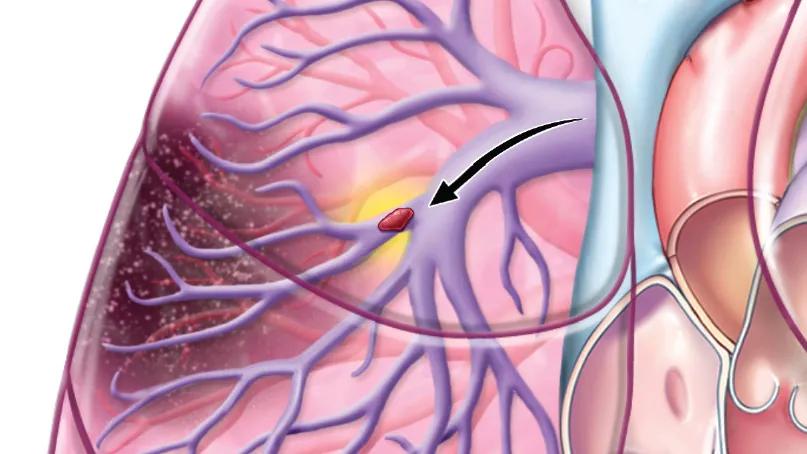
Image content: This image is available to view online.
View image online (https://assets.clevelandclinic.org/transform/17d43410-964f-4244-9615-e34749b00a74/Pulmonary-Embolism-Labeled)
clot in a lung passageway with an arrow pointing at it
Recent months saw the release of the first-ever comprehensive, multidisciplinary clinical guideline in the U.S. on the evaluation and management of adults with acute pulmonary embolism (PE).
Advertisement
Cleveland Clinic is a non-profit academic medical center. Advertising on our site helps support our mission. We do not endorse non-Cleveland Clinic products or services. Policy
The document, issued by a multispecialty group of 10 medical societies spearheaded by the American Hospital Association (AHA) and the American College of Cardiology (ACC), provides a welcome alternative to the most recent (2019) acute PE guidelines from the European Society of Cardiology (ESC), which U.S. physicians found insufficient to meet clinical needs.
“The ESC guidelines divide patients with PE into three risk categories: low, intermediate and high,” says Cleveland Clinic vascular medicine physician Leben Tefera, MD, who served on the writing committee for the AHA/ACC/Multisociety guideline. “A general classification system like that makes it hard to know which patients are critically ill and might benefit from evolving technology. We wanted a more clinically appropriate classification that would be helpful in differentiating patients who are stable enough to go home the same day from those who are very sick. Now we have it.”
PE may be managed by various types of clinicians — pulmonologists, critical care specialists, vascular medicine physicians, cardiologists, emergency medicine physicians, interventional radiologists and others — which has rendered it somewhat of an orphan disease.
Dr. Tefera suspects that this ambiguity about the specialty to which PE “belongs” may be a key reason why medical organizations have been hesitant to claim ownership of the disease and take up its cause. Fortunately, the AHA and ACC stepped in to fill the need. Nevertheless, developing the guideline proved to be a multiyear process that involved dozens of multidisciplinary experts.
Advertisement
The central feature of the new AHA/ACC/Multisociety guideline — which is jointly published in Circulation and the Journal of the American College of Cardiology — is an updated classification system consisting of five clinical categories of acute PE, ranging from lowest risk (A) to highest risk (E) for adverse outcomes. Categories are divided into subcategories, as detailed in the summary of the classification below.
Patients in Categories A and B have no or mild symptoms and a low risk of severe complications; they typically can be safely discharged from the emergency department. Categories C-E include people with symptoms of acute PE who are at higher risk of adverse outcomes and require hospitalization.
| Essentials of the Classification System |
|---|
| CATEGORY A. Subclinical (incidental and asymptomatic) |
| CATEGORY B. Symptomatic (low clinical severity score) |
| B1. Subsegmental (single/multiple) |
| B2. Non-subsegmental |
| CATEGORY C. Symptomatic (elevated clinical severity score) |
| C1. Normal right ventricle and normal biomarkers |
| C2. Abnormal right ventricle or ≥1 abnormal biomarker |
| C3. Abnormal right ventricle and ≥1 abnormal biomarker |
| ± R. Respiratory modifier (O2 <90%, respiratory rate ≥30, need supplemental O2) |
| CATEGORY D. Incipient Cardiopulmonary Failure |
| D1. Transient hypotension |
| D2. Normotensive shock |
| ± R. Respiratory modifier (>6 L nasal cannula or use of a nonrebreather mask) |
| CATEGORY E. Cardiopulmonary Failure |
| E1. Recurrent or persistent hypotension with cardiogenic shock |
| E2. Refractory cardiogenic shock or cardiac arrest |
| ± R. Respiratory modifier (hypoxemic respiratory failure or ventilatory failure) |
| Essentials of the Classification System |
| CATEGORY A. Subclinical (incidental and asymptomatic) |
| CATEGORY B. Symptomatic (low clinical severity score) |
| B1. Subsegmental (single/multiple) |
| B2. Non-subsegmental |
| CATEGORY C. Symptomatic (elevated clinical severity score) |
| C1. Normal right ventricle and normal biomarkers |
| C2. Abnormal right ventricle or ≥1 abnormal biomarker |
| C3. Abnormal right ventricle and ≥1 abnormal biomarker |
| ± R. Respiratory modifier (O2 <90%, respiratory rate ≥30, need supplemental O2) |
| CATEGORY D. Incipient Cardiopulmonary Failure |
| D1. Transient hypotension |
| D2. Normotensive shock |
| ± R. Respiratory modifier (>6 L nasal cannula or use of a nonrebreather mask) |
| CATEGORY E. Cardiopulmonary Failure |
| E1. Recurrent or persistent hypotension with cardiogenic shock |
| E2. Refractory cardiogenic shock or cardiac arrest |
| ± R. Respiratory modifier (hypoxemic respiratory failure or ventilatory failure) |
“These categories provide much better stratification of patients who are sick and who are not sick,” Dr. Tefera says. “They make it easier to decide whether to treat a patient with anticoagulation alone versus a more advanced therapy like thrombectomy, catheter-based thrombolysis or surgical embolectomy.”
In addition to improving patient care in the short term, the expanded clinical classification system is expected to have a long-term impact on clinical trials.
“A very narrow classification system makes it hard to know which patients are best suited to receive an advanced intervention,” Dr. Tefera explains. “Having additional classes into which patients can fit is helpful in determining which patients will benefit most from a procedure and which don’t need it.”
Recommendations for treating patients in each of the five categories were updated following a review of the extensive literature on acute PE published in recent years. One major change is that low-molecular-weight heparin has replaced unfractionated heparin as a level 1 recommendation for initial parenteral anticoagulation in patients in Categories C1 through E1.
Advertisement
Assessment by a pulmonary embolism response team (PERT) for patients in Categories C through E also was given a level 1 recommendation. As Director of Cleveland Clinic’s multidisciplinary PERT, Dr. Tefera enthusiastically endorses the team’s value in providing comprehensive patient care.
“Our team comprises specialists in vascular medicine, pulmonology, critical care medicine, cardiology and interventional radiology,” he notes. “We closely evaluate patients and then meet on Zoom to discuss what’s best for each one.
“We see patients very rapidly after they are diagnosed, and again within four weeks after they are discharged,” he continues. “We evaluate them for ongoing need for anticoagulation, appropriateness of the anticoagulant, and when to stop anticoagulation. These are important issues that too often can get overlooked after discharge. We have been doing this since 2016, and now this approach is formally recommended in the guideline.”
“Cleveland Clinic’s multidisciplinary PERT cares for a high volume of patients with PE, and we have seen how assessment of right ventricular function, biomarkers, respiratory status and clinical trajectory guides treatment decisions,” adds Aravinda Nanjundappa, MBBS, MD, an interventional cardiologist with a specialty interest in peripheral vascular disease. “This new guideline formalizes these principles and provides a practical framework for contemporary PE care.”
Dr. Nanjundappa says he appreciates how the new classification system moves beyond the traditional “stable versus unstable” model and better reflects the spectrum of disease severity seen in clinical practice. “From the perspective of an interventional cardiologist, it helps identify patients who may benefit from advanced therapies while avoiding unnecessary procedures in lower-risk patients, ultimately improving patient care and future clinical trial design,” he observes.
Advertisement
Advertisement

Formal assessment aimed at unmasking psychological distress following PE treatment

AHA statement details nuanced, evidence-based strategies

The benefits of multiarterial grafting are possible without opening the chest

Collaborative citywide initiative reshapes protocols to boost cardiac arrest survival
For severe cases, complete unroofing of the bridge is imperative
Lower threshold expanded revascularization candidacy without raising early complication rates

Elevated levels of the gut microbial metabolite predict prevalence and adverse outcomes in community-based study

They generally depend on the mutated gene, clone size and clinical setting
 Search