Locations:





‘Sac flow’ is more precise and will ease unfounded patient concerns, experts argue
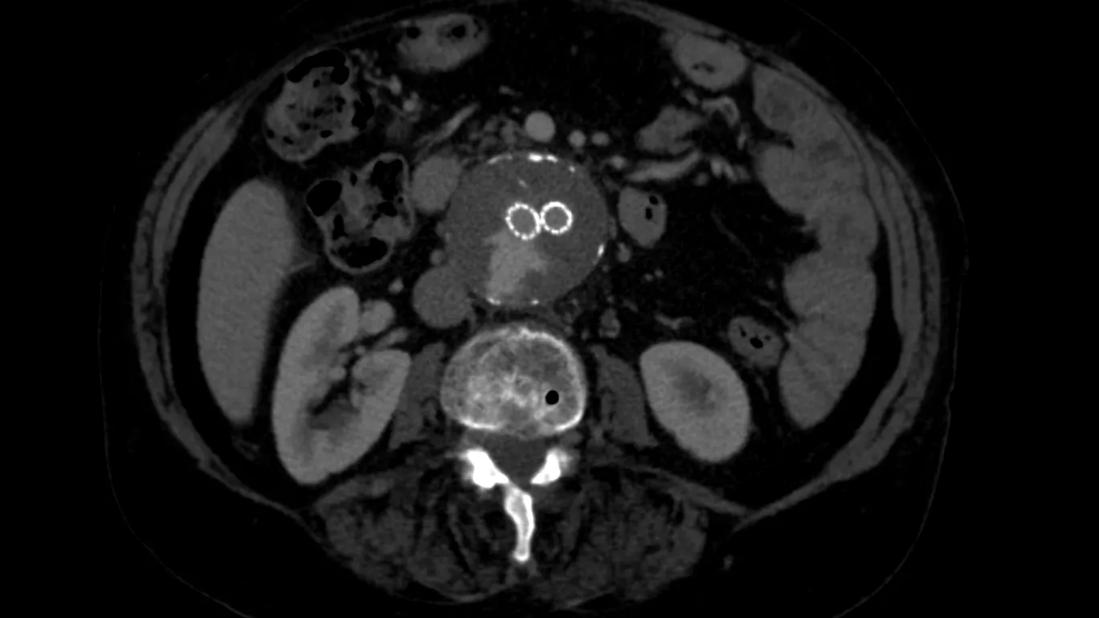
Image content: This image is available to view online.
View image online (https://assets.clevelandclinic.org/transform/b73193e2-0010-4ced-9880-88ce9e51986b/endoleak-cqd)
scan of the inner organs of the human midsection
When it comes to talking about complications after endovascular aneurysm repair (EVAR), the term “endoleak” has overstayed its welcome. That’s the message from a multidisciplinary group of aortic aneurysm experts in an editorial published in the Journal of Vascular Surgery (2026;84[1]:1-3).
Advertisement
Cleveland Clinic is a non-profit academic medical center. Advertising on our site helps support our mission. We do not endorse non-Cleveland Clinic products or services. Policy
“The problem is that ‘leak’ suggests a sense of emergency that doesn’t reflect the benign nature of type II endoleaks, which represent most of these events,” says the editorial’s first and corresponding author, Sean Lyden, MD, Chair of Vascular Surgery at Cleveland Clinic. “In today’s world of widespread patient access to their own medical records, patients see the word ‘endoleak’ and often panic before they can get a clear explanation from a clinician with expert knowledge of EVAR complications.”
To avoid this needless patient anxiety — and the financial burden of potential unnecessary healthcare utilization in response — Dr. Lyden and his co-authors call for “endoleak” to be replaced with the more descriptive “sac flow” to better align the terminology with clinical reality. They also suggest that classifications of sac flow be supplemented by modifiers denoting whether the flow is new or persistent and whether the sac is enlarging or not.
Since it was introduced in 1996, the term “endoleak” has been the standard for describing blood flow outside a stent graft but within an aneurysm sac following EVAR. Despite three decades of use, the word has long had its critics. “Surgeons across the United States have hated the term from early on,” says Dr. Lyden.
The objection stems from the sense that “leak” implies a failure of the EVAR device and a leaking or ruptured aorta. Although concern may be warranted and prompt treatment is needed for type I or type III endoleaks, they are not the equivalent of a ruptured aorta and do not require emergency treatment. For type II endoleaks, which are caused by blood flow through an open side vessel, such as the lumbar, accessory renal or interior mesenteric arteries, evidence over three decades shows that they rarely lead to rupture, even if left untreated.
Advertisement
Dr. Lyden notes that when patients see in their record that their repaired aneurysm has “an endoleak,” they equate this to “leaking” and are apt to interpret it as a life-threatening emergency rather than a clinical subtype.
And the confusion is not limited to patients. Clinicians in non-vascular-related specialties, especially in emergency departments, often lack the nuanced imaging expertise needed to distinguish a benign type II endoleak from a surgical emergency. This can lead to unwarranted patient transfers and expensive interventions. Dr. Lyden recalls multiple instances in his experience when patients were transported via helicopter for what were ultimately determined to be stable and previously recognized sac flows.
To address this confusion, in April 2025 the VIVA Foundation convened a Vascular Leaders Forum — consisting of vascular surgeons, interventional radiologists and cardiologists from across the globe, along with FDA representatives — to consider and propose a new nomenclature. The result is the newly published editorial, which recommends not just the change from “endoleak” to “sac flow” but also a refinement of how these events are categorized.
The authors suggest retaining the previous classification of the events into types I to V with the same letter system to denote subtypes indicating location (where applicable). However, they suggest adding two clinical modifiers to the classification scheme:
Advertisement
Dr. Lyden explains that these new modifiers would add important factors that shape clinical decision-making. “If a sac flow is new, it’s probably a problem, but if it’s persistent, it may not be, so long as it’s not associated with growth,” he says. “We want the nomenclature to reflect how we actually evaluate and manage cases.”
He notes that while he and his co-authors are urging the immediate use of “sac flow” in future manuscript submissions, they acknowledge that formal adoption of the new name and revised classification system requires the backing of major societies in vascular surgery and other relevant specialties, which they are now advocating.
“We see our paper as a necessary rallying cry to start a broader movement,” Dr. Lyden concludes. “By retiring the use of ‘leak’ and focusing on ‘sac flow,’ we have an opportunity to improve the patient experience and better ensure appropriate care.”
His colleague Francis Caputo, MD, Vascular Surgery Director of Cleveland Clinic’s Aorta Center, believes a change is welcome and long overdue. “Since the advent of EVAR, the term ‘endoleaks’ has often caused undue fear and confusion for patients and clinicians,” Dr. Caputo says. “We are finally at a point of renaming them, not to minimize their clinical significance but to provide a better understanding of the pathology.”
Cardiothoracic surgeon Patrick Vargo, MD, concurs. “Endovascular technology continues to advance into new spaces and reach new patients,” he observes. “This makes it all the more important that we use the most precise and descriptive nomenclature to help everyone understand the residual aneurysm flow that can occur with endovascular devices.”
Advertisement
Advertisement

Surgeons can estimate the location of conduction tissue they cannot see
Innovative approach to living-tissue AVR achieves low reintervention rates, excellent long-term survival
Expert advice on repair vs. replacement, timing of surgery in asymptomatic cases and much more
Modified-Bentall single-patch Konno enlargement (BeSPoKE) optimizes hemodynamics, facilitates future TAVR
Experience-based takes on valve-sparing root replacement from two expert surgeons
30-year study of Cleveland Clinic experience shows clear improvement from year 2000 onward
Surgeons credit good outcomes to experience with complex cases and team approach
For many patients, repair is feasible, durable and preferred over replacement
 Search