Locations:





Findings promise to shape future antiplatelet drug development and treatment strategies
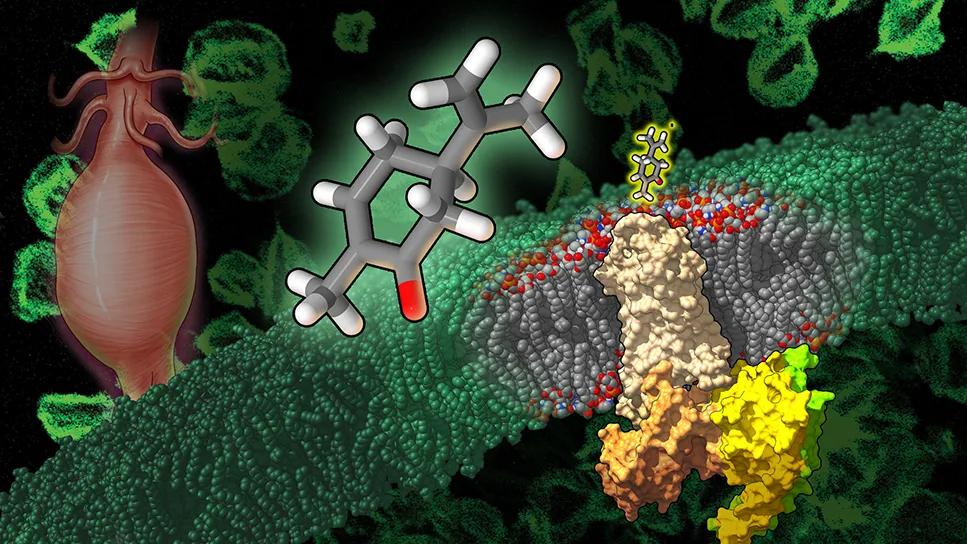
Image content: This image is available to view online.
View image online (https://assets.clevelandclinic.org/transform/fc03977d-e020-4ccd-ba46-fa0feb877111/olfactory-receptor-platelet-reactivity-hero)
stylized illustration of the olfactory receptor
A Cleveland Clinic-led research team has identified a novel therapeutic pathway that could reshape antiplatelet therapy. They found that targeting a specific olfactory receptor located on the surface of platelets may suppress dangerous clot formation without raising the risk of life-threatening bleeds.
Advertisement
Cleveland Clinic is a non-profit academic medical center. Advertising on our site helps support our mission. We do not endorse non-Cleveland Clinic products or services. Policy
“This approach directly addresses the need to reduce the high residual platelet reactivity that persists in some patients despite use of dual antiplatelet therapy,” says Scott Cameron, MD, PhD, Section Head of Vascular Medicine at Cleveland Clinic and senior author of the research, which was published in Circulation (2026;153[23]:1827-1844).
The role of platelets is the focus of a laboratory directed by Dr. Cameron in the Department of Cardiovascular and Metabolic Sciences, Cleveland Clinic Research. In a 2022 publication in the Journal of Clinical Investigation, he and colleagues reported their discovery of olfactory receptors in platelets, which revised the previous assumption that such receptors were present only in nerve pathways from the nose to the brain.
Dr. Cameron’s research interest in potential connections between the sense of smell and blood clots stems from an encounter with a patient in 2018 who was using cleaning chemicals with a strong odor just before the onset of myocardial infarction symptoms. “That made me start to think differently about clotting,” he explains.
Dr. Cameron and colleagues also knew from prior work that odor molecules — such as carvone, the active compound in spearmint — could activate platelets. Since odors are not usable as drugs, they wanted to instead find stable, modifiable chemical compounds that could be used as therapeutics. Building on their prior research on ectopic olfactory receptors in the vasculature, they focused on OR2L13, the most prevalent olfactory receptor identified in human platelets.
Advertisement
In their current study, the researchers conducted a high-throughput screen of 8,000 bioactive, nonodorant compounds to identify potential agonists for the OR2L13 receptor. The most promising candidate, a chemical probe designated CCF0054500, was evaluated in a series of ex vivo human studies and in vivo murine models. The human studies involved tested the compound using platelets isolated from patients with established coronary artery disease (CAD) and peripheral artery disease (PAD).
Several key findings emerged:
Advertisement
In addition to identifying CCF0054500 as a chemical probe that activates an olfactory receptor integral to hemostasis, the research team also discovered how it does so — by disrupting the actin cytoskeleton, the structure underneath the membrane of the platelet.
Briefly, unlike traditional agents, CCF0054500 triggers the phosphorylation of heat shock protein 27. This signaling event leads to depolymerization of the actin cytoskeleton, essentially preventing the platelet from spreading or changing shape to form a stable clot.
“This insight may benefit development of future antiplatelet therapy strategies,” Dr. Cameron observes.
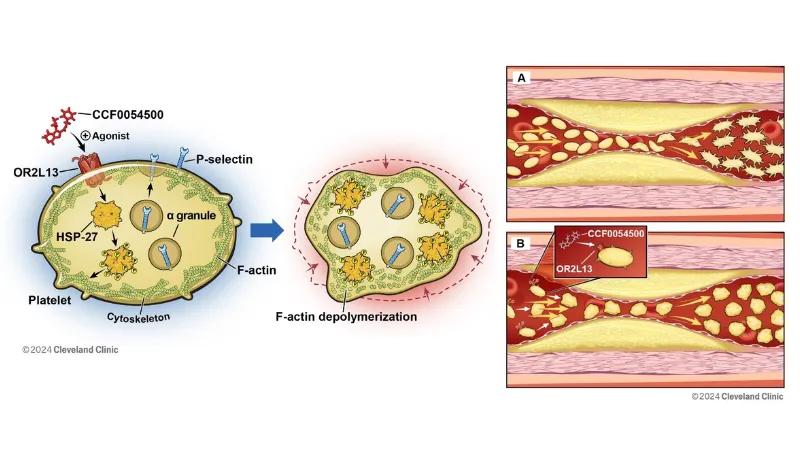
Image content: This image is available to view online.
View image online (https://assets.clevelandclinic.org/transform/a6081f6c-a277-4214-9c31-005280fd1fda/Social-Blurbs-74)
Illustration depicting the effects of activating the platelet olfactory receptor OR2L13 (shown as the red transmembrane protein in the left panel) with a compound identified by the Cameron lab (CCF0054500). The middle panel shows disruption of the platelet cytoskeleton accompanied by changes in membrane shape. In the paired images on the right, panel A demonstrates increased platelet reactivity within a narrowed vessel (stroke risk), while panel B shows reduced platelet activity following addition of the compound. Image created by Dave Schumick.
On the clinical front, the researchers note that further pharmacokinetic studies and human trials are needed to explore the practical potential of these findings. “With that essential caveat,” Dr. Cameron says, “targeting platelet OR2L13 appears to represent a promising new frontier in the prevention of arterial thrombosis, particularly for patients at risk despite standard-of-care therapy. By use of a signaling pathway that leaves the protective mechanisms of hemostasis intact, this approach could offer a safer alternative for high-risk populations, including the elderly and those with complex atherosclerotic disease.”
“This novel approach, meticulously characterized by Dr. Cameron and his team using an olfactory receptor agonist, is particularly compelling because it appears to act through a downstream mechanism common to all the pathways of platelet activation that have traditionally been targeted individually with antithrombotic medications,” notes interventional cardiologist A. Michael Lincoff, MD, who wasn’t involved in the study. “While the finding that this agent can inhibit thrombosis without compromising protective hemostasis in mouse models remains to be corroborated in humans, this therapy holds exciting potential as a means of achieving the sweet spot of suppressing residual high platelet reactivity in patients with cardiovascular disease without excessive bleeding risk.”
Advertisement
Advertisement
Advertisement

Combined hematology-gynecology/adolescent medicine clinic addresses major gap in care

The relationship between MTHFR variants and thrombosis risk is a complex issue, but current evidence points to no association between the most common variants and an elevated risk

Pinpointing how tumors reprogram platelets and trigger blood clots

IV thrombolysis should not be delayed because of planned thrombectomy

Aim is for use with clinician oversight to make screening safer and more efficient

Findings help close the knowledge gap around VTE practice patterns

Confounding symptoms and a complex medical history prove diagnostically challenging

Oral anticoagulants may be beneficial but need to be balanced against bleeding risks
 Search