Locations:





The steep learning curve is easing as robotics, VR and improved imaging technologies enhance precision and surgeon confidence
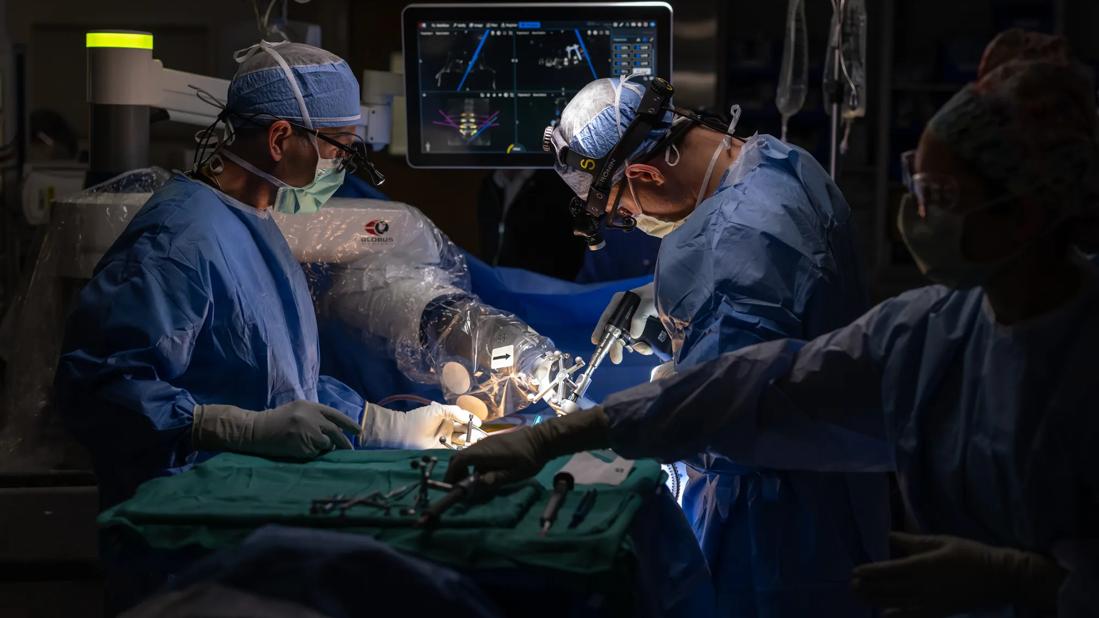
Image content: This image is available to view online.
View image online (https://assets.clevelandclinic.org/transform/fe10efaa-4a3c-498a-af3d-4b2549e072bc/NEU_3767808_04-18-23_1060_AMO-jpg)
surgeons with new spine robot during minimally invasive surgery
The central philosophy behind minimally invasive spinal surgery (MISS) is to match the outcomes of traditional surgery while causing less tissue disruption and potential damage. There are several benefits of MISS — reduced perioperative morbidity, lower surgical site infection rates, decreased blood loss and less iatrogenic mechanical instability. Nevertheless, several challenges have hindered the widespread adoption of this approach by surgeons.
Advertisement
Cleveland Clinic is a non-profit academic medical center. Advertising on our site helps support our mission. We do not endorse non-Cleveland Clinic products or services. Policy
“While MISS offers several advantages over traditional approaches to spine surgery, it introduces a new set of challenges,” explains Mr. Alexander Montgomery, Consultant Spinal Surgeon at Cleveland Clinic London. “MISS surgeons must deal with less exposure and visualisation of the operative field, and this decreased visualisation can expose the surgeon to different potential complications. To overcome the diminished visualisation, additional imaging also becomes necessary. All of this means patient selection is critical. On the surgeon’s side of things, there is a steep learning curve for mastering these techniques.”
Despite the challenges with MISS, its benefits are evident, and ongoing innovations may mitigate these difficulties. The development of new surgical approaches and various technologies, including robotics, 3-D printed devices and virtual reality (VR) could improve outcomes for patients, diminish the associated learning curve and reduce costs.
“There’s a catch-22 at the heart of MISS,” says Mr. Montgomery. “We know that minimally invasive operations lead to better and faster recovery outcomes for patients, but many surgeons are hesitant because of the steep learning curve. The published literature suggests that proficiency can require anywhere from 20 to 50 or more procedures depending on the complexity of the operation — figures of up to 44 cases are cited for procedures such as TLIF, and some series suggest that complication rates only plateau reliably after 50 cases. What is consistent across the evidence is that patient outcomes remain broadly acceptable throughout that learning period.”
Advertisement
While patient outcomes and improvement rates remain stable throughout a surgeon’s learning period, once the surgeon becomes proficient, surgical time becomes much faster than in an open surgical approach. So as operating room time decreases, the potential for increased patient volume increases. With the reduced blood loss compared to open surgery, patients also require shorter hospital stays. From an aesthetic perspective, patients undergoing MISS have much smaller post-operative scars than those from open surgeries, and the smaller surgical site leads to faster recovery times.
MISS encompasses more than just surgical ability and proficiency, though. Tools that enhance navigation and visualisation have been integral to making the approach feasible.
“About 15 years ago, most spine surgeons used fluoroscopy for image guidance when placing the pedicle screws,” says Mr. Montgomery. “We’ve come a long way since then. With fluoroscopy, the images were two-dimensional, and we were incredibly dependent on the experience of the radiographer because inadequate images could lead to the wrong placement of the screws. Fluoroscopy also exposed surgeons to increased occupational radiation, which has been linked to increased risk of cataracts and several types of cancer.”
Pre-operative SPECT/CT imaging has meaningfully improved surgical planning. By providing functional three-dimensional views rather than the flat anatomical images of fluoroscopy, it enables precise identification of relevant anatomy and — in procedures such as radiofrequency ablation — identification of which joints are genuinely biologically active rather than simply arthritic, supporting more targeted treatment and reducing the risk of unnecessary intervention.
Advertisement
Of all the technological advances supporting MISS, intraoperative navigation has had the most significant impact on making the technique more widely accessible. Where surgeons once relied on fluoroscopy and two-dimensional imaging, modern navigation systems provide real-time three-dimensional guidance that substantially reduces the technical challenge of working in a restricted surgical field. Navigation directly addresses the core difficulty of MISS — limited visualisation of the operative field — and has been instrumental in improving the accuracy of screw placement and reducing reliance on intraoperative radiation.
“Navigation has genuinely transformed what is achievable with minimally invasive techniques,” says Mr. Montgomery. “It gives surgeons the spatial confidence to work precisely in a narrow field, and that has made MISS a realistic option for a far greater number of surgeons and patients.”
Robotic-assisted surgery represents a promising addition to this landscape, though it remains at an earlier stage of its journey. “We are beginning to see studies on spinal surgery and robotics,” says Mr. Montgomery, “and there is emerging evidence from both randomised controlled trials and retrospective studies that navigated robotic assistance is comparable to conventional methods.” Robotics has the potential to reduce human error further and improve the accuracy of hardware placement — but its role is still being defined, and navigation remains the more established and transformative tool in current practice.
Advertisement
Virtual reality (VR) is also demonstrating real promise, offering surgeons immersive simulation to build procedural confidence before operating, as well as supporting pre-operative planning and technique refinement. Looking further ahead, artificial intelligence has the potential to transform MISS further still — from intelligent navigation and real-time intraoperative decision support, to predictive modelling that helps identify which patients are most likely to benefit from a minimally invasive approach.
“The perceived barriers to MISS — learning curve, technical complexity and reduced visualisation — have historically made surgeons cautious. But with advances in navigation, imaging, robotics, VR and, on the horizon, AI, many of these barriers are no longer as significant. Compared with open surgery, MISS is associated with equal, if not better, outcomes and a faster recovery for patients. As surgeons, we must continue to gather data, innovate and stay current so that we can offer patients the best available care.”
Advertisement
Advertisement
How ongoing efforts will be bolstered by Cleveland Clinic’s new Neurological Institute building
Study finds broadly similar outcomes between MIS and open surgical approaches

Success for these complex operations requires judicious patient selection and presurgical patient optimization
Meta-analyses signal an opportunity to reshape risk stratification and surgical protocols for these comorbidities
Minimally invasive approach is gaining prominence as a fast and safe outpatient procedure

A preview of Cleveland Clinic’s emerging AI platform for spine care decision-making
Expanded bevy of dedicated ORs will feature customized designs, leading-edge technology, optimized workflows

Opportunities and impacts of a growing surgical approach
 Search