Locations:





 Search
Program provides nurses with a wide range of experiences to hone specialized skills
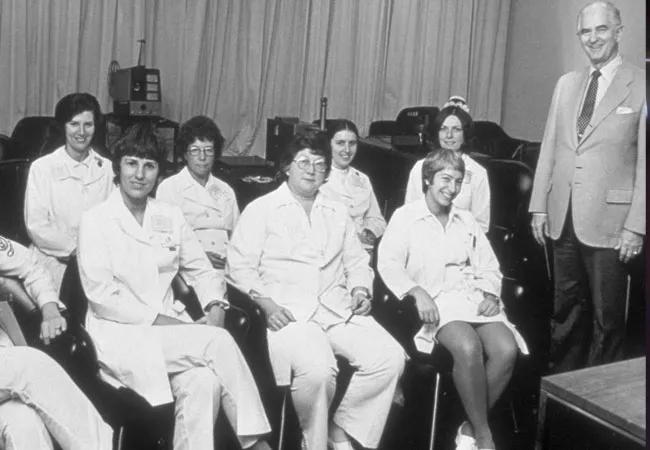
Image content: This image is available to view online.
View image online (https://assets.clevelandclinic.org/transform/c77cf4d4-65a1-4564-9cce-0e61ac35ee74/20-NUR-2006311-WoundOstomySchool-courses-CQD_650x450_jpg)
20-NUR-2006311-WoundOstomySchool-courses-CQD_650x450
This year, Cleveland Clinic’s renowned R.B. Turnbull, Jr., MD School of Wound, Ostomy, Continence (WOC) Nursing Education Program enters its 60th year of continuous operation. Established in 1961, it was the first of its kind in the world and is one of only five WOC education programs in the United States with Wound, Ostomy, and Continence Nurses’ Society® (WOCN®) accreditation.
Advertisement
Cleveland Clinic is a non-profit academic medical center. Advertising on our site helps support our mission. We do not endorse non-Cleveland Clinic products or services. Policy
About 120 nurses seeking to become WOC nurse specialists enroll each year in the Cleveland Clinic program. “Students are attracted to the program because it is the first of its kind in the world, and the clinical experiences provide a wide range of complex situations to observe,” says Linda J. Stricker, MSN, RN, CWOCN, Program Director for the school, which is within Cleveland Clinic’s Digestive Disease and Surgical Institute.
The program prepares nurses for pre- and post-operative management of ostomy patients, prevention and treatment of pressure injury, chronic wound management, fistula and other skin disorders, and the care of patients with urinary and fecal incontinence. Through the program, nurses acquire the knowledge and skills to establish a WOC practice, provide direct patient care and education, and address psychological concerns, discharge planning, rehabilitative counseling and follow-up care.
Program graduates meet requirements to apply and sit for the administered credentialing exam by the WOCN Certification Board (WOCNCB). Certification exam choices include CWOCN, CWON®, CWCN®, COCN® and CCCN®.
Named after Rupert B. Turnbull Jr., MD, a pioneer in colorectal surgery at Cleveland Clinic, the school initially was a program to teach ostomy care, then called enterostomal therapy. In 1958, Dr. Turnbull learned that Gill-Thompson, who was one of his former ileostomy patients, was assisting stoma patients in her nearby hometown of Akron. She told Dr. Turnbull, “I want to get into your line of work.”
Advertisement
Dr. Turnbull offered Gill-Thompson a position as the world’s first full-time enterostomal therapist, and together they established the first enterostomal therapy training program, which would become the R.B. Turnbull Jr., MD School of Wound Ostomy Continence Nursing Education.
A decade later, 12 of the school’s first graduates met and formed the North American Association of Enterostomal Therapists, which is now known as WOCN. A year later, the organization held its first convention at Cleveland Clinic.
Devoting her life to helping others and revolutionizing ostomy care, Gill-Thomson became the program’s director, serving in the role until 1978. Other past Cleveland Clinic WOC Nursing Education Program directors include Joan Van Neil, RN, MA, ET, and Paula Erwin-Toth, MSN, RN, CWOCN, CNS.
“Achieving this 60-year milestone is significant in terms of sustainability of the specialty, which is important for patients served by WOC nurses,” says Stricker. “What began as an idea — to help those with ostomy care needs when options were scarce — has grown world-wide, with two professional societies devoted to similar missions. The WOCN and the World Council of Enterostomal Therapists publish professional nursing journals devoted to promoting WOC nursing research, as well as an ever-growing database to promote evidence-based care for patients with fecal and urinary diversions, chronic wounds, and continence care concerns.”
While the Cleveland Clinic program was previously offered onsite through in-person classes, it is now delivered online by WOCNCB-certified, MSN-prepared WOC nurse faculty members. Traditional clinical experiences are available through Cleveland Clinic’s network of clinical affiliation agreements.
Advertisement
The program is offered in winter, summer and fall cohorts, and includes three traditional pathways as well as one experiential pathway. The curriculum offers courses in:
The didactic portion includes individual projects, self-directed learning modules, asynchronous discussion threads and online testing. Each didactic course lasts four weeks.
Clinical practicums, which are a minimum of 40 hours, are completed with a school-approved preceptor and begin following didactic completion. The focus is on transitioning to the role of nurse specialist in the care of patients with WOC nursing needs, establishing a WOC nursing practice, and preparing for the certification exams.
Pathway options are as follows:
One Specialty Track (5 months)
Participants choose one of the wound, ostomy or continence courses and complete a 40-hour clinical requirement, as well as a final comprehensive exam.
Dual Specialty Tracks (6 months)
Participants choose two of the wound, ostomy or continence courses and complete an 80-hour requirement and two final comprehensive exams.
Full Scope Specialty Track (7 months)
Participants complete all three specialty courses, 120 hours of clinical experience and three final comprehensive exams.
Experiential Pathway (varies, up to 16 weeks)
A continuing education (CE) option in which nursing CE’s are awarded for each successfully completed course. There is no practicum, and one final quiz is administered for each specialty course completed. Note: With the Experiential Pathway, students do not become WOC Nursing Education program graduates but can combine the continuing education credits with work experience to qualify for the certification exams desired.
Advertisement
To enroll in Cleveland Clinic’s WOC Nursing Education program, individuals must have a registered nursing license with a minimum of a four-year baccalaureate nursing degree, or baccalaureate degree in a field other than nursing with demonstrated baccalaureate-level nursing competencies in the areas of health assessment, leadership and management, research and statistics and community health nursing. One year of RN clinical experience is also required.
“The WOC nursing specialty is a choice nurses can make for professional growth, and an opportunity to take a new nursing career direction,” adds Stricker. “Many will expand on the WOC role with formal education toward a nurse practitioner degree and license, to become educators, and develop policies and procedures for safe, effective patient care. It is a way to position one’s career to reach a desired goal.”
For more information, email wocschool@ccf.org.
Advertisement
Advertisement
Initiative provides hands-on opportunities to promote early, progressive activity

Continuing to grow by following the right path at the right time

Teaching caregivers to recognize warning signs, de-escalate difficult situations and maintain professional boundaries

Veteran caregivers offer practical wisdom for building confidence and practicing with purpose
Skill, dedication and a passion for women and children inspire this joy-filled specialty

Nurses use flexibility, strong clinical judgment and teamwork to manage increasingly complex patients

Creativity and perseverance help scrub tech transform a simple surgical cup into a patented medical device

Nurse-led program helps patients navigate childbirth, pregnancy loss and the postpartum period