Locations:





A review of pathophysiology, risk factors, clinical presentation and treatment options
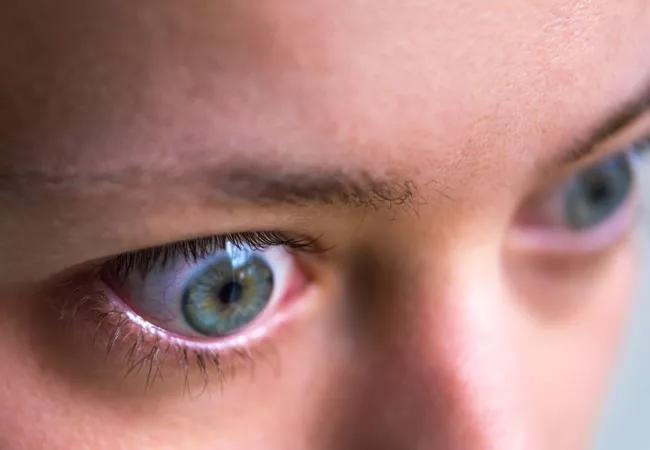
Image content: This image is available to view online.
View image online (https://assets.clevelandclinic.org/transform/e3d1e896-b457-438f-b987-d3a4105152ed/23-EYE-4215262-CQD-Thyroid-eye-disease-tips-general-ophth-hero-jpg)
Thyroid eye disease
This is a shortened reprint of an article from the November 2025 issue of Cleveland Clinic Journal of Medicine (2025 Nov 3;92(11):693-701). See the journal for the full article with tables and references.
Advertisement
Cleveland Clinic is a non-profit academic medical center. Advertising on our site helps support our mission. We do not endorse non-Cleveland Clinic products or services. Policy
By Ashley B. Vincent, DO; Alexander R. Engelmann, MD; Catherine J. Hwang, MD; and Christian Nasr, MD
Thyroid eye disease (TED), also known as Graves’ or thyroid-associated orbitopathy, is an inflammatory autoimmune disorder that affects orbital and periorbital tissues.
TED is most known for its association with Graves’ disease, but it can also occur in patients with euthyroidism or hypothyroidism. It has a pooled prevalence of 27% in North American patients with Graves’ disease, with 85% of patients developing TED within 18 months of Graves’ onset. The incidence of TED is thought to be decreasing for several reasons, including:
TED is characterized by inflammation and remodeling of orbital tissue, resulting in enlargement of the extraocular muscles and expansion of the retrobulbar fat and connective tissue compartment. This process is caused by autoimmune, environmental and immunologic factors that lead to uncontrolled activation and proliferation of orbital fibroblasts.
The key effector cells in TED are the CD34+ fibroblasts, which are derived from circulating fibrocytes, cells that promote wound healing at sites of tissue injury and possess proinflammatory properties. Orbital fibroblasts in patients with TED can express thyroid-stimulating hormone (TSH) receptors. In addition, insulin-like growth factor (IGF) 1 receptors are overexpressed on orbital fibroblasts, B cells and T cells in individuals with TED. TSH receptors and IGF-1 receptors form a functional complex that, when activated, facilitates CD34+ fibroblast infiltration into the orbit, followed by release of inflammatory cytokines (including interleukin 16), adipogenesis, hyaluronan production and chemokine secretion. The release of chemokines facilitates lymphocyte trafficking into the orbit, leading to further differentiation of fibroblasts into adipocytes and scar-forming myofibroblasts.
Advertisement
There are nonmodifiable and modifiable factors that increase a person’s risk for developing TED.
Nonmodifiable risk factors include:
Modifiable risk factors include:
The natural history of TED that was described by Rundle and Wilson in 1945 is still widely accepted today. The initial active inflammatory phase, during which patients experience progressive inflammation and tissue expansion, can last from 6 to 36 months, depending on smoking status. In the brief static phase, the disease will stabilize as inflammation subsides. TED then improves during the inactive fibrotic phase, which typically occurs 18 to 24 months after onset, but symptoms may persist. Recurrent TED has been described in 15.7% of patients, and mostly occurs within the first 10 years after the initial episode.
Advertisement
Patients with TED present with a range of ocular signs and symptoms that reflect the pathogenesis described previously. Most patients have bilateral disease. However, asymmetric and unilateral cases can occur. Common signs and symptoms include:
Eyelid retraction and proptosis are the most common TED symptoms (pooled prevalence 57% for both), followed by diplopia due to restricted extraocular muscle movement and swelling.
Patients with severe TED require urgent intervention, and can present with vision-threatening corneal breakdown, globe subluxation or dysthyroid optic neuropathy. Dysthyroid optic neuropathy is the most severe manifestation of TED. It is caused by compression of the optic nerve at the orbital apex due to extraocular muscle swelling, which can result in permanent vision loss. In rare cases, it can be caused by stretching of the nerve because of proptosis.
About 5% of patients with TED may progress to dysthyroid optic neuropathy. Specific risk factors include increasing age, male sex and heavy smoking. Patients with type 1 diabetes mellitus are at higher risk due to diabetic vasculopathy. Patients with dysthyroid optic neuropathy may have the following initial symptoms:
Diagnostic imaging may show apical crowding, increased extraocular muscle volume, increased superior ophthalmic vein diameter and proptosis.
Advertisement
Imaging is not mandatory for patients with bilateral TED, but it should be considered in unilateral or asymmetric cases, for preoperative orbital surgery evaluation or to assess for apical crowding as a risk factor for dysthyroid optic neuropathy. Computed tomography or magnetic resonance imaging will reveal tissue expansion of extraocular muscles, orbital fat and lacrimal glands. Noncontrast computed tomography of the orbits is the preferred imaging modality because it is relatively inexpensive, increasingly available and already used during preoperative evaluation for decompression surgery. Magnetic resonance imaging, however, has better soft-tissue resolution and can show muscle edema on T2-weighted images, which may improve identification of acute inflammation.
Although proptosis is most readily detected with an exophthalmometer in the clinical setting, it can also be seen on both computed tomography and magnetic resonance imaging. A measurement of 22 mm or greater or an asymmetry between eyes greater than 2 mm is defined as pathologic.
Imaging may also help exclude differential diagnoses (e.g., orbital myositis, orbital cellulitis, immunoglobulin G4-related orbital disease, sarcoidosis, lymphoma, nonspecific orbital inflammation) as extraocular muscle enlargement in TED appears fusiform, and the tendons are not involved. The order of extraocular muscle involvement is inferior, medial, superior and then lateral recti. The oblique muscles are the least likely to be enlarged. Repeat imaging is generally not required unless patients have new signs or symptoms.
Advertisement
Laboratory evaluation for TED includes thyroid function tests and autoantibody titers. There are two antibody evaluation methods: measuring all immunoglobulins targeting TSH receptor antibodies (thyrotropin-binding inhibitory immunoglobulin test) and the thyroid-stimulating immunoglobulin assay.
The 2022 American Thyroid Association and the European Thyroid Association consensus statement on the management of thyroid eye disease recommends specific treatments determined by disease activity and severity, symptoms, impact on the patient’s daily living and quality of life, and risk to vision.
Restoring and maintaining euthyroidism is associated with TED stabilization and improvement. Patients with Graves’ hyperthyroidism can be treated with antithyroid drugs, radioactive iodine or total thyroidectomy. However, current evidence suggests that the use of antithyroid drugs or thyroidectomy does not alter the disease course of mild TED, whereas radioactive iodine treatment can worsen or cause de novo TED. Immunosuppression with glucocorticoids is recommended both as prophylaxis and for treating radioactive iodine-induced TED.
Local treatment of TED includes management of dry eyes and surface inflammation. Dry eyes may be due to incomplete blinking or change in blinking rate, inadequate tear distribution and excess tear evaporation from a widened palpebral fissure, and decreased tear production from the inflammatory process of TED. Patients should be treated with artificial tears during the day. While sleeping, ophthalmic gels or ointments and taping the eyelids or wearing swimming goggles are recommended, depending on the degree of lagophthalmos (inability to close eyelids completely) and other symptoms. Elevating the head at night helps decrease edema.
Patients should be counseled to quit smoking and to avoid secondhand smoke.
Treatment decisions are based on assessment of clinical activity, severity, duration and the orbital components involved. The clinical activity score (CAS) is a simple, validated scoring system used to assess disease activity. The CAS has seven items based on TED signs and symptoms commonly seen. A score of 3 or higher indicates active disease. On follow-up assessment, a 10-item CAS that includes three additional points for worsening proptosis, motility and visual acuity is used for monitoring change over time.
Disease severity assessment determines whether there is an immediate or future threat to vision.
The goal of mild TED treatment is to improve quality of life, promote remission and prevent progression. Treatment includes the local interventions discussed above and a single course of sodium selenite 100 μg twice daily for six months.
Patients with mild TED generally do not experience a significant impact on quality of life or symptoms that necessitate pharmacologic or surgical intervention, and can often be treated with watchful waiting.
Several medical therapies are used to treat moderate-to-severe TED. For patients with active disease, the goal of therapy is to shorten the active phase and achieve remission. These therapies include:
Sight-threatening TED, an emergency that requires immediate treatment due to the risk of irreversible vision loss, can be caused by dysthyroid optic neuropathy, severe corneal breakdown or rarely globe subluxation. Owing to optic nerve compression, IV glucocorticoids are recommended as first-line therapy for patients with dysthyroid optic neuropathy. The recommended regimen is IV methylprednisolone 500 to 1,000 mg daily for three consecutive or alternate days. If a patient fails to respond to treatment, urgent orbital decompression is recommended.
When dysthyroid optic neuropathy is due to optic nerve stretching caused by proptosis, surgical decompression is indicated as this condition rarely responds to medical therapy.
Patients with dysthyroid optic neuropathy who require orbital decompression may also need adjuvant medical or orbital radiation therapy to inactivate TED.
Surgical intervention in the acute phase of disease is indicated only for treating irreversible sight-threatening complications because eyelid, extraocular muscle and orbit surgery during the active phase has the potential to cause inflammation to flare. The two main surgical options include permanent tarsorrhaphy for exposure keratopathy (severe dryness of the cornea leading to breakdown of the corneal surface) and optic nerve decompression for dysthyroid optic neuropathy. If surgical intervention is warranted for either of these reasons, a patient’s disease may be considered active enough to require use of IV glucocorticoids, teprotumumab or other pharmacologic therapies.
Once a patient’s TED has been quiescent for four to six months, surgical treatment may be considered and must occur in sequence after the patient is euthyroid. The first step is treating proptosis with orbital decompression surgery, if indicated, to remove bone and expand orbital volume. Next, surgery to correct strabismus may help improve alignment. However, many patients may still require prism glasses to achieve single vision. The final step is adjusting eyelid position by either lowering a retracted eyelid or raising a ptotic one. Some patients may subsequently elect to undergo cosmetic surgery to correct disease-related changes to their facial appearance.
If these surgeries are performed out of order, the progress made with a previous surgery may be undone. Surgery can result in substantial improvements in quality of life for patients with TED due to better visual function and perceived appearance.
Although TED was first described a millennium ago, effective management remains a challenge. Surgery has been a last resort for a century, and Rundle and Wilson’s observation on the course of TED holds true in most but not all cases. However, in the past decade, with better understanding of the pathophysiology of TED, medical therapies have been developed that target specific pathways or receptors involved in the disease.
Success in controlling TED is sometimes short-lived, with reactivation haunting patients and clinicians, leading to as-yet unanswered questions. Are we interrupting the course of the disease, and the activity picks up where it left off after we discontinue treatment? Should we perhaps learn from our immunology colleagues and treat continuously with smaller doses, given at shorter intervals, and for a longer period? What about combination therapy? One thing we do know is that patients with TED have hope.
Drs. Vincent and Nasr are with the Division of Endocrinology at Banner University Medical Group. Dr. Engelmann is a clinical fellow at Cleveland Clinic Cole Eye Institute. Dr. Hwang is an oculofacial plastic surgeon at Cleveland Clinic Cole Eye Institute.
Advertisement

New studies clarify how sensory loss and nystagmus shape real-world visual function
Learn the latest recommendations in diagnosis, treatment and surveillance
The drug does not provide lasting disease control for most patients

Registry data highlight visual gains in patients with legal blindness
Study is first to show reduction in autoimmune disease with the common diabetes and obesity drugs
It’s the first step toward reliable screening with your smartphone

Fixational eye movement is similar in left and right eyes of people with normal vision

Oral medication may have potential to preserve vision and shrink tumors prior to surgery or radiation
 Search