Locations:





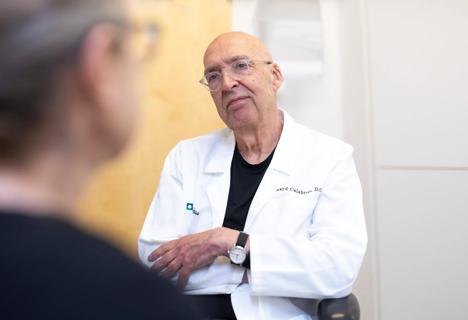
A conversation with Leonard Calabrese, DO
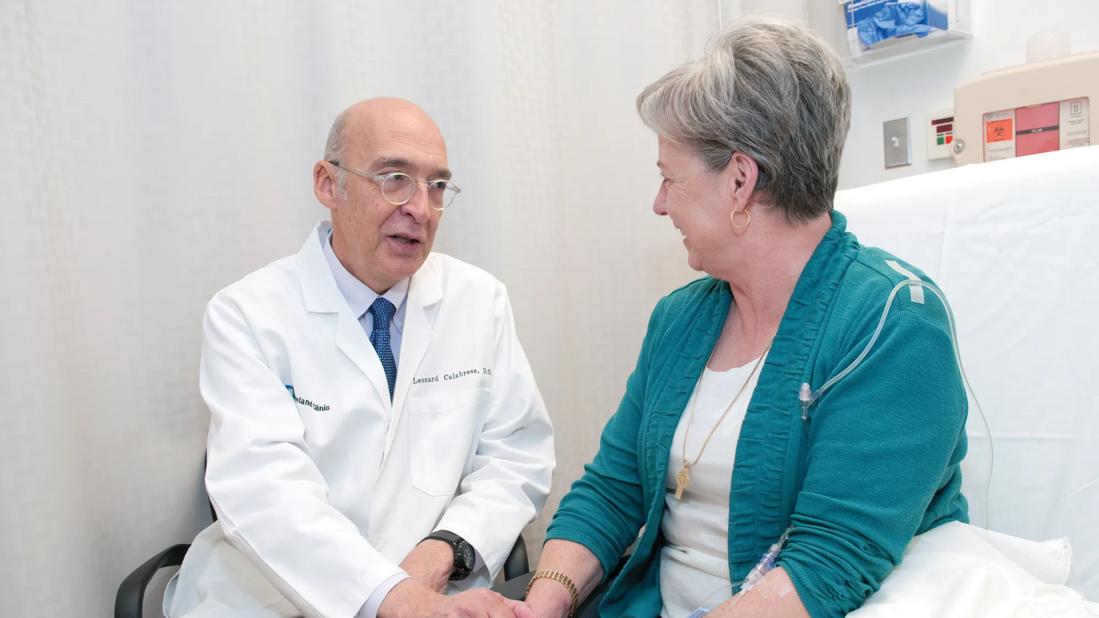
Image content: This image is available to view online.
View image online (https://assets.clevelandclinic.org/transform/d1dc6228-95f0-4aae-91f8-015e3c6216b3/leonard-calabrese-with-patient)
Photo of Leonard Calabrese speaking to patient
“I've always been attracted to the seams where immunology meets cardiovascular disease or neurologic disease and beyond. Over my career, the immune system has gone from being considered a somewhat arcane and complex system outside of the mainstream of medical practice to now being hegemonic among all biologic systems. The world’s leading causes of death are due to chronic low-grade inflammation. This is at the core of a basic understanding of our diseases and related diseases.”
Advertisement
Cleveland Clinic is a non-profit academic medical center. Advertising on our site helps support our mission. We do not endorse non-Cleveland Clinic products or services. Policy
So says Leonard Calabrese, DO, who heads Cleveland Clinic's Section of Clinical Immunology. Dr. Calabrese also is director of the R.J. Fasenmyer Center for Clinical Immunology, founded in 2005 as a premier center of clinical research, educational programs and service to the community.
After graduating from medical school at Kansas City University’s College of Osteopathic Medicine, he joined Cleveland Clinic, where he completed his internship, residency and rheumatology fellowship before joining the staff.
In honor of Dr. Calabrese’s 50 years at Cleveland Clinic, Abby Abelson, MD, Chair of Cleveland Clinic’s Department of Rheumatic and Immunologic Diseases, invited Dr. Calabrese to take part in a conversation about the past and future of rheumatology and immunology.
Dr. Abelson: Congratulations, Lenny. We know you’re not going anywhere, but we wanted to take this opportunity to reflect on what you've seen over the last 50 years about the development of the department and some of the highlights, joys and challenges.
Dr. Calabrese: Well, this is a moment in time for reflection. When I was here as a medical student, my first rotation was in rheumatology with [Dr.] John Clough, and that was my eye-opening moment. The field of immunology was burgeoning, and we could talk about it in an afternoon and cover most of the field on a chalkboard.
Yet it was fascinating and stimulating and intriguing to me. During my residency, I continued my interest in that area and knew that was for me.
Advertisement
The first part of my career was during HIV and deficiency diseases. The second part of my career was investigating the emergence of biologic therapies. And the last part of my career has been organizing efforts, with a lot of support from so many sources, particularly from Richard Fasenmyer, so that the Center for Clinical Immunology will endure long after I'm not there.
Dr. Abelson: Can you share any vignettes about what patients experienced in rheumatic diseases 50 years ago and that have been really transformed as a result of the scientific work with which you’ve been involved?
Dr. Calabrese: It's almost unrecognizable what we do now in comparison to what patients had at that time. We had glucocorticoids and methotrexate and penicillin, and a few other therapies, for mild to moderate biologic activity. Every rheumatologist of a certain age had patients who had been harmed by these diseases sitting in their waiting rooms in wheelchairs. Now we are talking about remission.
And for the past five years, we have been talking about deeper remission, if not a cure, for certain diseases. It makes me almost want to pinch myself to think how the dialogue and the landscape have changed. And we at Cleveland Clinic have been part of every aspect of this, from clinical trials to the first biologics to CAR T and advanced therapeutic programs.
Dr. Abelson: Your impact has been felt internationally in several areas, and one is your impact on generations of rheumatologists through your varied CME programs. Can you talk a little bit about that?
Advertisement
Dr. Calabrese: With the opening of the R.J. Fasenmyer Center for Clinical Immunology, we immediately made it part of our mission to educate rank-and-file practitioners, who were largely physicians at that time. Now we proudly embrace the education of advanced practitioners so that we can translate the remarkable advances in basic and translational immunology in a way for clinicians who are without laboratory backgrounds in basic immunology or without ongoing exposure to educational programs in a rapidly changing field. That has been our enduring mission from day one.
Twenty-five years ago, we were focused on the introduction of monoclonal antibodies to our field while now we attract faculty who are world leaders in the cutting edges of immunology, including advances in translational immunology, the use of big data and beyond. And it's gone from biologics to translational immunology to the prospects of immunologic cures. I am particularly proud of our immunology bootcamp, which is now in its 14th year, where we now focus sessions on the emerging field of evidence-based integrative immunology in the care of patients with immune-mediated inflammatory diseases.
Dr. Abelson: As clinicians in partnering with care for people with lifelong chronic illnesses, emphasizing the importance of empathy and not losing that touching connection with patients has inspired all of us. Can you speak about your work on empathy?
Dr. Calabrese: I became interested in interactions and relationship-centered care with patients who had conditions that had no treatment and had no cure. As a clinical immunologist practicing in the early days of the field, I was often referred patients of high complexity without unifying diagnoses. Many of these patients are now recognized as having myalgic encephalomyelitis/chronic fatigue syndrome. While demanding in terms of time and effort, I found the care of these patients rewarding in many ways. Most of them felt marginalized and unheard before being validated as having a disease shared by a large and growing community.
Advertisement
Even in the absence of curing this disease, we could often heal these patients. There are diseases where people can be healed and not cured, and then people who actually have their diseases cured and not healed, which is an interesting concept. You can relieve suffering by expunging people of guilt by sharing belief in the meaning and reality of their symptoms and letting them know that you're going to care deeply for them during their journey.
That has a lot of validity for what we now call post-acute infectious syndromes, like long COVID. I realized that this should be the same message for every single patient in every single setting. It's not enough to just give somebody a pill and get them out the door and be happy.
Deep listening has an important role in patient care. Over the past several decades, we have learned that the basis of this maxim lies in the field of the brain-immune axis. We're actually harnessing our own placebo biology, a phenomenon that used to be considered pejorative and associated with trickery. Now we recognize it is a powerful and useful source of biologic therapy, and we want it. We want to figure out how this makes us feel less tired, less painful, more mentally clear — things we all want.
Dr. Abelson: As you look toward the future, what developments come to mind that you think are exciting? This morning, your daughter, Cassie, gave an eloquent review of all the latest updated science on vaccines for our immunosuppressed patients. Her work has many aspects to it. And there are many people doing many exciting things.
Advertisement
So what do you see as a bright future for the department and for the field of rheumatology?
Dr. Calabrese: First, I feel that the area of infectious diseases and rheumatic and immune-mediated inflammatory diseases is unequivocally an area of recognized importance and growth. We have been involved since the early days of HIV and its intersection with rheumatic and immunologic diseases through the COVID-19 pandemic and now are engaged at the intersection of primary immunodeficiency diseases and autoimmune complications.
Second, we have made major contributions, and continue to, in the treatment of patients undergoing cancer immunotherapy and immunologic adverse events immunotherapy. We were on the ground floor of this field and have published extensively, and Cleveland Clinic has dedicated tremendous resources to immunotherapy for cancer. We continue to grow this work.
And the third part is the area of integrative immunology, how the immune system has centrality in how we age and what type of diseases we get and how we ultimately die. There is science — serious science — in this emerging field. We want to contribute to that evidence-based learning about what lifestyle has to do with immunologic health and understanding of the brain-immune axis. It just continues to be profoundly exciting to me.
Advertisement
Patient had tenolysis and fasciectomy but sympoms recurred
Best practices in a changing landscape
Case: Presentation includes joint pain and neurological symptoms
Evidence suggests empathy influences immune function and well-being
Going beyond simple referrals to streamline patient access
Tracing our understanding of this complex systemover more than a century
Drug-free remission holds more than a year after treatment
Cleveland Clinic group works toward earlier diagnosis of this rare disease
 Search