Locations:





High fevers, diffuse rashes pointed to an unexpected diagnosis
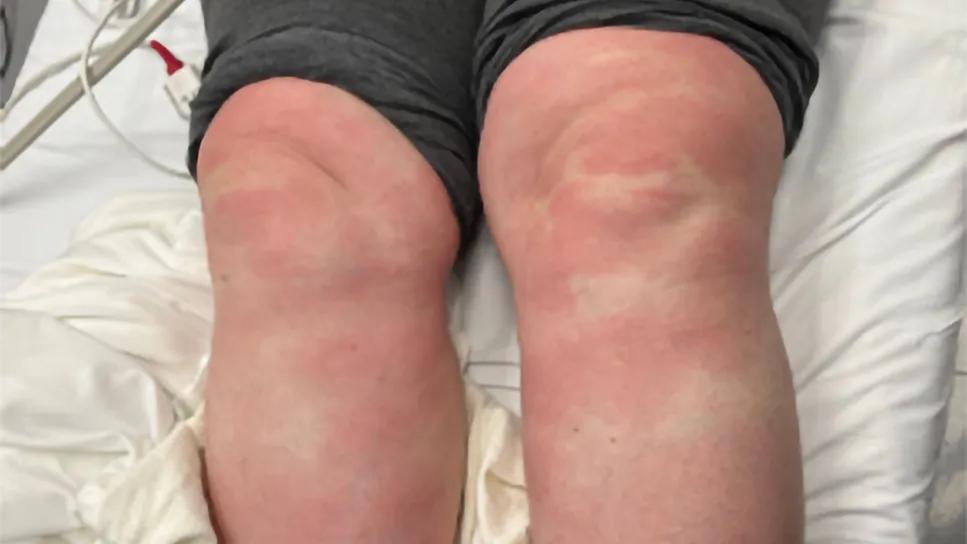
Image content: This image is available to view online.
View image online (https://assets.clevelandclinic.org/transform/1f789060-222a-4ab8-9968-bc063f8a1c22/brown-leg-rash)
Red rash on legs
A 53-year-old female presented to the hospital with a history of persistent fever. Approximately three weeks before she was admitted, she began experiencing fevers ranging from 100° to 102°F, accompanied by chills and myalgias. These fevers occurred almost daily — initially at night but more recently also in the morning — and were somewhat responsive to ibuprofen and acetaminophen. About a week after the onset of fever, she developed a red, non-itchy, non-raised rash that started on her chest and back, eventually spreading to her legs and arms. She also reported joint pain in her shoulders, elbows, knees and hips, along with muscle aches in her upper arms. The patient had a history of atrial fibrillation status postablation, hypertension, hyperlipidemia and asthma.
Advertisement
Cleveland Clinic is a non-profit academic medical center. Advertising on our site helps support our mission. We do not endorse non-Cleveland Clinic products or services. Policy
On the morning of her hospital admission, she was experiencing increased joint pain, which waxed and waned and was associated with stiffness. There were no significant alleviating or exacerbating factors, and the pain did not respond to ibuprofen. A fever of 104°F had prompted her visit to the emergency department.
A review of systems was positive for nausea, decreased appetite, slight weight loss, headaches, a mild nonproductive cough, and a sore throat that resolved after a few days. She denied any recent travel out of state, insect bites, smoking or drug use. She has a dog and had fed a budgie bird but reported no other significant animal exposure. She had visited a drive-through safari park several times over the previous months with the car windows typically closed.
Her physical examination revealed mild tenderness in her elbows, knees and hips without swelling or warmth to the touch, and she exhibited normal range of motion. There were blanching erythematous patches on her chest, trunk, back, upper arms and legs. Laboratory tests showed an elevated white blood cell count and inflammatory markers, with a CRP of 4.3 mg/dL and an ESR of 63 mm/hr.
Her kidney and liver function tests were normal, as were complement levels. M protein was positive for IgM lambda. Ferritin was mildly elevated at 267 ng/mL and ANA was 1:320.
Other autoimmune serologies, including ENA and ANCA, were negative. Computed tomography angiography images of her chest, abdomen and pelvis were unrevealing. These studies were ordered to evaluate for parenchymal lesions such as abscess or aortic involvement, including aortitis.
Advertisement
From a rheumatologic perspective, we considered an acute viral illness such as parvovirus B19 because of the patient’s fevers, anemia and joint pain, although parvovirus more typically causes small joint involvement. Given the rash, fever and positive M protein, we also considered Schnitzler syndrome, although that is typically associated with neutrophilic urticaria, and the M protein is IgM kappa.
The patient’s normal liver function and only mildly elevated ferritin made adult- onset Still’s disease unlikely. Although a clear infection hadn’t been found, our colleagues in Infectious Disease initiated antibiotics, and her fever resolved, suggesting a bacterial infectious etiology. Anaplasma and babesia PCR testing was negative, as was Rocky Mountain spotted fever IgG. However, Lyme Western blot for both IgG and IgM were positive.
With antibiotic therapy, her joint pain and rash improved, which supported a diagnosis of Lyme disease in the context of positive serologies. She was treated with a four-week course of doxycycline. The patient’s joint pain and fevers resolved with antibiotics, making Lyme disease the most likely diagnosis.
This case illustrates an unusual presentation of Lyme disease. Fever in Lyme disease is typically low grade and occurs in the early localized and early disseminated stages, often alongside erythema migrans or as part of a viral-like syndrome. High or spiking fevers are not typically characteristic of Lyme disease and should prompt consideration of alternative diagnoses or coinfections with other tick-borne pathogens, such as anaplasma or babesia, although these were not present in this patient per additional testing.
Advertisement
The rash in Lyme disease is usually erythema migrans, which begins as a single expanding lesion at the tick bite site. In early disseminated Lyme disease, multiple erythema migrans lesions may develop at distant sites, but a true diffuse, non-annular rash is not typical. This patient's generalized rash and high fevers were atypical for Lyme disease.
This highlights the importance of considering a broad differential diagnosis and bringing an awareness of the potential for atypical presentations in endemic areas.
Lyme disease cases are on the rise, with a significant increase in recent years. In 2023, Ohio reported 1,301 confirmed cases, more than double the 554 cases reported in 2022. Lyme disease vigilance in the region will continue to be important.
Advertisement
Advertisement
Patient had tenolysis and fasciectomy but sympoms recurred

Best practices in a changing landscape

Case: Presentation includes joint pain and neurological symptoms

Evidence suggests empathy influences immune function and well-being

Going beyond simple referrals to streamline patient access

Tracing our understanding of this complex systemover more than a century

Drug-free remission holds more than a year after treatment

Cleveland Clinic group works toward earlier diagnosis of this rare disease
 Search