Locations:





Therapists and physicians collaborate to get medically stable patients moving
Podcast content: This podcast is available to listen to online.
Listen to podcast online (https://www.buzzsprout.com/2243576/19959302)
Up until the late 20th century, patients recovering from stroke, severe brain injury or neurological surgery often were kept on total bedrest during their time in the neuro intensive care unit (ICU). Today, medical experts understand that early mobilization is crucial for reducing risks for long-term weakness, delirium and other complications.
Advertisement
Cleveland Clinic is a non-profit academic medical center. Advertising on our site helps support our mission. We do not endorse non-Cleveland Clinic products or services. Policy
“Some of the most common complications we see are things like pressure injuries, deep-vein thrombosis and contractures — things that happen when people are in bed for a prolonged period of time with limited mobility,” says Adam Barron, MD. “All that is helped by early mobilization and ambulation.”
Dr. Barron is a neurologist with Cleveland Clinic’s Cerebrovascular Center. In the latest episode of Cleveland Clinic’s Neuro Pathways podcast, he and physical therapist Natalie Lilly, DPT, discuss what early mobilization means for patients in a neuro ICU or surgical stepdown unit.
Among their insights: Just because a hospitalized patient might be experiencing confusion does not mean they must stay immobilized.
“You can hear ‘not following commands’ and some people just move on, but that’s kind of our bread and butter in the ICU,” says Dr. Lilly. “The best thing we can do is functional activity. So what kind of things would be more likely to be automatic for the patient? For physical therapy, that’s getting them up and out of bed. For occupational therapy, it might be seeing whether they can use a toothbrush or brush their hair.”
The conversation also covered:
Listen to the 30-minute episode now in the player above or read on for an edited excerpt of its transcript. Check out more Neuro Pathways episodes at clevelandclinic.org/neuropodcast or wherever you get your podcasts.
Advertisement
This activity has been approved for AMA PRA Category 1 Credit™ and ANCC contact hours. After listening to the podcast, you can claim your credit here.
Glenn Stevens, MD, Podcast Host: Talk about the patient lifts in the intensive care unit in the new Neurological Institute Building.
Adam Barron, MD: We will have built-in ceiling lifts, which is important for our patient population, especially for mobility-limited patients who still need to get into a chair or need to get up out of bed. That's an important part of the Neuro ICU.
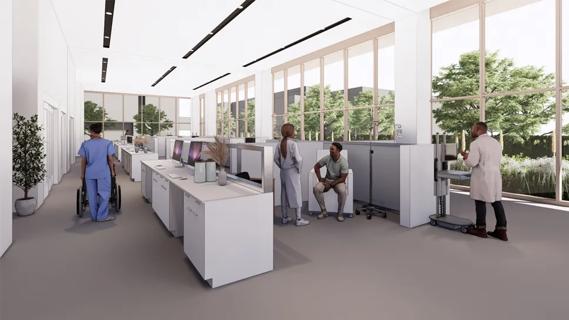
I think the other major highlight is just the physical space of the building. One of the biggest limitations for our therapy teams in our current space is the size of the rooms and the hallways — what it takes to mobilize a patient with those devices. Even if we know it can be done safely, it can be challenging to pivot and ambulate these patients down the hallways. We're looking forward to the larger hallway space, and the larger rooms that are going to be more facile for these patients to get out of bed.
Dr. Stevens: When we're talking intensive care, are we talking step-down and intensive care, or are we talking about primarily intensive care?
Dr. Adam Barron: Primarily, ICU is our experience, but these patients are also mobilized in the step-down units and have similar mobility difficulties. Of course, if a patient with stroke comes into the neuro ICU and a couple days later they're at the point where they can go to a step-down unit, their mobility issues haven't improved over that timeframe, so they are still going to need that level of therapy.
Advertisement
Dr. Stevens: My understanding is there are going to be bathrooms in the intensive care unit rooms. Is that right?
Dr. Natalie Lilly: That'll be a big plus.
Dr. Barron: And for a lot of patients, that's an important part of occupational therapy in particular. There are a lot of grooming tasks and things like that that are important to assess and understand as a patient who's getting ready to leave the hospital or leave the ICU. Having that available in our unit's going to be a great thing.
Advertisement
Advertisement

Designed for digitization, distance health, discovery and more
Combining customized care, research capabilities and flexibility for the future

Leading investigators outline a new roadmap for clinical trials and observational research

The selective D1/D5 dopamine agonist provides symptom relief and improves daily function.
5-year funding award supports cohort expansion and deep phenotyping of AD and related dementias

Highest response rates seen with stress-lowering techniques like yoga, meditation and mindfulness
Digital subtraction myelography unveils often-overlooked but highly treatable underlying defect
Housing multidisciplinary clinicians in one leading-edge facility can transform GME along with patient care
 Search