Locations:





Combining customized care, research capabilities and flexibility for the future
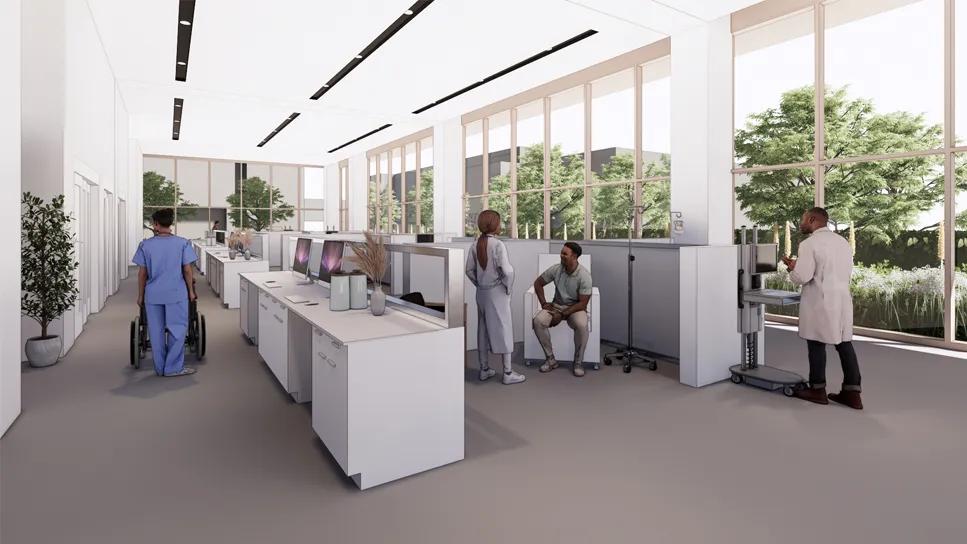
Image content: This image is available to view online.
View image online (https://assets.clevelandclinic.org/transform/ba0913e7-97cb-4c87-adfb-acd1f95999ad/rendering-of-new-neuro-therapeutics-space)
illustration of a bright clinical room with clinicians inside
The January 2027 opening of the new Neurological Institute building on Cleveland Clinic’s Main Campus will introduce a number of novel concepts in healthcare facility design. Among them is reengineering of the traditional infusion suite into a dynamic unit that’s been named the advanced therapeutics space.
Advertisement
Cleveland Clinic is a non-profit academic medical center. Advertising on our site helps support our mission. We do not endorse non-Cleveland Clinic products or services. Policy
Located on the building’s ground floor, this space is designed to bridge routine patient care with intricate clinical trial protocols, integrating intensive outpatient nursing, specialized monitoring capabilities and advanced research resources in a single location for administration of a range of neuropsychiatric therapies.
“We’ve intentionally built the advanced therapeutics space with flexibility in mind, moving beyond traditional infusion concepts to accommodate where neurotherapeutic delivery is now and how it may evolve over time,” says Robert Bermel, MD, Director of Cleveland Clinic’s Mellen Center for Multiple Sclerosis Treatment and Research and a neurologist involved in designing the space.
While standard infusion suites focus primarily on delivering routine intravenous biologics, the new advanced therapeutics space will function as an intensive outpatient nursing environment. The suite is built to support complex procedures that may require immediate observation, precise environmental control or rapid biosample assessment.
The space encompasses 38 treatment bays designed to accommodate distinct patient populations and treatment requirements. Recognizing that clinical needs vary substantially across neurological conditions, the unit is evenly divided between two types of treatment spaces:
Advertisement
Additionally, the suite incorporates modular design principles, allowing rooms to be reconfigured as care paradigms change. For example, treatment bays can accommodate sofas or reclining couches rather than standard infusion chairs to ensure patient comfort during extended multihour monitoring protocols.
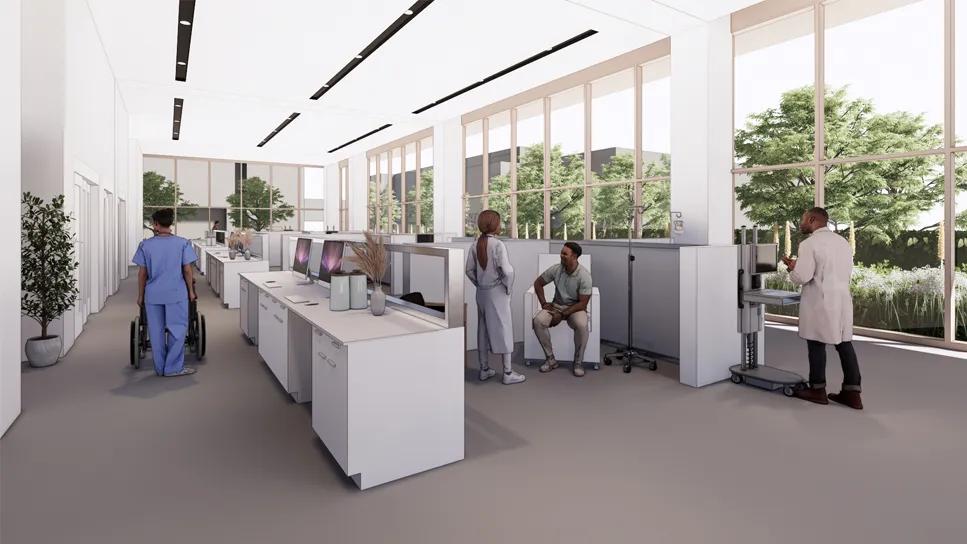
Image content: This image is available to view online.
View image online (https://assets.clevelandclinic.org/transform/ba0913e7-97cb-4c87-adfb-acd1f95999ad/rendering-of-new-neuro-therapeutics-space)
Artist’s rendering of a portion of the advanced therapeutics space, with private bays along the wall on the left and semi-private bays bathed in natural light along the exterior wall on the right.
One factor informing the design of the advanced therapeutics space is the rapid emergence of cell-based therapies in neuroimmunology and other conditions. Over the past decade, cellular treatments — historically restricted to inpatient oncology wards following intensive conditioning chemotherapy — have evolved toward same-day outpatient delivery models.
Cleveland Clinic researchers are involved in early-phase clinical trials evaluating autologous and allogeneic CAR T-cell therapies, as well as other infused T-cell-directed platforms, for autoimmune neurological disorders. Although introduced into neurotherapeutics for MS, these investigational therapies are now also being explored for other neuroimmunologic disorders and for neuromuscular conditions such as myasthenia gravis and chronic inflammatory demyelinating polyneuropathy.
“Historically, patients participating in cell therapy trials had to navigate fragmented visits across multiple facilities — getting an infusion in one building, an MRI in another and clinical evaluations elsewhere,” explains Daniel Ontaneda, MD, PhD, staff neurologist and Director of Research for the Mellen Center. He notes that this new space within the larger Neurological Institute building — which also houses advanced neuroimaging and outpatient offices for all neurological subspecialties — “creates a single-stop environment for these patients while embedding advanced assessment tools right where care is delivered.”
Advertisement
A key feature of the space is its capacity for “last mile” cell product handling. Autologous cellular products often require time-sensitive thawing, preparation and quality verification right before administration. The new unit incorporates dedicated equipment with such processing capabilities in a few of the infusion bays, enabling seamless delivery of cell products.
In fact, several of the private bays in the advanced therapeutics space are allocated exclusively for clinical trial visits, whether for cellular products or other investigational therapies. This allows study consenting, baseline screening, therapy administration and biomarker collection to all occur in the same space.
Looking ahead, Dr. Ontaneda anticipates the space will also be useful for administration of even more-advanced therapies, such as emerging in vivo cell editing and vector delivery techniques.
Neurological Institute leaders also envision the advanced therapeutics space as an ideal setting for administration of novel psychoactive and neuropsychiatric therapies. With regulatory approval anticipated soon for psychedelic therapies — including short- and long-acting formulations delivered intranasally, subcutaneously or intravenously — administration is expected to require specialized settings.
“Context influences the therapeutic experience and, potentially, the clinical efficacy of psychedelic therapies,” notes staff psychiatrist and Vice Chair of Psychiatry Brian Barnett, MD, who directs psychedelics research. “A noisy or disruptive environment can be traumatizing for someone who’s under the effects of psychedelics. By contrast, private rooms with low lighting, a quiet atmosphere and close monitoring by specialized nursing staff allow us to administer these therapies safely and effectively.”
Advertisement
Because psychedelics and other psychoactive agents are controlled substances, the new therapeutics space is equipped to securely store them on hand. It also will provide ready access to as-needed medications for the anxiety or nausea that can occur during administration of psychedelics. “For all these reasons, this space is really well suited to giving these types of therapies,” Dr. Barnett says.
Although clinical use of ketamine infusions in the space will initially be limited to chronic pain, Dr. Barnett sees the unit’s research-dedicated bays as ideal for clinical trials of ketamine for treatment-resistant depression. “A lot of efforts are underway to combined ketamine with other drugs to see if we can extend the durability of efficacy,” he says. “This space is perfectly equipped and staffed for those trials.”
Beyond the research-dedicated bays in the therapeutics space, an adjacent lab can handle immediate blood draws and cerebrospinal fluid samples collected via lumbar puncture for real-time biological data capture during infusions. This is particularly useful for patient monitoring in clinical trials.
Dr. Ontaneda sees such capabilities, when paired with other features of the new Neurological Institute building, as positioning Cleveland Clinic for heightened leadership in the conduct of early-phase clinical trials. “Under one roof we have these infusion and lab resources, a full range of advanced neuroimaging modalities including 7T MRI, and an unprecedented ability to capture quantitative performance metrics with our neurological assessment center,” he says. “Combining these capabilities with disease-level expertise equips us well to do proof-of-concept studies across a range of neurological subspecialty areas. The advanced therapeutics space, together with our enhanced integration of these capabilities in the new building, will serve as an operational template for a dedicated clinical trials unit we plan to develop in the new building a bit further down the road.”
Advertisement
Indeed, like the new building as a whole, the advanced therapeutics space was designed to integrate research infrastructure into daily clinical operations wherever feasible. “The new building brings all our neurological subspecialties together in a single location,” says Dr. Bermel, “and the advanced therapeutics space will be filled by patients and providers from various subspecialties. That’s intentional, in the hope of fostering what we call ‘casual collisions’ with our colleagues from other areas. That’s how cross-disciplinary collaborations happen, resulting in a new research project or a new idea for a treatment.
“A guiding vision for our new building has been to support delivery of the finest clinical care today integrated with research to shape the neurological care of tomorrow,” he continues. “This new advanced therapeutics space may realize that vision as well as any other aspect of the building.”
Advertisement
Expanded bevy of dedicated ORs will feature customized designs, leading-edge technology, optimized workflows

Routine capture of standardized neuroperformance data may expand and refine investigations

Reimagining the outpatient neurological visit with routine capture of neuroperformance data
Advanced surgical suite in our soon-to-open facility promises to redefine care standards
Phase 3 STELLAR trial underscores role of molecular stratification in glioma care

A passionate specialist surveys the field’s past, present and future
Today’s research helps illuminate tomorrow’s needs
Novel ‘assessment center’ will be a partner in care by serving as an engine of structured data collection
 Search