Locations:





Hyperthermic intraperitoneal chemotherapy can improve patient outcomes
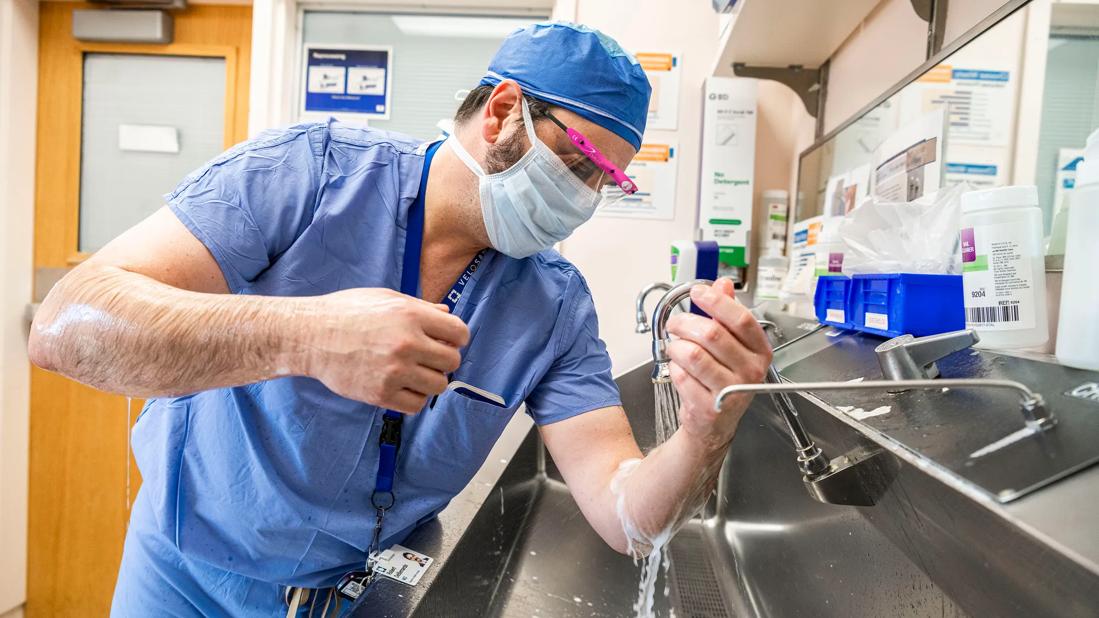
Image content: This image is available to view online.
View image online (https://assets.clevelandclinic.org/transform/8a345233-6c1d-4bae-ad8e-205fd801badb/deBernardo-HIPEC-2072453)
Doctor scrubbing before surgery
Hyperthermic intraperitoneal chemotherapy (HIPEC) has been used to treat abdominal cancers for more than 40 years. In some patients with ovarian cancer, HIPEC combined with tumor resection has been shown to provide a survival benefit. Yet across the United States, too few medical centers offer HIPEC for ovarian cancer, leaving some patients without access to a treatment from which they might benefit.
Advertisement
Cleveland Clinic is a non-profit academic medical center. Advertising on our site helps support our mission. We do not endorse non-Cleveland Clinic products or services. Policy
Clinicians at Cleveland Clinic hope to help bridge that gap with a new twice-yearly program that trains providers who want to establish HIPEC capabilities at their own medical centers.
“If we can help more programs offer HIPEC, we are going to improve the lives of women with ovarian cancer. They will remain in remission longer, and more will be cured,” says Robert DeBernardo, MD. “The number one priority is to lower the barrier to care.”
HIPEC is used immediately after cytoreductive surgery to target disease in the peritoneum. After all visible disease has been surgically removed, the medical team places inflow and outflow catheters in the abdominal cavity and connects them to a perfusion pump that circulates a warmed chemotherapy solution throughout the peritoneal space. Typically, the solution consists of several liters of crystalloid containing the selected chemotherapy agent. It is maintained at 41 to 43 degrees Celsius and circulated for about 90 minutes.
Because the treatment is delivered in the operating room, it requires coordination among surgery, anesthesia, pharmacy, nursing and perfusion personnel. During the perfusion phase, the team monitors core temperature, hemodynamics, urine output, glucose and electrolytes. After the circulation period is complete, the perfusate is drained and the catheters are removed.
“We started using HIPEC for ovarian cancer about 15 years ago without a whole lot of data to go on,” says Dr. DeBernardo. “But in 2018, the van Driel trial showed that women with ovarian cancer who received HIPEC lived longer. They had improved progression-free and overall survival compared with similar patients who did not receive that intervention.”
Advertisement
“These results have been repeated in other studies,” he says.
“In ovarian cancer, we can see improvement in progression-free survival from a variety of medications, such as PARP inhibitors, but they do not generally increase overall survival," he adds. "So this is one relatively simple intervention that improves both progression-free and overall survival.”
While the number of medical centers offering HIPEC is growing — the website hipectreatment.com identifies more than 115 — most are larger institutions concentrated in the eastern half of the country.
“Clinicians have generally had very little experience with HIPEC, and when they have, it has often come from the world of gastrointestinal oncology, where we see 12- or 14-hour surgeries and complications,” Dr. DeBernardo says.
In the setting of ovarian cancer, however, HIPEC tends to be a different experience. Complication rates and length of hospital stay are similar to those for surgical patients who did not receive HIPEC.
“The problem is, how does someone start a HIPEC program?” says Dr. DeBernardo. “Everyone would give one dose of chemotherapy to achieve the same results that HIPEC has been shown to provide these patients. We use the older chemotherapy drug cisplatin, which we administer in the abdominal cavity. That means we need a pump, we need tubing, and we need to be able to perfuse the patient with chemotherapy in the operating room. That also means the surgeon has to learn something new.
“You also have to convince hospital administrators to buy a pump and secure perfusion support. What do we do in terms of staff safety? So it’s a bit of a heavy lift.”
Advertisement
Some institutions have surgical oncologists who perform HIPEC for other cancers. Gynecologic oncologists can partner with them, but training is still required.
“The problem is that surgical oncologists don’t know ovarian cancer, and they may not be familiar with the chemotherapy considerations,” says Dr. DeBernardo. “So we want to make sure patients receive the right drugs. But if they partner, it becomes relatively easy.”
The CME course will include a short lecture covering the data, clinical pearls, operating protocols and safety concerns.
The technique to be taught is a closed technique. After the cancer has been surgically removed, tubing is inserted and the abdomen is closed. The abdomen is then filled with heated saline and checked for leaks. Once no leaks are identified, the drug is added to the circuit for circulation. After 90 minutes, the abdominal cavity is opened and drained, the tubing is discarded, and the abdomen is closed again.
Practical considerations will include questions such as:
“People will not only leave here with practical information, but also with protocols that I have been using for more than 15 years,” says Dr. DeBernardo. “They’re going to have continued support from us and from the pump company. They will be able to contact us and say, ‘I have a patient. Do you think she’s a reasonable candidate for this?’ We have one of the largest HIPEC programs in the country. We’ve done hundreds of these procedures for women with ovarian cancer, so we can support them in building a program, because this should be the standard of care.”
Advertisement
Advertisement

Low-dose aspirin, more frequent checkups may lower risks
History of laparoscopy with morcellation should inform differential

Akron General project highlights the benefits of doula partnerships

Change eliminates waste associated with dual-field approach

Researchers compare two image modes in detecting left ventricular remodeling

Nutrition and cooking program supports maternal-infant health
New moniker brings clarity to this complex condition

A device implanted at the ankle joins the lineup of third-line treatments
 Search