Locations:





 Search
Promising new option for severe tricuspid regurgitation
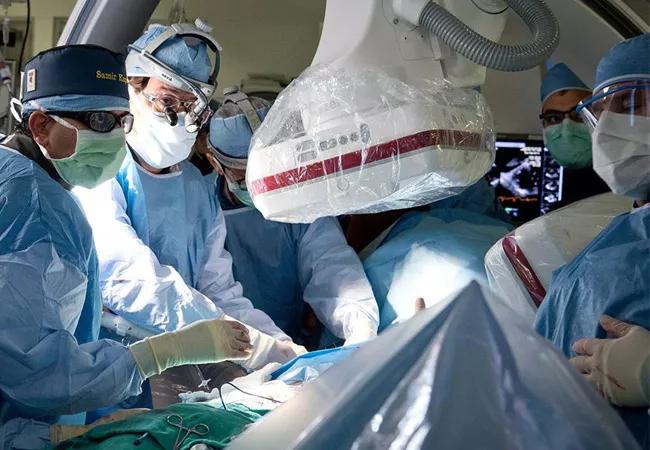
Image content: This image is available to view online.
View image online (https://assets.clevelandclinic.org/transform/29cb9866-67b4-4c02-91c5-12d363bd6faa/17-HRT-006-First-TTVR-CQD-Feat_jpg)
First Implant of a Transcatheter Tricuspid Valved Stent Marks New Frontier in Percutaneous Valve Care
Transcatheter heart valve replacement has just expanded to a new front: A Cleveland Clinic team successfully performed the world’s first implantation of a transcatheter tricuspid valved stent.
Advertisement
Cleveland Clinic is a non-profit academic medical center. Advertising on our site helps support our mission. We do not endorse non-Cleveland Clinic products or services. Policy
The procedure was done in November 2016 in a 64-year-old woman with a long history of severe tricuspid regurgitation (TR 4+), which invariably leads to lethal right heart failure. Following stent implantation (see Figure below), the new tricuspid valve demonstrated excellent valve performance, indicating significant reduction of the patient’s severe valve regurgitation. The patient was stable and faring well 30 days after the procedure.
“This is a step forward in the treatment of tricuspid regurgitation,” says Cleveland Clinic cardiothoracic surgeon Jose Navia, MD, who led the team. “The hope is to provide a device that is able to capture the diseased tricuspid valve annulus, which has been enlarged inordinately by the ravages of functional tricuspid regurgitation.” Such enlargement causes a reverse flow of venous blood from the right heart that should go to the lungs, Dr. Navia explains.
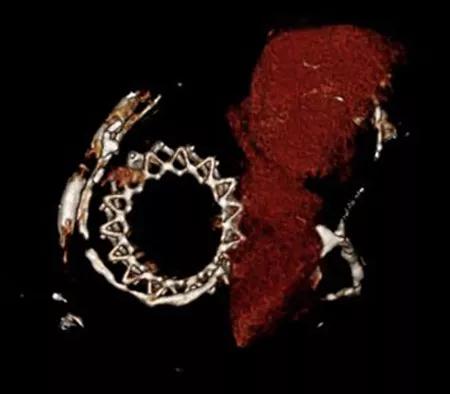
Image content: This image is available to view online.
View image online (https://assets.clevelandclinic.org/transform/fd374352-d4dc-4fe5-b591-33c1c50716c3/17-HRT-006-First-TTVR-CQD-inset_jpg)
Figure. Image of the implanted transcatheter tricuspid valved stent.
“This patient’s annulus measured 49.7 mm in diameter,” notes Samir Kapadia, MD, Section Head of Invasive and Interventional Cardiology at Cleveland Clinic. “There are currently no valved stents that can secure such a dimension without extending into any of the chambers and still provide valvular function, yet millions of patients present with this problem worldwide.”
That unmet need fueled development of the novel stent that was used in the current patient — the GATE™ tricuspid atrioventricular valved stent (AVS) from NaviGate Cardiac Structures Inc. The company licensed the stent technology from Cleveland Clinic, and Drs. Navia and Kapadia serve on NaviGate’s scientific advisory board. Dr. Navia is also a company shareholder.
Advertisement
The stent was conceived for placement as a minimally invasive alternative to open valve repair or replacement to treat tricuspid valve regurgitation. Its main point of distinction is its design in the form of a diffuser that enables it to be easily threaded through the vasculature to reach atrioventricular valves and avoid protrusion into the adjacent chambers.
Once the device is deployed in the heart, a narrow strap is anchored in the tissue to one side of the loose and leaky tricuspid valve. The strap is pulled taut, bringing the valve leaflets together and restoring normal closure.
Like transcatheter mitral and aortic valve procedures, this first transcatheter tricuspid valve replacement was conducted in a hybrid operating room at Cleveland Clinic.
“Transcatheter tricuspid valve replacement promises to be an alternative treatment for patients in whom open tricuspid valve surgery poses too high a risk,” says Dr. Navia.
Advertisement
Advertisement
First prospective study shows early extubation and low vasoactive/inotropic medication use
Height-indexed aortic measurements may better identify risk than diameter alone

Insights from an expert cardiologist and a transplant surgeon

Findings promise to shape future antiplatelet drug development and treatment strategies
How and why we're offering robot-assisted options for a full array of cardiac operations
Insights on common questions from referring providers

A snapshot of key stats from one of the world's busiest centers
‘Sac flow’ is more precise and will ease unfounded patient concerns, experts argue