Image of Note: Using Robotics to Expand Esophagectomy Options
A snapshot of evolving practice
As one of a limited number of cardiothoracic surgery programs that offer esophageal procedures, Cleveland Clinic’s Department of Thoracic and Cardiovascular Surgery has seen its esophageal surgery volumes rise in recent years, surging to 261 cases in 2016.
Advertisement
Cleveland Clinic is a non-profit academic medical center. Advertising on our site helps support our mission. We do not endorse non-Cleveland Clinic products or services. Policy
Esophagectomy for esophageal cancer is one procedure where volume-based expertise is yielding the greatest outcome dividends: Across 153 esophagectomies from July 2013 through June 2016, Cleveland Clinic surgeons achieved among the lowest risk-adjusted combined morbidity and 30-day mortality rates in the entire country, with a standardized incidence ratio of 0.55 (95% CI, 0.38-0.75), according to the Society of Thoracic Surgeons General Thoracic Surgery Database.
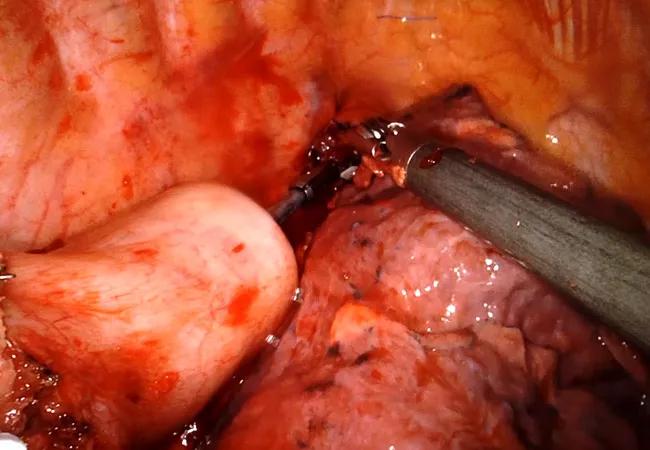
Now Cleveland Clinic surgeons are increasingly turning to robotics to offer a minimally invasive option to patients requiring esophagectomy. A snapshot of robotic esophagectomy is presented above, showing engagement of an end-to-end anastomosis stapler to connect the gastric conduit with the proximal esophagus.
“Minimally invasive esophagectomy is a complex operation and requires a multidisciplinary approach and very careful patient selection,” says Sudish Murthy, MD, PhD, Section Head of Thoracic Surgery.
“The best way to achieve excellent results after esophagectomy is to tailor the operation for the patient and his or her cancer,” adds Siva Raja, MD, PhD, Surgical Director, Center for Esophageal Disorders. “We are facile in performing all the variations of esophagectomy, even in the setting of chemotherapy and radiation, to help our patients achieve their cure.”





 Search