Locations:





Large analysis adds to evidence that absolute diameter alone may miss vulnerable patients
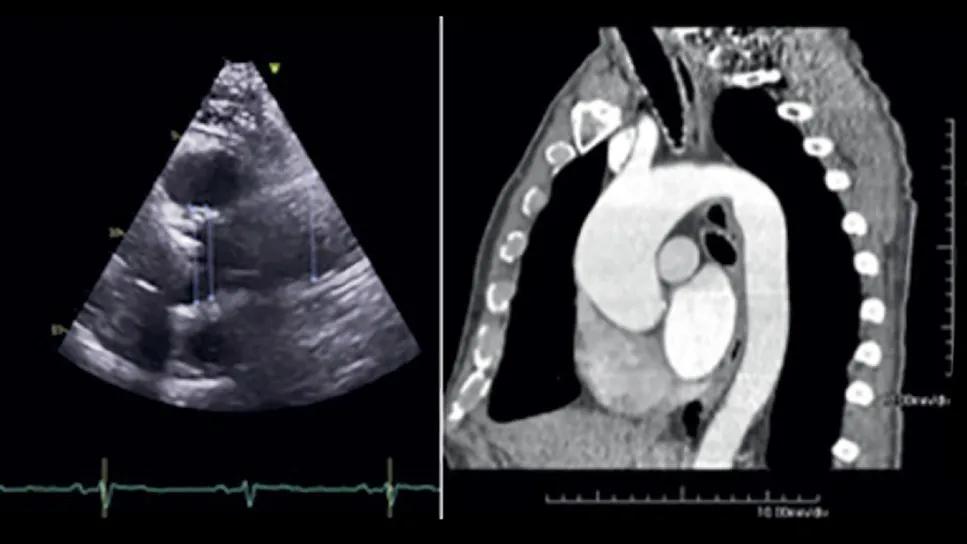
Image content: This image is available to view online.
View image online (https://assets.clevelandclinic.org/transform/7ddfb31a-dacd-4f94-92b1-4e455904d063/echo-CTA-ascending-aortopathy)
cardiac echo and cardiac CT images side by side
Decisions about when to proceed with surgery for ascending aortopathy should prioritize contrast-enhanced computed tomographic angiography (CE-CTA) and use height-indexed aortic metrics to ensure optimal precision and individualized treatment, a new Cleveland Clinic investigation suggests.
Advertisement
Cleveland Clinic is a non-profit academic medical center. Advertising on our site helps support our mission. We do not endorse non-Cleveland Clinic products or services. Policy
The researchers conducted a large observational cohort study (JACC Cardiovasc Imaging. 2026 Epub 21 July) to answer two broad questions in ascending aortopathy management:
“Our analysis, which we believe is the largest study of its kind to date, confirms and builds upon initial evidence suggesting that echocardiography tends to underestimate aortic size compared with CE-CTA and that height-indexed measures provide incremental prognostic utility over absolute size measures alone,” says senior author Milind Desai, MD, MBA, Medical Director of Cleveland Clinic’s Aorta Center.
“Historically, the size of the aorta was measured in many ways, but modern imaging is usually based on echocardiography findings and CT scan size,” notes co-author Lars Svensson, MD, PhD, a cardiothoracic surgeon and Chief of Cleveland Clinic’s Heart, Vascular & Thoracic Institute. “The further refinement is indexing the cross-sectional area of the aorta to the patient’s height since this helps to predict the risk of an event, as shown in this study.”
“These findings reinforce a growing consensus that leading treatment guidelines are due for revision to endorse incorporating CTE-CTA-based indexed measurements into risk stratification for patients with ascending aortopathy,” adds Dr. Desai.
Advertisement
Ascending aortopathy typically remains asymptomatic until it reaches a catastrophic stage such as dissection or rupture. While current U.S. and European guidelines generally recommend surgery when maximal aortic diameter reaches 5 to 5.5 cm, historical data show that most dissections occur at diameters below these cutoffs. “These observations underscore the need for better risk stratification tools that account for an individual’s body habitus rather than relying on a one-size-fits-all diameter,” Dr. Desai notes.
In addition to evaluating incremental differences in risk stratification between absolute and indexed aorta metrics, he and his Cleveland Clinic colleagues undertook the current study to quantify differences in TTE and CE-CTA measurements of the aorta. “While the accessibility of TTE makes it essential for initial assessment and surveillance, the 3D nature and higher reproducibility of CE-CTA have made it the gold standard for diagnosis and procedural planning,” notes study co-author Vidyasagar Kalahasti, MD, a staff cardiologist with the Aorta Center. “However, no large comparisons of the two modalities in this setting had previously been reported.”
The researchers retrospectively evaluated 7,459 consecutive patients with ascending aortopathy (defined as a maximum diameter ≥ 4 cm) who were seen at Cleveland Clinic between 2010 and 2023. For inclusion, all patients had to have undergone both TTE and CE-CTA within a one-year window. Patients initially presenting with type A dissection were excluded.
Advertisement
The study determined the concordance of the two imaging modalities in categorizing patients into one of three aortic diameter subgroups: < 4.5 cm, 4.5 to 4.9 cm, and ≥ 5 cm. It also analyzed the prognostic value of three specific metrics:
For data consistency, all measurements were captured during the diastolic phase of the cardiac cycle. The primary end point was a composite of long-term adverse events, including all-cause mortality, aortic dissection and aortic rupture.
Although the two imaging modalities showed a strong statistical correlation overall (r = .80; P < .001), discordance in measurements was frequent and clinically important, with TTE tending to underestimate aortic size relative to CE-CTA, especially for larger aneurysms. Specifically:
Among patients classified in the 4.5 to 4.9 cm subgroup by CE-CTA, 60% were classified by TTE as under 4.5 cm at the level of the aortic root and 32% at the level of the mid-ascending aorta.
Among patients with CTA-confirmed aneurysms (≥5.0 cm), aortic size was underestimated by TTE at the aortic root in 58% of cases and at the mid-ascending aorta in 37% of cases.
“This is consistent with findings from previous smaller studies and may be due to inherent axial resolution limits of ultrasound, which can falsely increase perceived wall thickness and lead to smaller inner-edge measurements,” Dr. Desai notes.
Over mean follow-up of 3.6 years, there were 865 composite events. While an absolute diameter of ≥ 5 cm was a strong predictor of risk for these events (hazard ratio of 2.42), indexed metrics provided even greater prognostic value.
Advertisement
The AHI (at a threshold of > 3.20 cm/m) was an especially powerful predictor, with a hazard ratio of 3.24 (95% CI, 2.22 to 4.17). The CSAH (at a threshold of ≥ 10 cm²/m) had a hazard ratio of 2.09 (95% CI, 1.55 to 2.39).
Notably, among the group of 5,213 patients who did not undergo surgery, only 37% of adverse events were associated with an aortic diameter ≥5.0 cm, whereas 53% of adverse events were associated with a CSAH ≥ 10 cm²/m, suggesting that the CSAH is particularly useful for unmasking risk in patients who might otherwise be considered low-risk based on diameter alone.
The study authors note that although the CSAH offered greater sensitivity, the AHI was effective at identifying a very high-risk subset of patients with excellent specificity. “These complementary attributes suggest that a combined approach, absolute diameter plus indices, may better balance sensitivity and specificity in clinical decision-making,” they write.
The researchers share several takeaway messages from their analysis:
Advertisement
“Standard reliance on absolute diameter thresholds is insufficient for optimal patient care,” Dr. Desai concludes. “Indexed parameters, particularly the CSAH ratio derived from CE-CTA, offer incremental value for identifying patients who need timely aorta surgery to avoid catastrophic events.”
Advertisement

Elevated levels of the gut microbial metabolite predict prevalence and adverse outcomes in community-based study
Height-indexed aortic measurements may better identify risk than diameter alone
Robust signal from observational study raises prospect of a long-sought medical therapy
New Cleveland Clinic data challenge traditional size thresholds for surgical intervention
Study finds comparable midterm safety outcomes, suggesting anatomy and surgeon preference should drive choice
New review distills insights and best practices from a high-volume center
Blood test can identify patients who need more frequent monitoring or earlier surgery to prevent dissection or rupture
Recent Cleveland Clinic experience reveals hundreds of cases with anatomic constraints to FEVAR
 Search