Locations:





Experts discuss advances in precision medicine, the value of collaborative care and more
Podcast content: This podcast is available to listen to online.
Listen to podcast online (https://www.buzzsprout.com/2237537/18648495)
Recent advances in the management of inherited arrhythmias are largely about greater care precision, according to electrophysiologist Jeffery Courson, DO, who directs Cleveland Clinic’s Adult Inherited Arrhythmia Clinic.
Advertisement
Cleveland Clinic is a non-profit academic medical center. Advertising on our site helps support our mission. We do not endorse non-Cleveland Clinic products or services. Policy
“The ability to do broad whole-genome sequencing is really making a big change,” he says. “Now that we can look at a multitude of genes, we can come up with a patient’s risk assessment for developing disease or we can sometimes offer more specific treatments. Take the example of long QT syndrome, which is one of the primary inherited arrhythmia disorders. We all know to use beta-blockers for most types of inherited long QT syndrome, but we now know that the sodium channel blocker mexiletine is more appropriate and effective for long QT syndrome type 3, which is caused by a specific gene mutation.”
Enhanced care precision is just one topic Dr. Courson discusses in a recent episode of Cleveland Clinic’s Cardiac Consult podcast devoted to the diagnosis and management of inherited arrhythmias and genetic cardiomyopathies. Together with Oussama Wazni, MD, MBA, Section Head of Cardiac Electrophysiology and Pacing at Cleveland Clinic, he explores the following:
Click the podcast player above to listen to the 16-minute episode now or read on for an edited excerpt. Check out more Cardiac Consult episodes at clevelandclinic.org/cardiacconsultpodcast or wherever you get your podcasts.
Advertisement
Oussama Wazni, MD, MBA: Let’s say a patient comes to your clinic with a profile suggesting one of these complicated syndromes, either an inherited arrhythmia or a cardiomyopathy. How do we evaluate them?
Jeffery Courson, DO: It always starts with a very careful history and physical exam. I know that sounds old-fashioned, but it’s incredibly important for these disorders, given the importance of family history in this setting. Then you do the basics. Almost always it’s an EKG and an echocardiogram. Then it’s more specific testing based on what you're looking for. For instance, for CPVT or catecholaminergic polymorphic ventricular tachycardia, a specific type of stress test may be incredibly important. There is some provocative testing you can do for Brugada syndrome. When you think about ARVC or arrhythmogenic right ventricular cardiomyopathy, a cardiac MRI can be essential. You might consider more advanced testing for the other forms of cardiomyopathy as well.
Dr. Wazni: Yes, it's a comprehensive evaluation that will include, at times, genetic testing, echo, definitely MRI in dilated cardiomyopathy and even in hypertrophic cardiomyopathy — to look for scarring. It’s certainly a comprehensive evaluation that will include a comprehensive team. Can you tell us more about who’s included in the team?
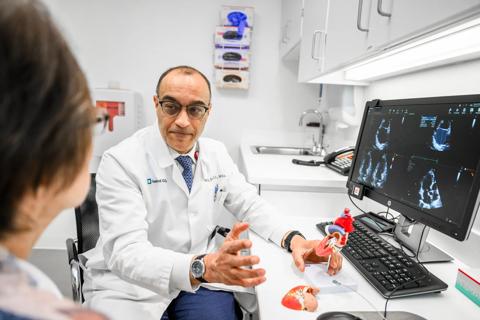
Dr. Courson: In addition to electrophysiology, it can include a heart failure cardiologist, an imaging cardiologist and sometimes a clinical cardiologist, along with genetic counselors and other genetics specialists. In fact, we have a new section in our Heart, Vascular & Thoracic Institute — the Section of Cardiovascular Genomics and Precision Medicine. It includes a group of providers and specialists who work among and with our other sections and teams, integrating genomics into cardiovascular care across the board. Our relationships with cardiovascular genomics, heart failure and cardiovascular imaging are incredibly important for managing inherited arrhythmias and cardiomyopathies. Oftentimes these are disorders that cannot be properly evaluated and managed by a single provider. It really is a collaborative effort among different subspecialties that come together to take care of one specific patient with a specific disorder.
Advertisement
Advertisement
Cleveland Clinic reports first U.S. series focused on use in this challenging setting
Application to flutter found safe and effective in study of 300+ patients
Study identifies a cohort of low-risk patients, finds LVEF predicts late VT/VF in those at higher risk
Nonthermal method promises faster procedure times, less risk to adjacent structures
Scenarios where experience-based management nuance can matter most
CD36 loss-of-function variant accounts for large portion of risk in this population

Cardiac imaging substudy is the latest paper originating from the VANISH trial
Vigilance for symptom emergence matters, a large 20-year analysis reveals
 Search